What's new this year
Year 5 is the first year of upper Key Stage 2, and there are no national tests. The big step is in maths: numbers get much larger, written methods get longer, and fractions, decimals and percentages start to connect. In English, writing becomes more varied and more deliberate, and reading moves on to longer, more complex books.
Children are often given more responsibility for homework and organising themselves, which is good preparation for Year 6 and secondary school. If your child finds the step up hard, mention it to the class teacher early; small gaps are easier to close now than later.
Maths in Year 5
- Numbers to at least 1,000,000, rounding, negative numbers and Roman numerals to 1,000.
- Factors, multiples, prime numbers, and square and cube numbers.
- Long multiplication by a two-digit number, short division with remainders, and multiplying and dividing by 10, 100 and 1,000.
- Fractions: equivalent fractions, mixed numbers, adding and subtracting with related denominators, and multiplying fractions by whole numbers.
- Decimals to three places, and percentages linked to fractions and decimals.
- Measuring angles in degrees, the area of rectangles, converting units, and reading line graphs and timetables.
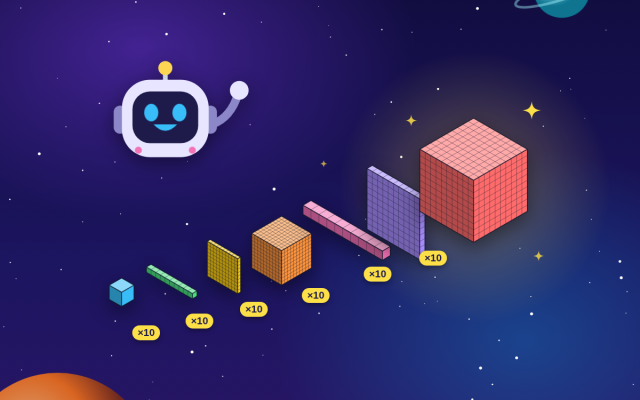
Place Value to a Million: A Rocket Mission with Pip
Learn place value to a million and how to count in powers of 10. Build blocks, set digits on a place value ch…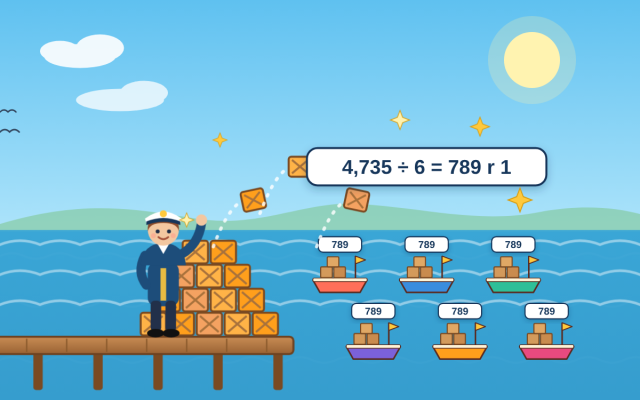
Year 5 Multiplication and Division: Harbour of Numbers
Learn Year 5 multiplication and division: long multiplication, short division and remainders, by loading boat…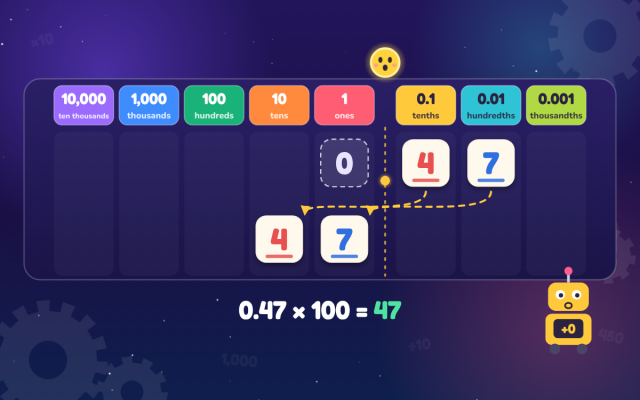
Multiply and Divide by 10, 100 and 1,000: Digit Slide Lab
Learn to multiply and divide whole numbers and decimals by 10, 100 and 1,000 by sliding digits across a place…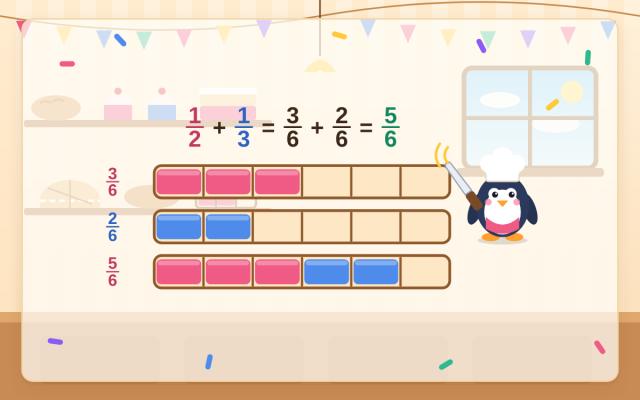
Adding and Subtracting Fractions: Bake with Pip the Penguin
Learn adding and subtracting fractions, mixed numbers included, then simplify, compare and order them by cutt…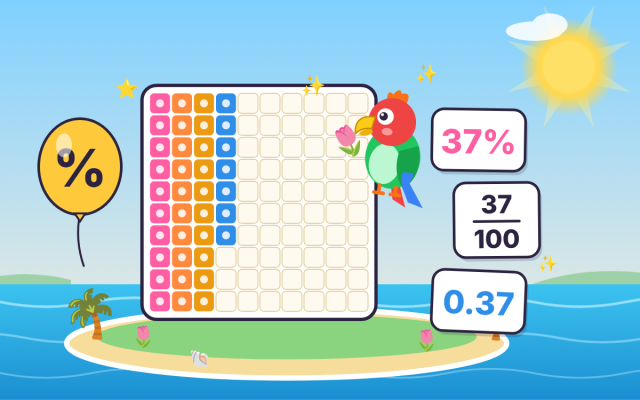
Percentages for Kids: Explore Percent Island with Percy
Learn what per cent means and how percentages, fractions and decimals match. Shade hundred squares, run a fra…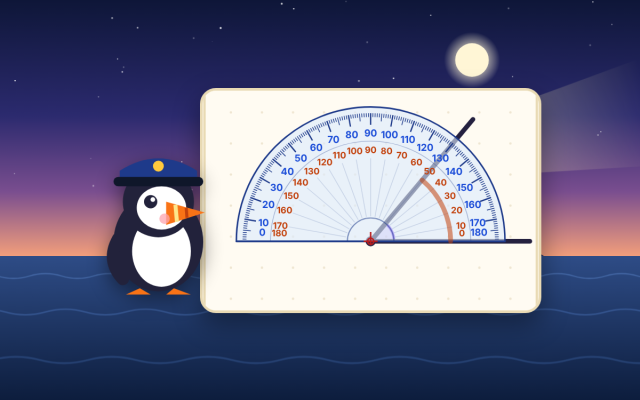
Measuring Angles: A Lighthouse Adventure with Pip
Learn about measuring angles in degrees with a protractor, then turn a lighthouse beam to estimate, draw and…English in Year 5
- Reading: a wider range of books, including myths, plays and older stories; summarising, inferring and explaining the effect of figurative language.
- Grammar: relative clauses ("the girl, who was late, ran"), and modal verbs and adverbs that show possibility (might, should, perhaps).
- Punctuation: brackets, dashes and commas for extra information, and commas to make meaning clear.
- Writing: linking ideas across paragraphs with words like later, nearby and secondly.
- Spelling: the Year 5 and 6 statutory word list, and prefixes and suffixes such as dis-, mis-, -ise and -ify.
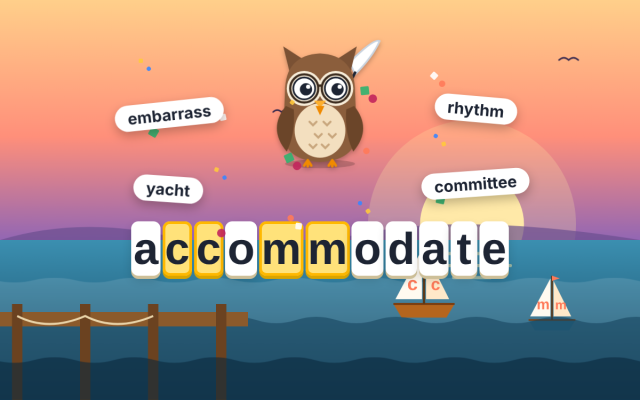
Year 5 and 6 Spelling Words: Sail the Spelling Isles
Learn the 100 Year 5 and 6 spelling words using word roots, word origins and memory tricks, then type them in…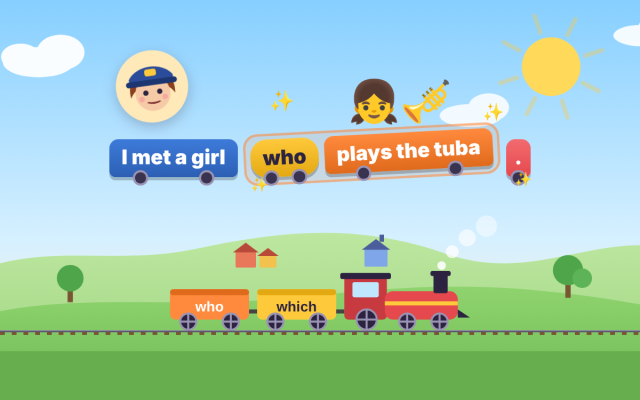
Relative Clauses: All Aboard the Relative Railway
Learn how relative clauses add information with who, which, where, when, whose and that by hooking word carri…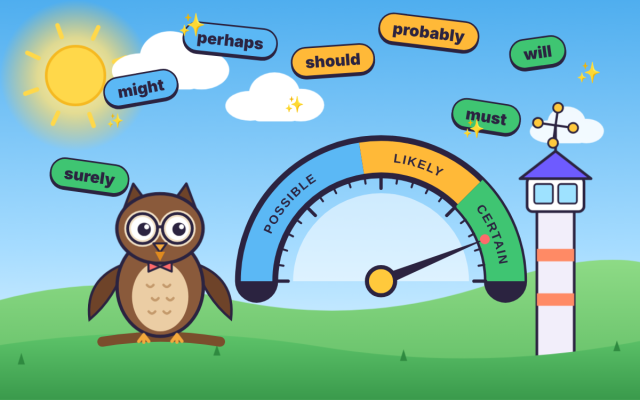
Modal Verbs and Possibility: The Maybe-Meter Game
Learn how modal verbs like might, should, will and must, and adverbs like perhaps and surely, show possibilit…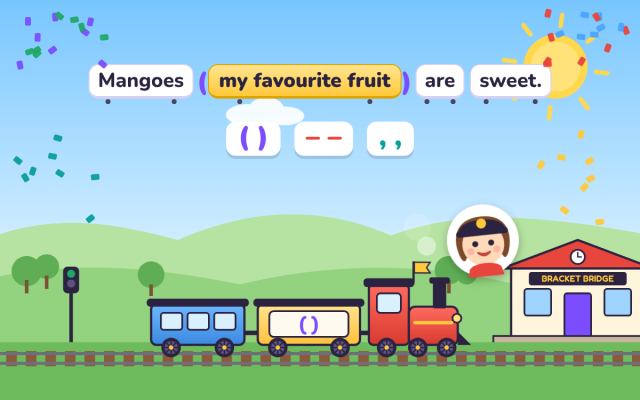
Parenthesis: Brackets, Dashes and Commas on a Word Train
Learn how to use parenthesis with brackets, dashes and commas, then add extra information to sentences by cou…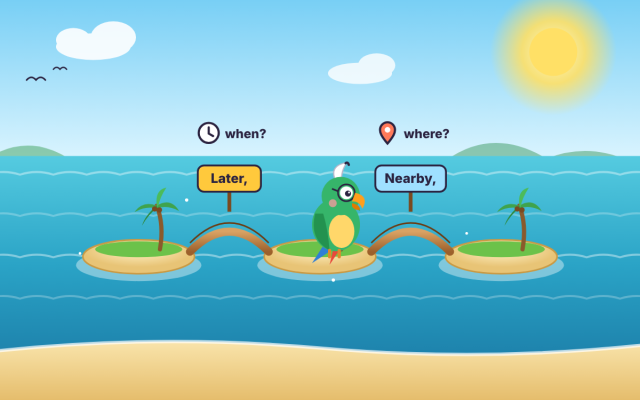
Linking Paragraphs: Build Bridges in Link Lagoon
Learn how linking paragraphs works: build cohesion with firstly, then, this, later, nearby and had by laying…
Figurative Language: Paint Word Pictures with Quill
Learn figurative language: spot similes, metaphors and personification, then explain their effect on the read…Coming soon: vote for the games you'd like first
- Reading detective: inferenceNot made yet
- Making inferences (KS1)Not made yet
- Story time: listen and join in (Reception)Not made yet
Science and other subjects
Year 5 science covers life cycles and reproduction in plants and animals, how humans change as they grow older, dissolving, separating mixtures and reversible and irreversible changes, Earth and space, and forces including gravity, friction, levers and gears. History and geography vary by school, for example Ancient Greece or mountains and climate zones.
This year's topics, subject by subject
The roadmaps below show the order in which topics usually build up through Year 5, subject by subject. Schools teach in different orders, so treat them as a guide to what's coming rather than a timetable.
Maths 30 topics, 16 coming soon
- Place value (Year 5)
- Roman numerals (Year 5)
- Rounding (Year 5) coming soon
- Negative numbers (Year 5)
- Adding and subtracting (Year 5) coming soon
- Mental maths strategies (Year 5) coming soon
- Multi-step word problems (Year 5) coming soon
- Factors and multiples (Year 5)
- Prime, square and cube numbers
- Multiplying and dividing by 10, 100 and 1,000 (Year 5)
- Multiplication and division (Year 5)
- Long multiplication (Year 5) coming soon
- Short division and remainders (Year 5) coming soon
- Word problems: multiplication and division (Year 5) coming soon
- Fractions (Year 5) coming soon
- Mixed numbers and improper fractions (Year 5) coming soon
- Multiplying fractions by whole numbers (Year 5) coming soon
- Decimals (Year 5) coming soon
- Percentages (Year 5)
- Word problems: decimals and percentages (Year 5) coming soon
- Converting units (Year 5)
- Imperial units (Year 5)
- Area and perimeter (Year 5) coming soon
- Volume (Year 5)
- Time and timetables (Year 5) coming soon
- Word problems: measures and time (Year 5) coming soon
- Angles (Year 5)
- Properties of shapes (Year 5) coming soon
- Reflection and translation (Year 5)
- Line graphs
English 43 topics, 30 coming soon
- Speedy, neat handwriting (Years 5–6) coming soon
- Spelling patterns (Years 5–6) coming soon
- Endings –cial and –tial (Years 5–6) coming soon
- Prefixes and suffixes (Years 5–6)
- Making verbs (Year 5)
- Homophones (Years 5–6)
- Statutory spelling words (Years 5–6)
- Must-know spellings (Year 5) coming soon
- Using a dictionary and thesaurus (Years 5–6) coming soon
- Must-know vocabulary (Year 5) coming soon
- Perfect tenses (Years 5–6)
- Modal verbs and possibility (Year 5)
- Relative clauses
- Parenthesis (Year 5)
- Commas for clarity (Year 5)
- Writing great sentences (Year 5) coming soon
- Retrieval (Years 5–6) coming soon
- Words in context (Years 5–6) coming soon
- Figurative language (Years 5–6)
- Author's word choice (Years 5–6) coming soon
- Predicting from clues in the text (KS2) coming soon
- Reading detective: inference coming soon
- Summarising (Years 5–6) coming soon
- Themes and comparing books (Years 5–6) coming soon
- Myths and legends coming soon
- Speaking with confidence
- Thinking like a writer (Year 5) coming soon
- Planning your writing (Years 5–6) coming soon
- Linking paragraphs (Year 5)
- Writing paragraphs (Year 5) coming soon
- Writing stories (Year 5) coming soon
- Write your own story (Years 5–6) coming soon
- Performing and acting coming soon
- Writing a playscript (KS2) coming soon
- Newspaper reports (Years 5–6) coming soon
- Writing a report (Years 5–6) coming soon
- Having a debate coming soon
- Persuasive writing coming soon
- Formal letters and emails (Years 5–6)
- Learning poems by heart (Years 5–6) coming soon
- Write a poem coming soon
- Editing your writing (Years 5–6) coming soon
- Making your writing amazing (Year 5) coming soon
Science 28 topics, 16 coming soon
- Planning enquiries and controlling variables (Years 5–6) coming soon
- Recording results: graphs and keys (Years 5–6) coming soon
- Using a microscope coming soon
- Life cycles
- Birds around us coming soon
- Plant reproduction
- Bees and pollinators coming soon
- Ocean life coming soon
- Endangered animals coming soon
- Growing older coming soon
- How the brain works coming soon
- Properties of materials (Year 5)
- Dissolving and separating
- Reversible and irreversible changes
- How electricity reaches our homes coming soon
- Gravity
- Friction, air and water resistance
- Floating and sinking coming soon
- Levers, pulleys and gears
- The solar system
- Day and night
- The Earth's orbit (Year 5)
- Phases of the Moon
- Stars and constellations coming soon
- Colours of light coming soon
- How rockets work coming soon
- Life on the space station coming soon
- Exploring Mars coming soon
History 8 topics, 7 coming soon
- The Vikings coming soon
- Alfred the Great and the struggle for England (KS2) coming soon
- Early Islamic civilisation
- The Silk Road coming soon
- The Maya coming soon
- The Kingdom of Benin coming soon
- The Aztecs coming soon
- The Tudors (KS2) coming soon
Earth & Geography 7 topics, 4 coming soon
- Europe coming soon
- Mountains coming soon
- Region study: a region of Europe (KS2) coming soon
- Latitude, longitude and time zones coming soon
- Climate zones and biomes
- Deserts
- Rainforests
Technology 9 topics, 8 coming soon
- Search engines coming soon
- Strong passwords and privacy coming soon
- Variables
- How planes fly coming soon
- Circuits in products coming soon
- How phones and wifi work coming soon
- Seasonal food and food miles (KS2) coming soon
- How a fridge keeps food cold coming soon
- Inventors and designers who changed the world (KS2) coming soon
Schools teach topics in different orders, so use this as a guide. Open the roadmaps, pick the school year, and follow the steps.
How you can help at home
- Use real numbers: populations, distances, football crowds. Ask which is bigger and by roughly how much.
- Look for percentages in sales and ask what the price would be.
- Ask your child to sum up a chapter in three sentences. Summarising is a key Year 5 reading skill.
- Keep times tables ticking over; they underpin almost everything in Year 5 maths.
- If a method is new to you, ask your child to teach it. Our guide to how maths is taught explains the common ones.
 TapLearn