Gravity: Why Things Fall, From Garden to Space
Discover why things fall with gravity: snip strings, drop balls around the globe and repeat Galileo's famous test in this Year 5 science game.
- Ages 8–11
- About 35 min
- Easy start
- Forces & Energy
Discover why things fall with gravity: snip strings, drop balls around the globe and repeat Galileo's famous test in this Year 5 science game.
Year 5 science · 1
Year 5 science · 1
Year 5 science · 1
Year 5 science · 1
What the chapters cover in the national curriculum in England:
Gravity: Why Things Fall is an interactive science game that teaches children aged 8–11 why unsupported objects fall towards the Earth because of gravity, matching the Year 5 forces objective in England.
Guided by Pip, a friendly narrator, children slide a table from under a book, snip a lantern's string and let go of a ball. Each time they see that an unsupported object, one with nothing holding it up, falls. They learn that gravity is a pull acting between the Earth and the falling object, and that it works across a gap without touching.
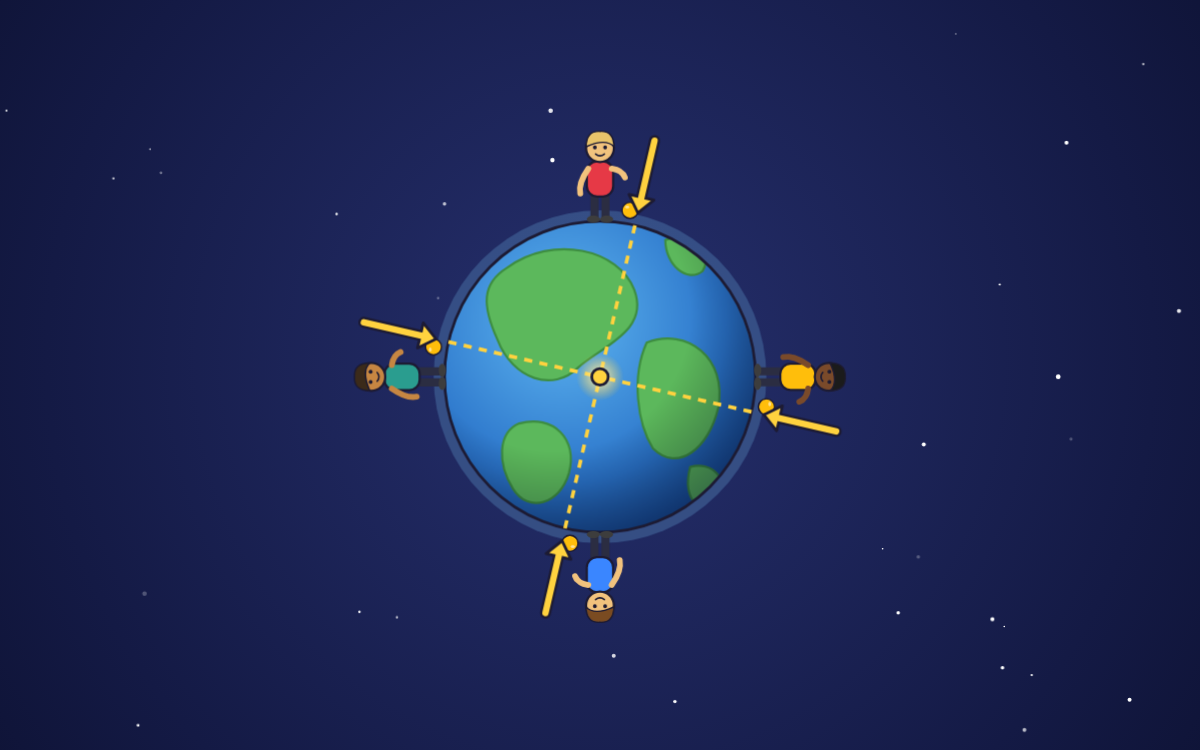
Next they zoom out to a globe to find that 'down' means towards the centre of the Earth for everyone. Then they repeat Galileo's test with a heavy ball and a light ball and tap Newton's apple. A 10-question Gravity Challenge checks what they have learned.
Gravity is an invisible pulling force, and the Earth's gravity pulls everything towards it. It is why unsupported objects fall to the ground, and why you always land after jumping, even though nothing touches you to pull you down.
No. A heavy ball and a light ball of the same size dropped together land at the same time, as Galileo showed about 400 years ago. Very light things like feathers fall slowly only because the air gets in their way.
People in Australia don't fall off because gravity pulls everyone towards the centre of the Earth, wherever they live. 'Down' always points towards the Earth's centre, so in Australia down is the ground under their feet, just as it is in the UK.
It is designed for children aged 8 to 11 and matches the Year 5 science objective on gravity in the national curriculum in England. Younger children who are curious about why things fall can also enjoy it with a grown-up's help.
It takes about 35 minutes to play everything. There is an optional warm-up on pushes and pulls, four narrated chapters with hands-on experiments and a 10-question Gravity Challenge. Children can pick any chapter from the map.
 TapLearn
Getting it ready…
Great work on chapter 1! To open the next chapters, ask a grown-up to take a look.
To play this game, ask a grown-up to take a look. There are lots of free games you can play right now too!
Create a free family account and your child can play every chapter of every game for 7 days, with no card needed. Their progress is kept. After that, the free plan is free for ever, and membership is £6.99 a month if you'd like to keep every chapter.
That's all the learning time for today. Great work! Flip will be ready to play again tomorrow.