What you'll learn
- Use firstly, then, after that and finally to order sentences
- Use 'this' and pronouns to point back to an earlier idea
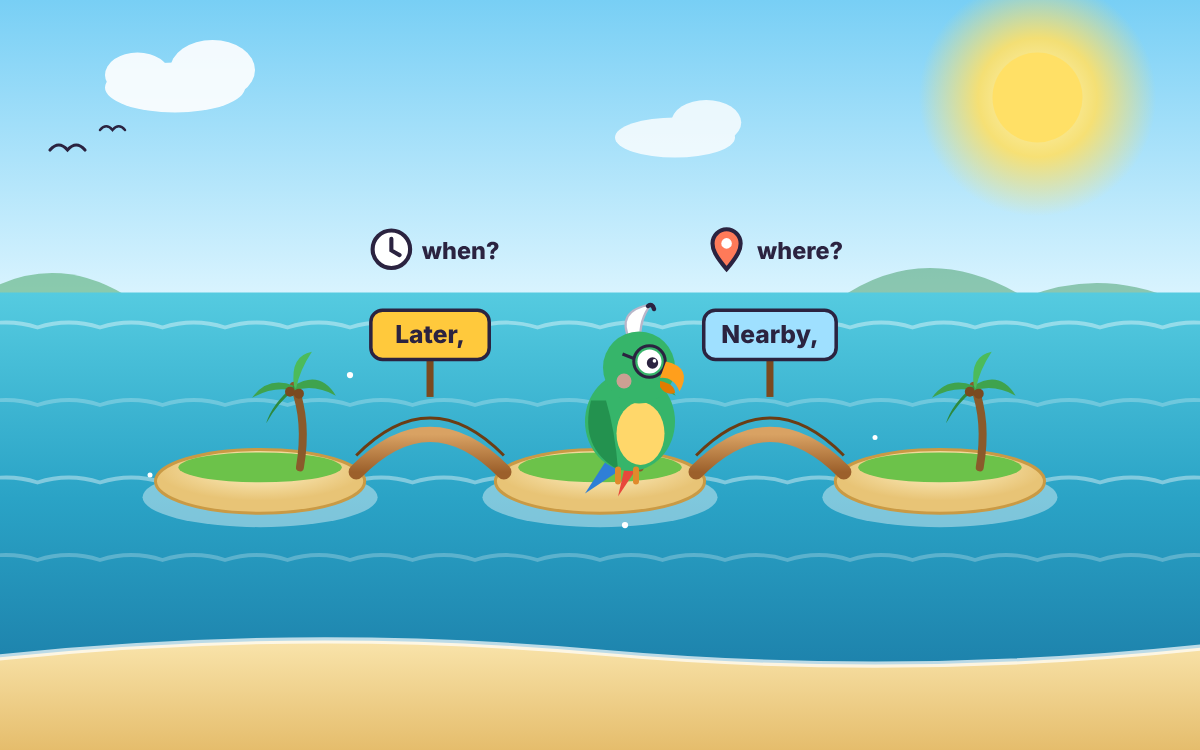
- Start paragraphs with adverbials of time, such as later
- Start paragraphs with adverbials of place, such as nearby
- Order points across paragraphs with firstly, secondly and finally
- Use the past perfect, as in 'had seen', to link back in time
Chapter by chapter
- Linking sentences in order: firstly, then, after that Free to try
Year 5 english · 1
- Linking back inside a paragraph with 'this' and pronouns
Year 5 english · 1
- Linking paragraphs with adverbials of time and place: later, nearby
Year 5 english · 2
- Linking paragraphs with adverbials of number: firstly, secondly, finally
Year 5 english · 2
- Linking paragraphs with tense choices: he had seen her before
Year 5 english · 2
- Using a range of devices to build cohesion within and across paragraphs
Years 5–6 english · 3 Year 5 english · 1 Year 5 english · 2
- Lighthouse Challenge: linking paragraphs quiz (10 questions)
What the chapters cover in the national curriculum in England:
- Year 5 english: Text: devices to build cohesion within a paragraph
- Year 5 english: Text: linking ideas across paragraphs using adverbials of time, place and number or tense choices
- Years 5–6 english: Draft and write by: using a wide range of devices to build cohesion within and across paragraphs
About this adventure
Link Lagoon is an interactive game about linking paragraphs that teaches children aged 9–11 how to join sentences and paragraphs so their writing flows, matching the Year 5 English curriculum in England. Writers call this cohesion: the way words and ideas stick together so a reader never gets lost.
Guided by Quill, a talking parrot editor, players turn sentences into stepping stones and paragraphs into islands. They put events in order, choose linking words for gaps, sort adverbials into time, place and number, hunt for links in short texts and type their own paragraph opener with the correct comma.
Along the way they meet the past perfect (had seen, had met), which takes a paragraph back to an earlier moment, and pronouns that point back to an idea already written. Every question explains the right answer, and an optional warm-up refreshes paragraphs, fronted adverbials and pronouns first.
Questions and answers
What does linking paragraphs mean?
Linking paragraphs means using words or phrases that show how one paragraph connects to the next, so the reader can follow along. For example, 'Later that day,' shows time has passed and 'Nearby,' shows the story has moved to a new place.
What is cohesion in writing, in simple words?
Cohesion is how well the sentences and paragraphs in a piece of writing stick together. Writers build it with linking words such as then and after that, with pronouns like it and this, and with adverbials that start new paragraphs.
What are adverbials of time, place and number?
They are words or phrases that link ideas by telling the reader when, where or in what order. Later and the next morning show time, nearby and across the river show place, and firstly and secondly count points in order.
What age is this linking paragraphs game for?
It is made for children aged 9 to 11, especially those in Year 5 in England, where linking paragraphs is taught. Year 6 pupils can also use it to revise cohesion before writing assessments.
What is in the game and how long does it take?
The game has six chapters, an optional warm-up and a ten-question final challenge, and takes about 45 minutes to play everything. Each chapter can be played on its own, so it also works in shorter sessions.
More to explore
See all
Parenthesis: Brackets, Dashes and Commas on a Word Train
Learn how to use parenthesis with brackets, dashes and commas, then add extra information to sentences by cou…
Letter Formation: Trace and Write with Squiggle the Snail
Learn letter formation: where each letter starts and which way to go. Trace, then write lower-case and capita…
Year 1 Handwriting: Trace Letters and Digits with Poppy
Learn Year 1 handwriting: hold a pencil well, start each letter in the right place and form capitals and digi…
Joined Handwriting: Learn the Joins with Loopy the Pencil
Learn joined handwriting with diagonal and horizontal joins, which letters stay unjoined and how to write nea…
Figurative Language: Paint Word Pictures with Quill
Learn figurative language: spot similes, metaphors and personification, then explain their effect on the read…
Perfect Tense: Solve Time Cases with Tock the Owl
Learn the perfect tense, from has finished to had seen, and use it to show time, cause and links between para…
Determiners for Year 4: Ride the Determiner Express
Learn what determiners are, from a, an and the to my, some and every, by building word trains and spotting de…
 TapLearn