What you'll learn
- What volume means and why we measure it in cubic centimetres (cm³)
- How to count cubes layer by layer, including hidden ones
- Why a taller shape does not always have the greater volume
- How to estimate an object's volume with a 1 cm³ cube model
- The difference between capacity and the volume of liquid inside
- When to use millilitres and when to use litres
Chapter by chapter
- Volume and cubic centimetres: counting 1 cm³ cubes Free to try
Year 5 maths · 1
- Building cuboids and cubes from 1 cm³ cubes, layer by layer
Year 5 maths · 1
- Comparing volumes: which cuboid has the greater volume?
Year 5 maths · 1
- Estimating volume: modelling objects with 1 cm³ cubes
Year 5 maths · 1
- Estimating capacity in millilitres and litres using water
Year 5 maths · 1
- Grand Volume Challenge (10 questions) (10 questions)
What the chapters cover in the national curriculum in England:
- Year 5 maths: Estimate volume and capacity
About this adventure
Volume and Capacity is an interactive maths game that teaches children aged 8–11 to estimate volume by building cuboids from 1 cm³ cubes, and to estimate capacity using water. It matches Year 5 maths in England, and Cubo, a talking 1 cm cube, reads every line aloud.
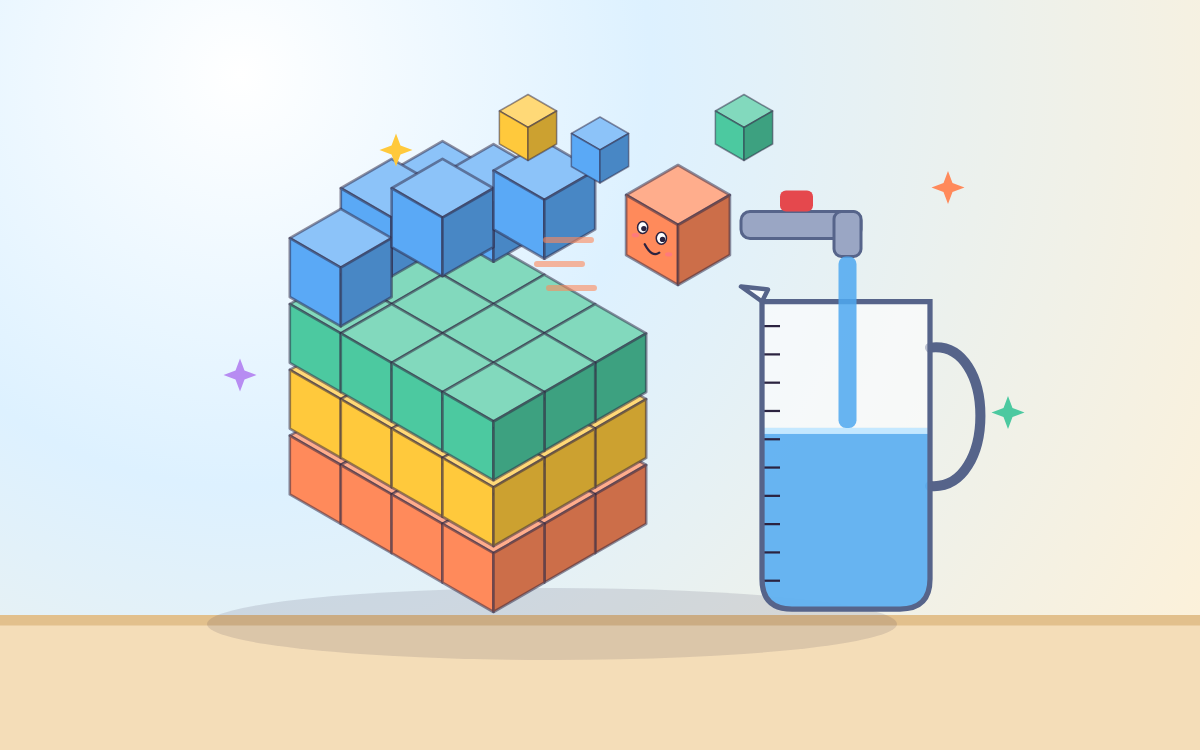
Players stack cubes to see that volume is the space a shape takes up, measured in cubic centimetres (cm³). They count cubes layer by layer, use an X-ray view to find hidden cubes, and test whether the taller shape really holds more. Then they wrap a book, an apple and a pyramid in cube models to make estimates.
In the water chapter, children learn that capacity is how much a container can hold when full. They pour to a 600 ml mark, compare everyday containers from a 5 ml teaspoon to a bath, and find out that 1 cm³ of water is exactly 1 ml.
Questions and answers
What is the difference between volume and capacity?
Volume is the amount of space something takes up, while capacity is how much a container can hold when it is full. A jug with a capacity of 1 litre might hold only 600 ml of water, which is the volume of water inside.
What is a cubic centimetre?
A cubic centimetre (cm³) is the space taken up by a cube that is 1 cm long, 1 cm wide and 1 cm tall. Children find a shape's volume by counting how many of these cubes it is made from.
How do you find the volume of a cuboid by counting cubes?
Count the cubes in one layer, then add that number once for every layer. A cuboid with 6 cubes in each of 3 layers has a volume of 6 + 6 + 6 = 18 cm³, including any cubes hidden at the back.
What age is this volume and capacity game for?
The game is for children aged 8 to 11 and is pitched at Year 5, where estimating volume and capacity is taught in KS2 maths in England. Every line is read aloud and shown as a caption, so less confident readers can follow along.
What does the volume and capacity game include and how long does it take?
It includes five chapters with animated introductions, hands-on building and pouring activities, typed and multiple-choice questions, two optional warm-ups and a 10-question Grand Challenge. Playing everything takes about 50 minutes, and children can start any chapter from the map.


 TapLearn