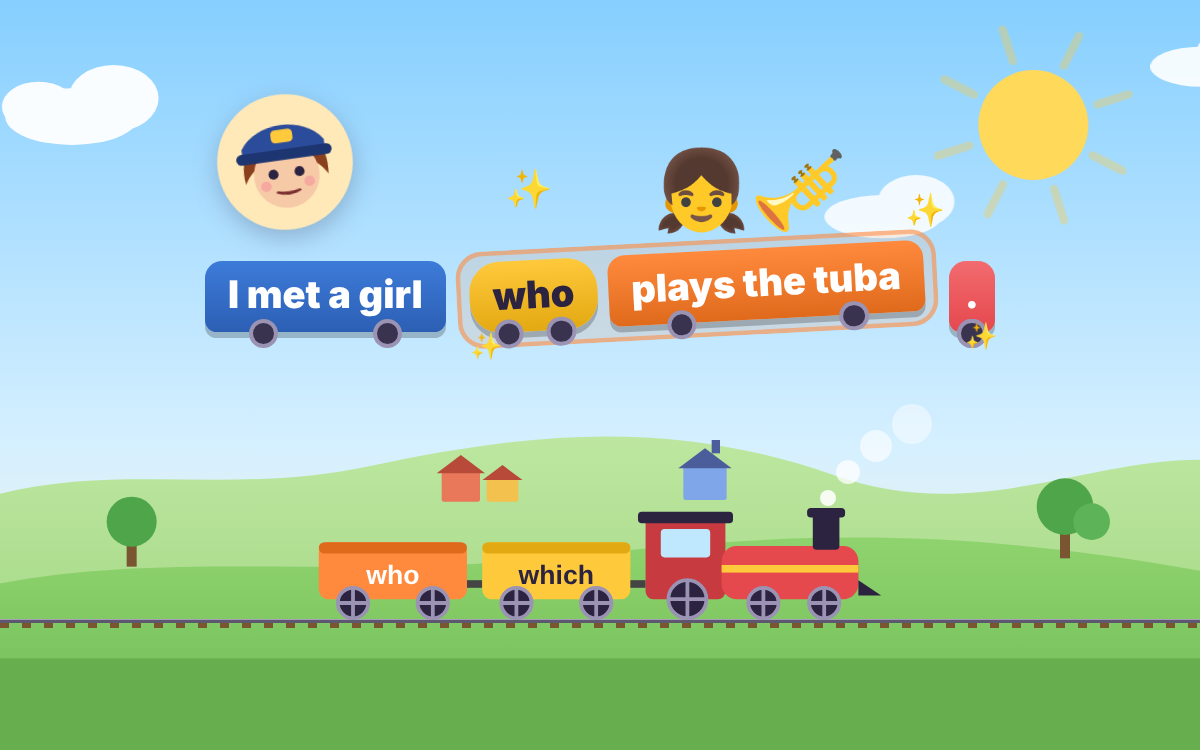
Relative Clauses: All Aboard the Relative Railway
Learn how relative clauses add information with who, which, where, when, whose and that by hooking word carriages onto a sentence train.
- Ages 9–11
- About 45 min
- Some thinking
- Grammar & Punctuation
Learn how relative clauses add information with who, which, where, when, whose and that by hooking word carriages onto a sentence train.
Years 5–6 english · 1 Year 5 english · 2 Year 5 english · 3
Years 5–6 english · 1 Year 5 english · 2
Years 5–6 english · 1 Year 5 english · 2
Years 5–6 english · 1 Year 5 english · 2 Year 5 english · 3
Years 5–6 english · 1 Year 5 english · 3
Year 5 english · 3 Years 5–6 english · 1
What the chapters cover in the national curriculum in England:
Relative Clauses: All Aboard the Relative Railway is an interactive game that teaches children aged 9–11 how to add information to sentences with relative clauses beginning with who, which, where, when, whose or that, or with the relative pronoun left out. It follows the Year 5 grammar objectives in England's national curriculum.
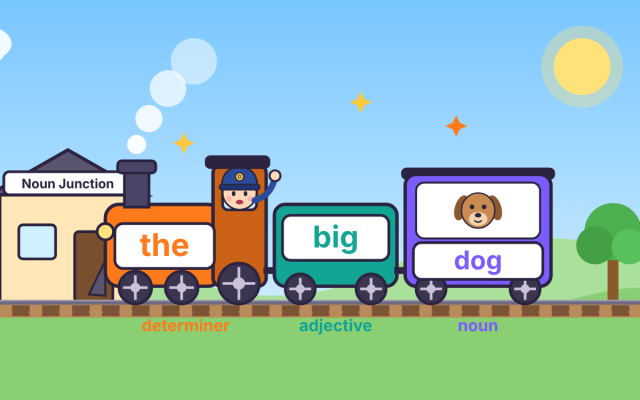
Every sentence is a train. Players hook relative clause carriages onto nouns, make hidden relative pronouns vanish, lift extra information out of sentences, sort cards into wagons and type clauses of their own, while Ruby the railway guard explains each step aloud.
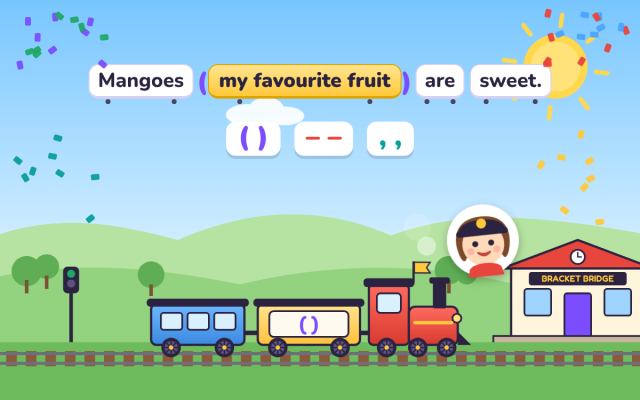
Along the way children meet the correct terms. A relative pronoun is the word that starts the clause, a relative clause is the whole group of words, and parenthesis is extra information wrapped in a pair of commas, brackets or dashes. They also find out what cohesion, ambiguity and modal verbs mean.
A relative clause is a group of words that adds extra information about a noun. It usually starts with a relative pronoun such as who, which, where, when, whose or that, as in 'the girl who plays the tuba'.
Use who for people and which for animals and things. That works for people, animals and things, so both 'the boy that sings' and 'the cake that Gran made' are correct.
An omitted relative pronoun is one that has been left out but is still understood, as in 'the book I read', meaning 'the book that I read'. It can usually go when someone such as I or we comes next, but not when a verb follows.
The game is designed for children aged 9 to 11. It matches the Year 5 relative clauses objectives in England's national curriculum and also works well as revision for Year 6 grammar.
It has six chapters, each with an animated introduction, guided activities and practice questions, plus a 10-question final challenge. Playing everything takes about 45 minutes, and children can start at any chapter from the railway map.
 TapLearn
Getting it ready…
Great work on chapter 1! To open the next chapters, ask a grown-up to take a look.
To play this game, ask a grown-up to take a look. There are lots of free games you can play right now too!
Create a free family account and your child can play every chapter of every game for 7 days, with no card needed. Their progress is kept. After that, the free plan is free for ever, and membership is £6.99 a month if you'd like to keep every chapter.
That's all the learning time for today. Great work! Flip will be ready to play again tomorrow.