What you'll learn
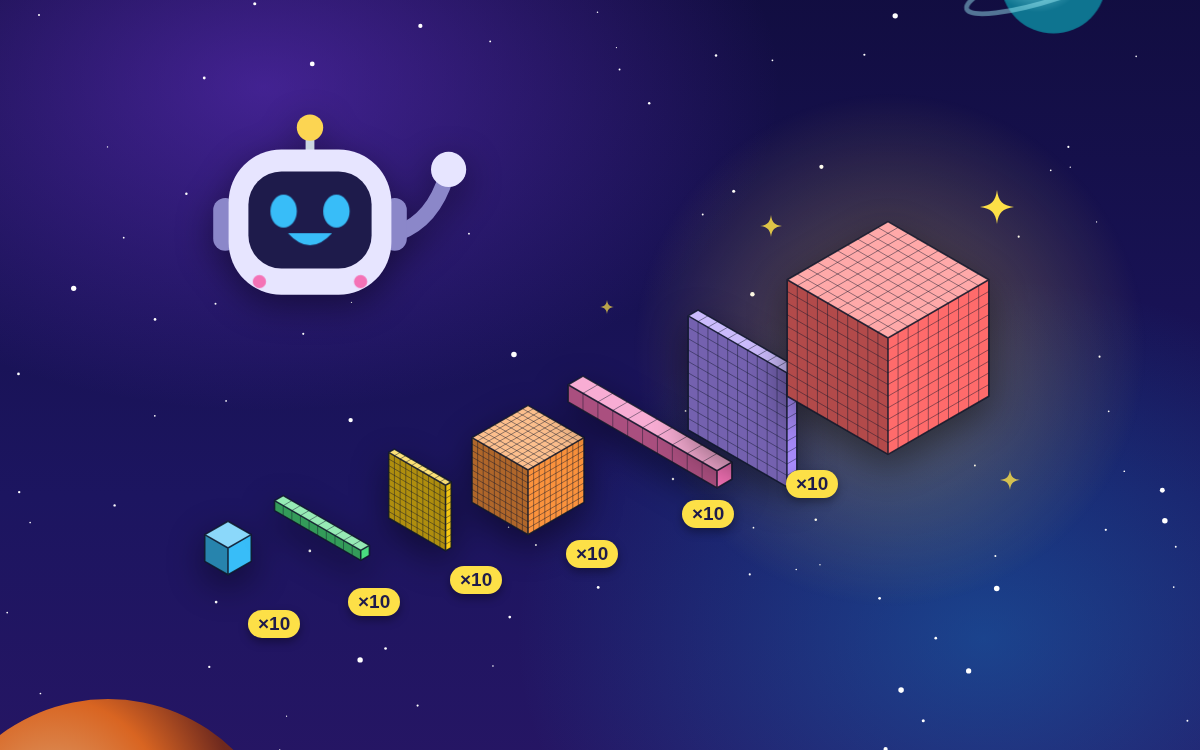
- Each place is worth ten times the place to its right
- Ten ones make a ten, and so on up to a million
- The value of any digit in a six-digit number
- Why zero is used as a placeholder, as in 305,120
- How to count on and back in powers of 10
- How to compare and order numbers up to 1,000,000
What's inside
- Block Lab
- Digit Detective
- Number Names
- Rocket Counting
- Greater or Less
- Million Master (10 questions)
About this adventure
Place Value to a Million is a free interactive game that teaches children aged 8–11 how to read, write, compare and count with numbers up to 1,000,000. Pip the robot talks them through every step, so they learn by doing.
In the Block Lab, players join ten cubes to make a ten, then keep multiplying by 10 until a giant cube shows one million. They set digits on a place value chart, find out what each digit is worth and use zero as a placeholder. They partition 452,318 into 400,000 + 50,000 + 2,000 + 300 + 10 + 8, and place the commas in large numbers.
A rocket counter shows which digit changes when you count on or back in powers of 10. Players then compare numbers using < and >, put numbers in order and finish with a 10-question quiz. The game follows the Year 5 place value objectives in KS2 maths.
Questions and answers
What is place value, in simple words?
Place value is the value a digit has because of where it sits in a number. In 574,236 the 7 is in the ten thousands place, so it is worth 70,000, even though the digit itself is just 7.
How many thousands are there in a million?
There are 1,000 thousands in one million. Each place is ten times the one to its right, so ten hundred thousands also make a million. In the game, children build a million cube by joining ten blocks worth 100,000 each.
What does counting in powers of 10 mean?
Counting in powers of 10 means counting on or back in steps of 10, 100, 1,000, 10,000 or 100,000. Usually only one digit changes, but crossing a boundary changes more: 34,990 plus 100 makes 35,090, so the thousands digit changes too.
What age is this place value game for?
It is designed for children aged 8 to 11 and matches the Year 5 place value objectives in the UK National Curriculum for KS2 maths. Confident younger learners and Year 6 pupils who want to revise can use it too.
What does the game include and how long does it take?
The game has five short activities and a 10-question quiz, and takes about 25 minutes to play from start to finish. A narrator reads every instruction aloud, and progress is saved so children can stop and carry on later.
More to explore
See all
Subitising to 5: Spot It Quick with Dotty the Ladybird
Learn subitising to 5: seeing how many there are without counting. Spot dot patterns, dice, fingers and tens…
Odd and Even Numbers: Pair Up Puffins with Pip
Learn to spot odd and even numbers using pairs, the 2 times table and the ones digit, by pairing puffins in b…
Counting to 20 and Beyond: Hop the Lily Pond with Pip
Learn counting to 20 and beyond, past 10 and on to 30, by tapping lily pads as Pip the frog hops along and ch…
Roman Numerals to 1,000: A Roma Town Quest with Octavia
Learn to read Roman numerals to 1,000 and recognise years like MMXXVI by splitting numerals into chunks and s…
Negative Numbers: Counting Below Zero with Pip the Penguin
Learn what negative numbers are, read temperatures below zero and count through zero, helping Pip the penguin…
Factors, Multiples and Primes: A Number Isle Adventure
Learn to find common factors, common multiples and prime numbers by planting flower beds, timing lighthouse f…
Numbers to 20: Count, Read and Compare with Dotty
Learn to read, write and compare numbers to 20 by counting apples, filling ten frames, hopping a frog along a…
 TapLearn