Dissolving and Separating Mixtures: Molly's Mixture Lab
Learn how solids dissolve to make a solution and how to separate mixtures by sieving, filtering and evaporating in Molly the mole's lab.
- Ages 8–11
- About 50 min
- Some thinking
- Materials & Matter
Learn how solids dissolve to make a solution and how to separate mixtures by sieving, filtering and evaporating in Molly the mole's lab.
Year 5 science · 1
Year 5 science · 2
Year 5 science · 2 Year 5 science · 1
Year 5 science · 1 Year 5 science · 2
Year 5 science · 2 Year 5 science · 1
What the chapters cover in the national curriculum in England:
Dissolving and Separating Mixtures is an interactive science game that teaches children aged 8–11 how some solids dissolve in a liquid to make a solution, and how to separate mixtures again by sieving, filtering and evaporating.
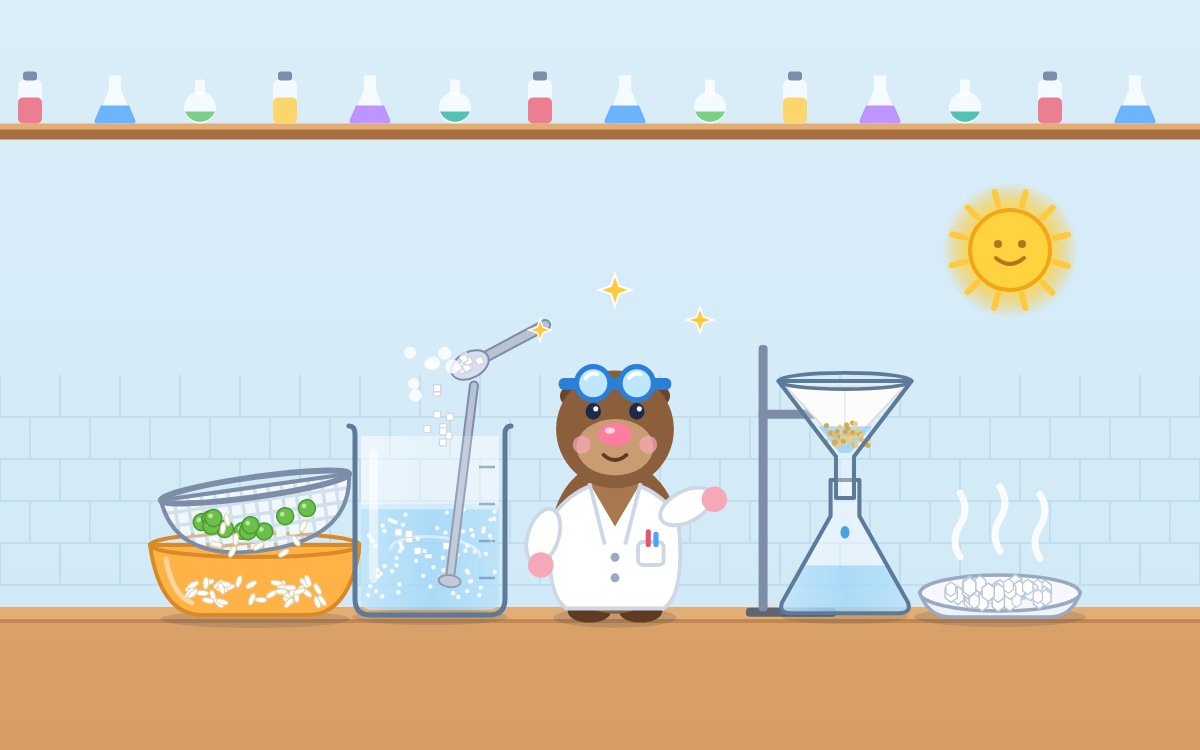
In Molly the mole's lab, players stir sugar into water, zoom in to see that it has broken into pieces too tiny to see, and test six solids to sort them into soluble and insoluble. They shake peas out of rice, pick a sieve with the right size holes, fold filter paper into a cone, and leave salt water on a sunny windowsill until salt crystals appear.
Along the way they compare dissolving with melting, find out why filter paper cannot catch dissolved salt, and finish by separating gravel, sand and salt in the right order. Questions use typed answers as well as choices.
Melting happens when a solid gets warm enough to turn into a liquid, like chocolate in a warm pan. Dissolving happens when a solid breaks into pieces too tiny to see and mixes into a liquid, like sugar stirred into tea.
You evaporate the water. Pour the salt water into a shallow dish and leave it somewhere warm: the water turns into water vapour and goes into the air, and salt crystals are left behind. Sieving and filtering cannot do this.
Use a sieve for solids with different-sized pieces, such as gravel and sand. Use filtering for a solid that has not dissolved in a liquid, such as sand in water. Use evaporating to get back a solid that has dissolved, such as salt.
It is made for children aged 8 to 11, especially Year 5. It follows the KS2 science national curriculum in England for dissolving, recovering a substance from a solution and separating mixtures.
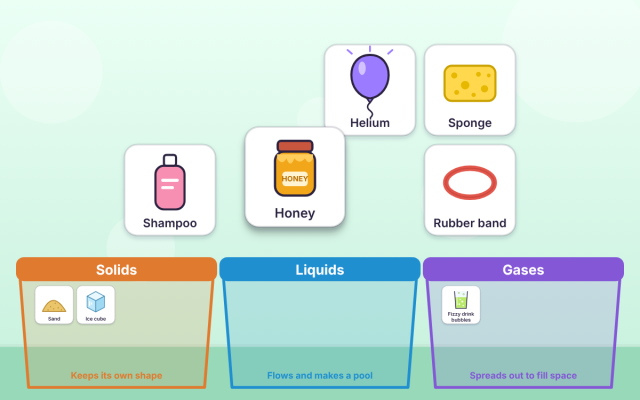
It has five lab stations, an optional warm-up on solids, liquids and gases, a quick check after each station and a 10-question final challenge. Playing everything takes about 50 minutes, and children can play one station at a time.
 TapLearn
Getting it ready…
Great work on chapter 1! To open the next chapters, ask a grown-up to take a look.
To play this game, ask a grown-up to take a look. There are lots of free games you can play right now too!
Create a free family account and your child can play every chapter of every game for 7 days, with no card needed. Their progress is kept. After that, the free plan is free for ever, and membership is £6.99 a month if you'd like to keep every chapter.
That's all the learning time for today. Great work! Flip will be ready to play again tomorrow.