A desert gets less than 250 mm of rain or snow a year
Deserts can be hot or cold, sandy, rocky or icy
Many hot deserts lie near the Tropics of Cancer and Capricorn
Why clear desert skies mean hot days and cold nights
How cacti, camels and fennec foxes are adapted to dry places
How desert people use oases, loose clothes and thick-walled homes
Chapter by chapter
What is a desert? A biome with very little rainFree to try
Years 3–6 geography · 1
Where are deserts? Climate zones, the Equator and the tropics
Years 3–6 geography · 1
Desert climate: hot days, cold nights and very little rain
Years 3–6 geography · 1
Desert vegetation: how plants survive with little water
Years 3–6 geography · 1
Desert animals: surviving heat and little water
Years 3–6 geography · 1
People in deserts: water, clothes, homes and travel
Years 3–6 geography · 1
Desert Explorer Challenge (10 questions)
What the chapters cover in the national curriculum in England:
Years 3–6 geography: Describe and understand key aspects of physical geography, including: climate zones, biomes and vegetation belts, rivers, mountains, volcanoes and earthquakes, and the water cycle
About this adventure
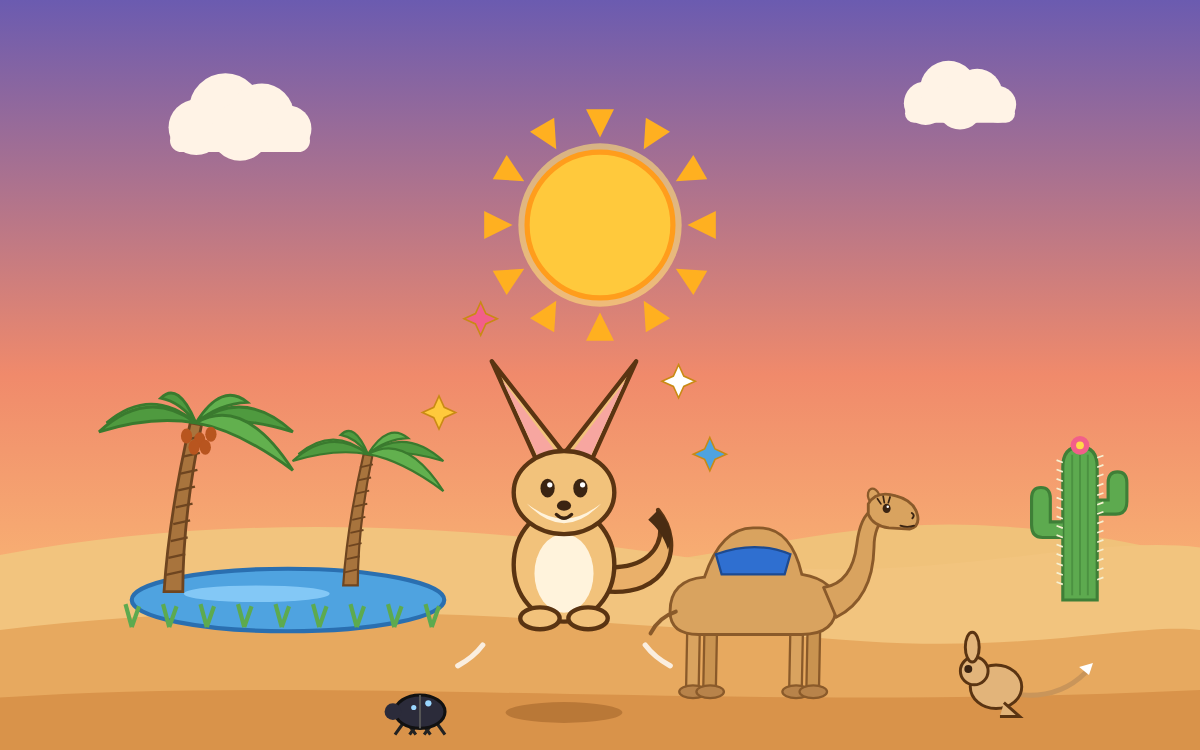
Desert Explorers is an interactive geography game that teaches children aged 7–11 about the desert biome: what a desert is, where deserts are found, what their climate is like and how plants, animals and people live there.
Guided by Fez the fennec fox, players fill rain gauges to discover that a desert is any place with less than 250 mm of rain or snow a year, so icy Antarctica counts too. They find the Sahara, Atacama, Gobi and five more on a world map, and watch warm, wet air rise at the Equator while dry air sinks near the Tropics of Cancer and Capricorn.
Later, they slide the sun across the Sahara sky to see the temperature fall at night, design a cactus that saves water, explore a camel's adaptations and build a cool mud-brick house by an oasis. A 10-question challenge checks everything at the end.
Questions and answers
What makes a place a desert?
A desert is any place that gets less than 250 mm of rain or snow in a year. Deserts can be scorching like the Sahara or freezing like Antarctica, and only about a fifth of all desert land is covered in sand.
Why are deserts hot in the day and cold at night?
Desert skies are usually clear, so the sun heats the ground strongly in the day. At night there are no clouds to act like a blanket, so the heat escapes into space and the temperature can drop by more than 30 °C.
How do camels survive in the desert?
Camels store fat, not water, in their humps and use it for energy when food is scarce. Long eyelashes and closable nostrils keep out sand, wide padded feet stop them sinking, and a thirsty camel can drink about 100 litres in ten minutes.
What age is this desert game for?
The game is designed for children aged 7 to 11 and is pitched mainly at Year 4, where deserts and biomes are usually taught in KS2 Geography. Every instruction is shown as a short caption and read aloud, so children can play on their own.
What does the desert game include and how long does it take?
It has six chapters covering what a desert is, where deserts are, desert climate, plants, animals and people, plus a 10-question final challenge. Playing everything takes about 45 minutes, and children can pick any chapter from the camp map.
Can we count your visit? We'd like to use one cookie, only on this site, to see how families find and use TapLearn, so we can make it better. No adverts, and nothing is shared. How we measure
Create a free family account and your child can play every chapter of every game for 7 days, with no card needed. Their progress is kept. After that, the free plan is free for ever, and membership is £6.99 a month if you'd like to keep every chapter.

 TapLearn