Early Islamic Civilisation: Explore Baghdad in AD 900
Learn about early Islamic civilisation and Baghdad around AD 900: build the Round City, trade goods and meet House of Wisdom scholars.
- Ages 8–11
- About 40 min
- Some thinking
- World Civilisations
Learn about early Islamic civilisation and Baghdad around AD 900: build the Round City, trade goods and meet House of Wisdom scholars.
Years 3–6 history · 1
Years 3–6 history · 1
Years 3–6 history · 1
Years 3–6 history · 1
Years 3–6 history · 1
What the chapters cover in the national curriculum in England:
Early Islamic Civilisation: Explore Baghdad in AD 900 is an interactive history game that teaches children aged 8–11 about Baghdad around AD 900, the House of Wisdom and how life there contrasted with Anglo-Saxon Britain. It follows the KS2 history study of a non-European society, and a narrator called Layla guides each step.
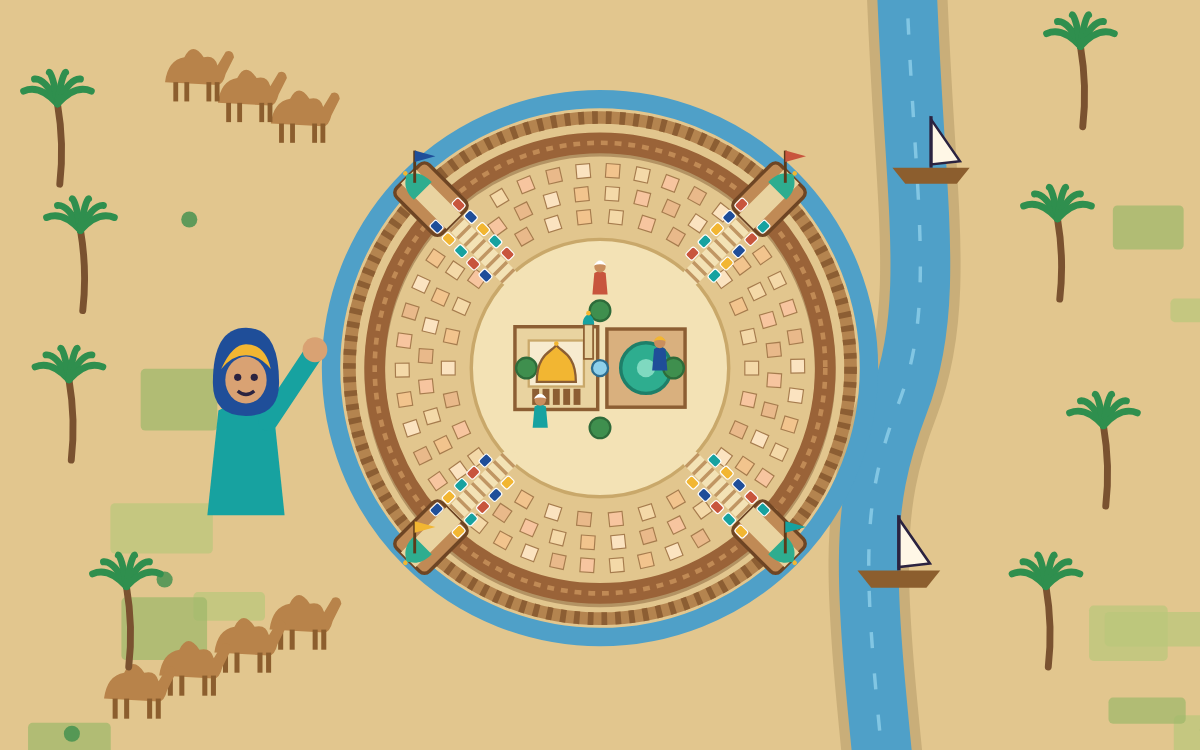
Players place Baghdad by the River Tigris on a map and a timeline, then build Caliph al-Mansur's Round City with its moat, walls, four gates, mosque and palace. They send silk, spices, gold and furs along trade routes, learn how paper came from China, and visit a bimaristan (hospital) and a hammam (bathhouse).
In the House of Wisdom, they help translators and try hands-on tasks with scholars such as al-Khwarizmi, whose work gave us the word algebra. Finally they sort similarities and differences between Baghdad and Anglo-Saxon Britain.
Early Islamic civilisation was the world of cities, trade and learning that grew up under the caliphs after Islam began in Arabia around AD 610. By about AD 750 its empire stretched from Spain to the edge of India, with Baghdad as its capital.
Caliph al-Mansur began building Baghdad as a round city in AD 762. With the mosque and palace in the centre, every gate was the same distance away, and a circle protected by a moat and two walls was easier to guard.
The House of Wisdom was a great library and centre of learning in Baghdad. Muslim, Christian and Jewish scholars there translated books from Greek, Persian and Sanskrit into Arabic, then tested the ideas and made new discoveries in maths, astronomy and medicine.
The game is for children aged 8 to 11 and matches the KS2 history curriculum in England. It is pitched mainly at Year 6, where Baghdad c. AD 900 is most often taught, and suits confident Year 4 and Year 5 readers too.
Playing everything takes about 40 minutes. There are five chapters, each with a short animated introduction and recap, hands-on building, sorting and matching tasks, quick checks along the way, and a 10-question final challenge.
 TapLearn
Getting it ready…
Great work on chapter 1! To open the next chapters, ask a grown-up to take a look.
To play this game, ask a grown-up to take a look. There are lots of free games you can play right now too!
Create a free family account and your child can play every chapter of every game for 7 days, with no card needed. Their progress is kept. After that, the free plan is free for ever, and membership is £6.99 a month if you'd like to keep every chapter.
That's all the learning time for today. Great work! Flip will be ready to play again tomorrow.