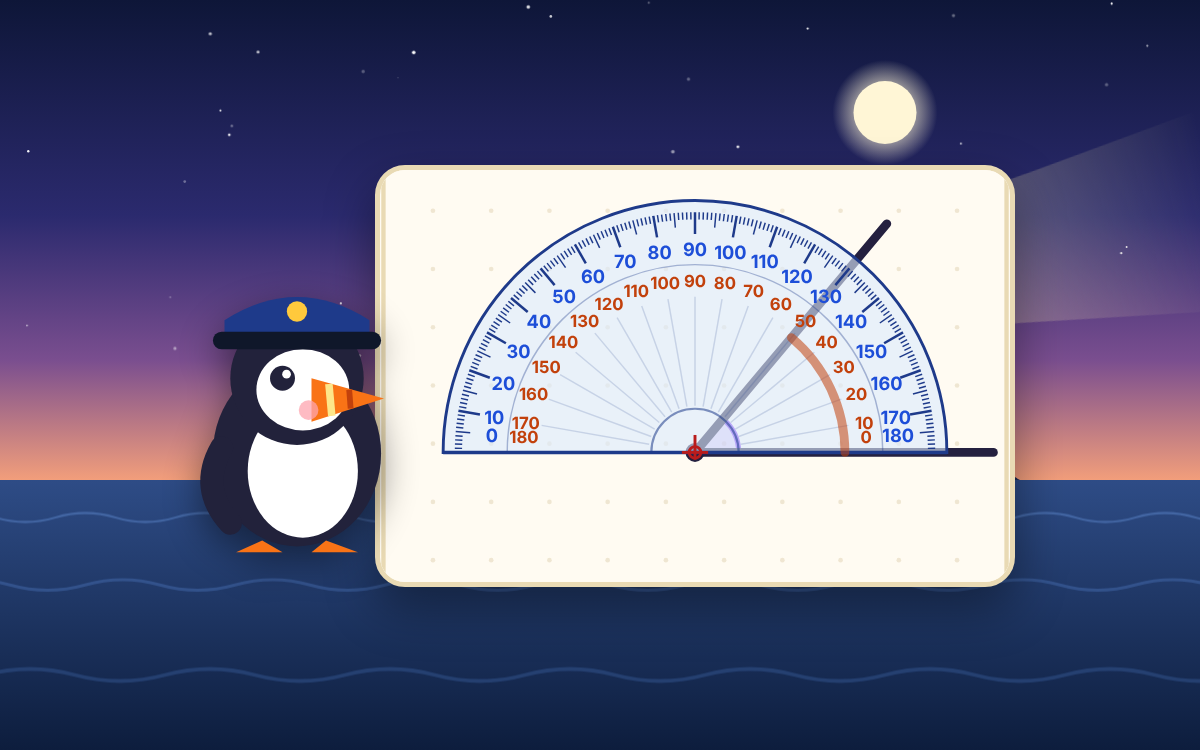
Measuring Angles: A Lighthouse Adventure with Pip
Learn about measuring angles in degrees with a protractor, then turn a lighthouse beam to estimate, draw and work out missing angles.
- Ages 9–11
- About 70 min
- Some thinking
- Shapes & Measures
Learn about measuring angles in degrees with a protractor, then turn a lighthouse beam to estimate, draw and work out missing angles.
Year 5 maths · 1
Year 5 maths · 1
Year 5 maths · 2
Year 5 maths · 2
Year 5 maths · 3
Year 5 maths · 3
What the chapters cover in the national curriculum in England:
Measuring Angles is an interactive maths game that teaches children aged 9–11 to estimate, measure and draw angles in degrees and to find missing angles, matching the Year 5 curriculum in England. Pip the puffin, keeper of Turnstone Lighthouse, reads every step aloud with captions, and the lamp's turning beam becomes the arm of each angle.
Children drag an on-screen protractor onto the vertex (the point where the two arms meet), choose the scale that starts at 0 and type their reading. They also mark and rule their own angles, sort acute, obtuse and reflex angles, and swing the beam through quarter, half and whole turns.
The game spots common slips, such as reading the wrong scale or using 360° on a straight line, and shows the fix straight away. A zoom bubble makes the protractor easy to read on a phone.
Put the centre of the protractor exactly on the vertex, line the baseline up with one arm, then count up from the 0 on that arm and read where the other arm crosses that scale. Estimating first tells you whether the answer should be more or less than 90°.
An acute angle is less than 90°, an obtuse angle is between 90° and 180°, and a reflex angle is more than 180° but less than 360°. A right angle is exactly 90°, and a straight line makes 180°.
Angles on a straight line add up to 180°, which is a half turn, and angles around a point add up to 360°, a whole turn. To find a missing angle, add the angles you know and take that total away from 180 or 360.
The game is for children aged 9 to 11 and follows the Year 5 maths curriculum in England, so it also suits Year 6 revision. Every line is read aloud with captions, and two optional warm-ups recap right angles and taking away from 180 and 360.
It has six chapters, each with an animated introduction, hands-on tasks and a three-question quick check, plus a 10-question Lighthouse Challenge. Playing everything takes about 70 minutes, and children can start any chapter from the island map.
 TapLearn
Getting it ready…
Great work on chapter 1! To open the next chapters, ask a grown-up to take a look.
To play this game, ask a grown-up to take a look. There are lots of free games you can play right now too!
Create a free family account and your child can play every chapter of every game for 7 days, with no card needed. Their progress is kept. After that, the free plan is free for ever, and membership is £6.99 a month if you'd like to keep every chapter.
That's all the learning time for today. Great work! Flip will be ready to play again tomorrow.