What you'll learn
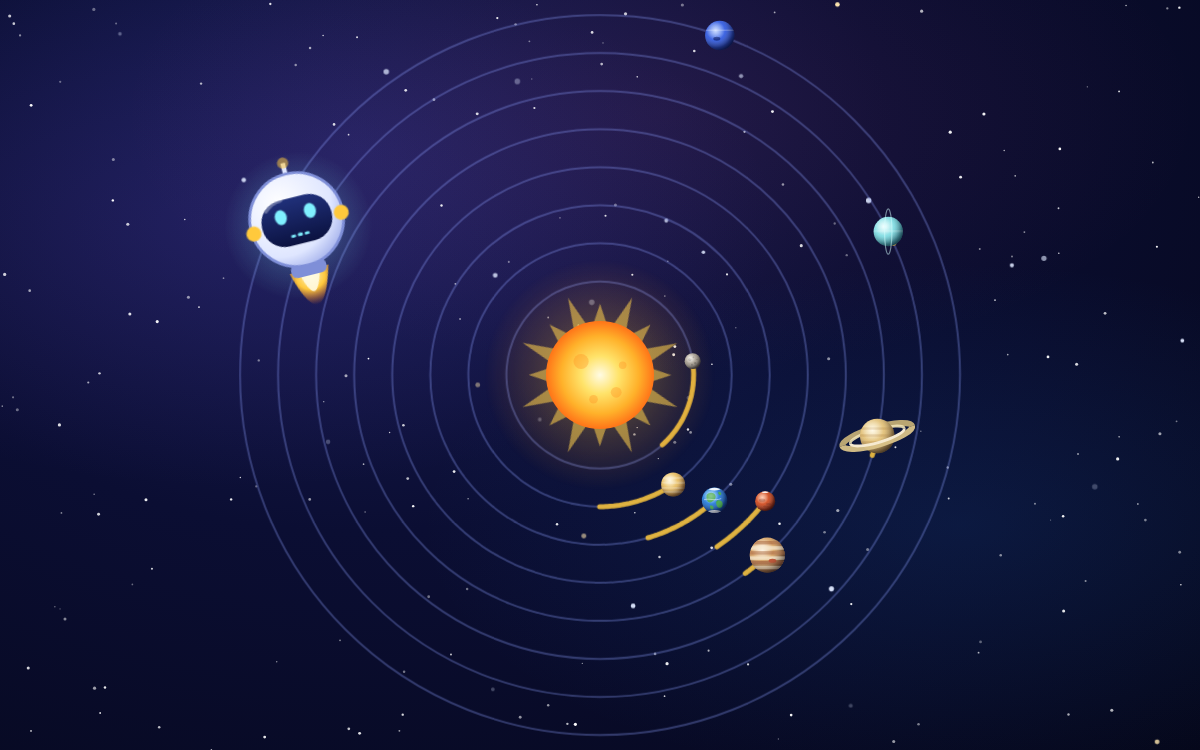
- The Sun is a star at the centre of the solar system
- The eight planets in order, from Mercury out to Neptune
- An orbit is the path one object takes around another
- One orbit of the Sun takes the Earth 365¼ days
- Planets further from the Sun take longer to orbit it
- Evidence that the Sun, Earth and Moon are spheres
Chapter by chapter
- The Sun and the eight planets of the solar system Free to try
Year 5 science · 1
- How the Earth orbits the Sun: one orbit is one year
Year 5 science · 1
- How the other planets orbit the Sun: near is quick, far is slow
Year 5 science · 1
- The Sun, Earth and Moon are spheres
Year 5 science · 2
- Evidence that the Earth is a sphere
Year 5 science · 2
- Solar system mission challenge (10 questions)
What the chapters cover in the national curriculum in England:
- Year 5 science: Describe the movement of the Earth and other planets relative to the sun in the solar system
- Year 5 science: Describe the sun, Earth and moon as approximately spherical bodies
About this adventure
The Solar System is an interactive science game that teaches children aged 8–11 how the Earth and the other planets orbit the Sun, and why the Sun, Earth and Moon are approximately spherical. It follows the Year 5 Earth and space objectives in the national curriculum for England.
Guided by Nova, a friendly robot, players place the eight planets in order using a memory trick, then pull the Earth round the Sun while a day counter shows that one orbit takes 365¼ days. They race Mercury against Neptune to see why planets further away have longer years.
Next, children sort spheres from flat shapes, watch gravity squeeze a lumpy rock into a ball, and play detective with real evidence: ships that vanish hull first over the horizon and the Earth's curved shadow on the Moon. A ten-question challenge with typed answers checks what they remember.
Questions and answers
What is the solar system, in simple words?
The solar system is the Sun and everything that travels around it, including eight planets. The Sun is a star at the centre, and the planets in order are Mercury, Venus, Earth, Mars, Jupiter, Saturn, Uranus and Neptune.
How long does it take the Earth to go around the Sun?
The Earth takes about 365¼ days to orbit the Sun once, and we call that one year. The extra quarter days add up to a whole day every four years, which is why a leap year has a 29th of February.
How do we know the Earth is round and not flat?
Ships sailing away disappear from the bottom up, because they go over the curve of the Earth. During a lunar eclipse the Earth's shadow on the Moon always has a curved edge, and photos from space show the whole planet as a ball.
What age is this solar system game for?
This game is made for children aged 8 to 11 and matches the Year 5 Earth and space topic in the national curriculum for England. Younger space fans can enjoy it with an adult, as Nova reads every instruction aloud.
What does the solar system game include and how long does it take?
The game has five chapters, an optional warm-up and a ten-question mission challenge, taking about 45 minutes in total. Children can start with any chapter and come back to finish the rest later, as their progress is saved.
More to explore
See all
Day and Night: Spin the Earth to See Why the Sun Moves
Learn why we have day and night and why the Sun seems to cross the sky, by spinning the Earth and following o…
Earth and Sun: Spin the Planet to Make Day and Night
Learn how the Earth and Sun give us days, nights and years by spinning the Earth, racing planets round the Su…
Phases of the Moon: A Moonwatch Adventure with Nova
Discover the phases of the Moon and why it seems to change shape: drag the Moon round the Earth, watch its su…
The Moon Landing: Blast Off with Apollo 11 and Columbus
Learn about the Moon landing in 1969 and the Apollo 11 crew, then sail with Columbus in 1492 and build a time…
Animal Life Cycles: Grow a Frog, Butterfly, Robin and Rabbit
Learn how animal life cycles work by helping a frog, butterfly, robin and rabbit grow, from egg or birth to a…
Skeletons and Muscles: Build a Body with Skelly
Learn how skeletons and muscles work together: build a skeleton, test how bones protect you, and make an arm…
The Heart and Circulatory System: Ride with Rosie
Learn how the heart and circulatory system work, then guide Rosie the red blood cell round the body, build yo…
 TapLearn