Factors and Multiples: A Factor Island Adventure
Learn factors and multiples, factor pairs and common factors by hopping, planting and building rafts on Factor Island, then solve real puzzles.
- Ages 8–11
- About 45 min
- Some thinking
- Calculation
Learn factors and multiples, factor pairs and common factors by hopping, planting and building rafts on Factor Island, then solve real puzzles.
Year 5 maths · 1
Year 5 maths · 1
Year 5 maths · 1
Year 5 maths · 1
Year 5 maths · 2
What the chapters cover in the national curriculum in England:
Factor Island is an interactive factors and multiples game that teaches children aged 8–11 how to spot multiples, find factor pairs and common factors, and use them to solve problems, matching the Year 5 maths curriculum in England.
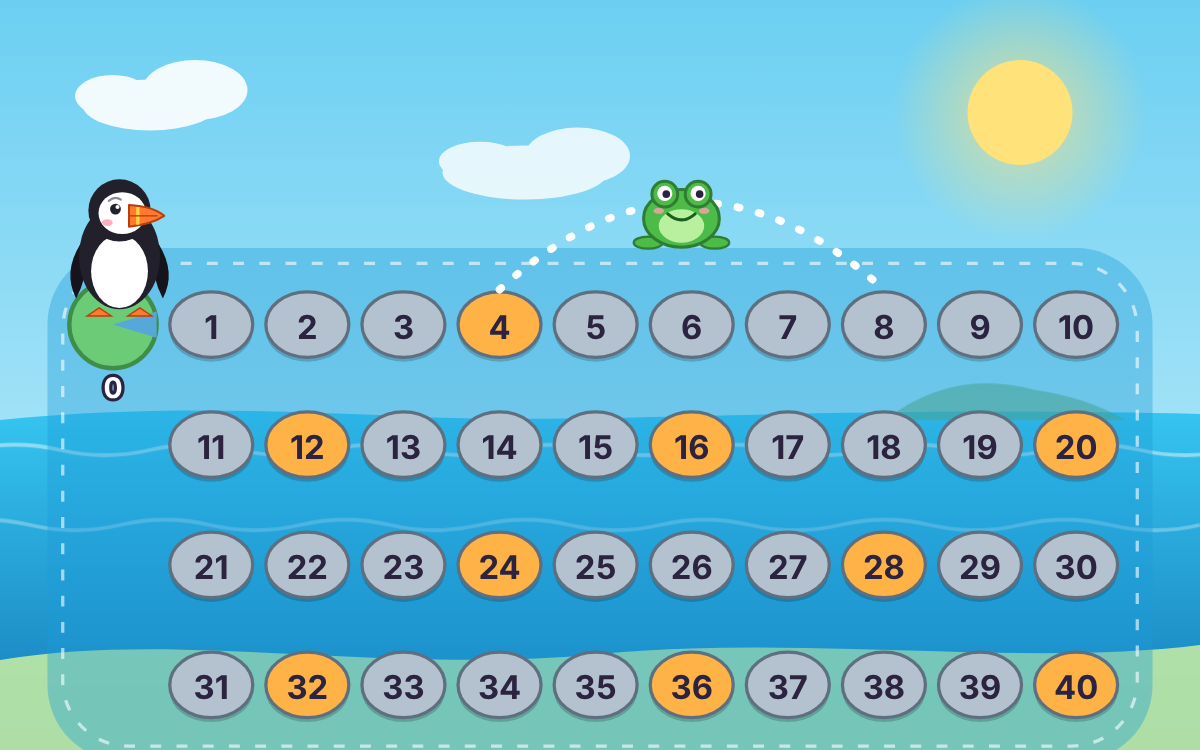
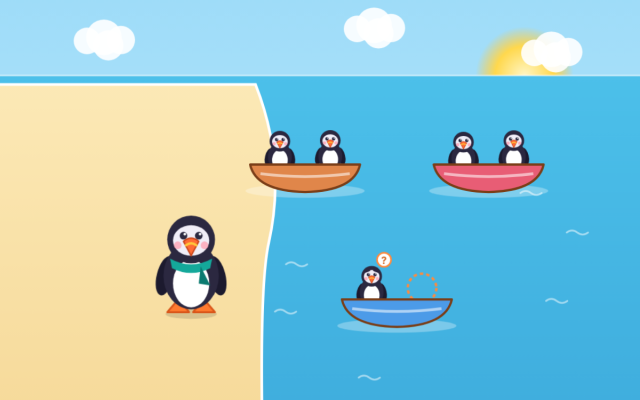
Players help Jumpy the frog hop in equal jumps, plant seedlings in equal rows and build rafts from square logs. Along the way they learn that a multiple comes from counting in equal steps, while a factor divides a number exactly with nothing left over. A factor pair is two numbers that multiply to make it, such as 3 and 4 for 12.
Pip the puffin narrates every step, with hints after a wrong answer and an optional times-table warm-up. Square and cube numbers join packing and sharing puzzles, and a 10-question quiz checks what has stuck.
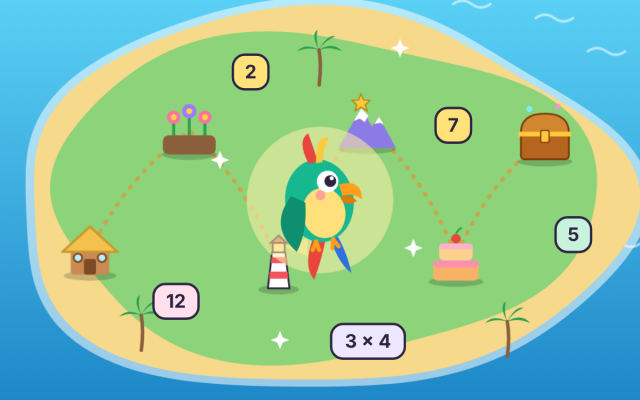
A factor divides exactly into a number, while a multiple is what you get when you count in equal steps of that number. For example, 3 is a factor of 12, and 12 is a multiple of 3, because 3 × 4 = 12.
Test whole numbers in order, starting from 1, and write down each pair that multiplies to make the number. Stop when the pairs meet in the middle and start repeating. For 24 the pairs are 1 × 24, 2 × 12, 3 × 8 and 4 × 6.
Common factors are numbers that are factors of two numbers at the same time. List the factors of each number and look for the ones that appear in both lists: the common factors of 12 and 18 are 1, 2, 3 and 6.
It is designed for children aged 8 to 11 and matches what pupils learn in Year 5 (ages 9–10) in England. Confident younger learners can use it as a stretch, and Year 6 pupils can use it for revision.
It has five narrated chapters, an optional times-table warm-up and a 10-question quiz, and takes about 45 minutes to play through. Children can pick any chapter from the island map and return to it later.
 TapLearn
Getting it ready…
Great work on chapter 1! To open the next chapters, ask a grown-up to take a look.
To play this game, ask a grown-up to take a look. There are lots of free games you can play right now too!
Create a free family account and your child can play every chapter of every game for 7 days, with no card needed. Their progress is kept. After that, the free plan is free for ever, and membership is £6.99 a month if you'd like to keep every chapter.
That's all the learning time for today. Great work! Flip will be ready to play again tomorrow.