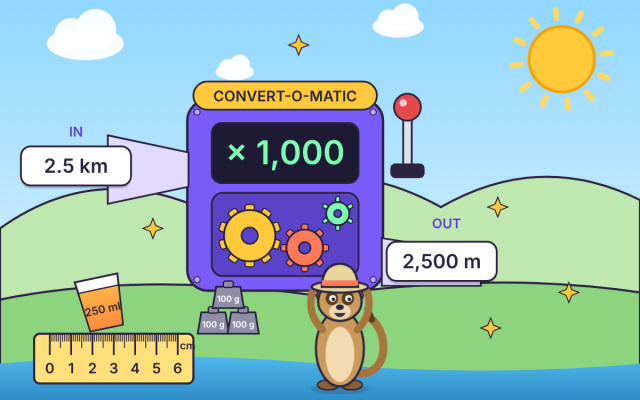
Multiplying by 10, 100 or 1,000 moves the digits left
Dividing by 10, 100 or 1,000 moves digits right
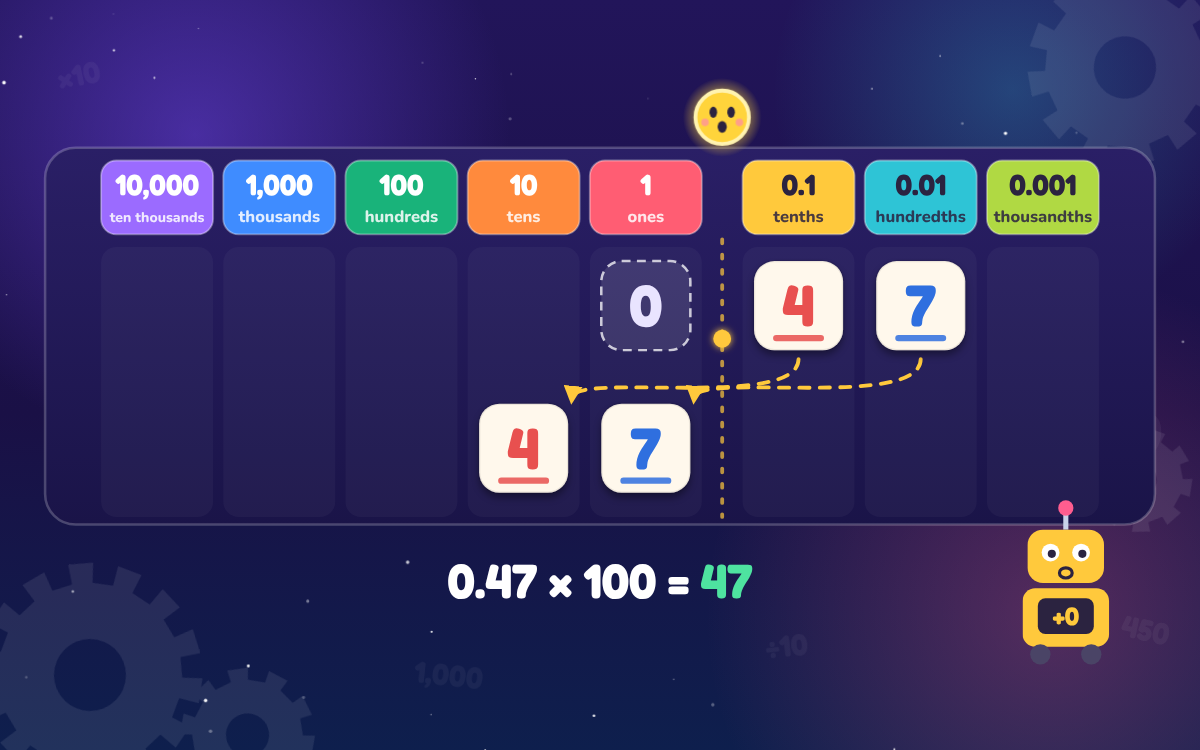
The decimal point stays still while the digits move
Why 3.5 × 10 is 35, not 3.50
Using placeholder zeros correctly, as in 8 ÷ 100 = 0.08
Working backwards to find missing numbers, like? × 100 = 36
Chapter by chapter
Multiplying whole numbers by 10, 100 and 1,000: digits move leftFree to try
Year 5 maths · 1
Dividing whole numbers by 10, 100 and 1,000: digits move right
Year 5 maths · 1
Multiplying decimals by 10, 100 and 1,000
Year 5 maths · 1
Dividing decimals by 10 and 100: placeholder zeros
Year 5 maths · 1
Missing numbers and real-life problems: multiplying and dividing by 10, 100 and 1,000
Year 5 maths · 1
Final challenge: multiplying and dividing by 10, 100 and 1,000 (10 questions)
What the chapters cover in the national curriculum in England:
Year 5 maths: Multiply and divide whole numbers and those involving decimals by 10, 100 and 1,000
About this adventure
Digit Slide Lab is an interactive maths game that teaches children aged 9–11 how to multiply and divide by 10, 100 and 1,000, with whole numbers and decimals, matching the Year 5 national curriculum in England.
Players work on a place value chart that runs from ten thousands to thousandths. They pull × and ÷ levers, drag digits along the chart and type answers on a keypad, and every answer is shown as an animation of the digits moving.
The key idea is that the decimal point stays still while the digits move: one place for 10, two for 100 and three for 1,000. Children also learn when placeholder zeros are needed, such as 4.2 ÷ 100 = 0.042, and see why adding a zero to the end of a decimal does not change its value. Narration, captions and gentle hints support every step.
Questions and answers
How do you multiply a number by 10, 100 or 1,000?
You move every digit 1, 2 or 3 places to the left on a place value chart, because each column is worth ten times the one on its right. Any empty places before the decimal point are filled with zeros, so 23 × 100 = 2,300.
Why isn't 3.5 × 10 just 3.50?
Adding a zero to the end of a decimal does not change its value, so 3.50 is still three and a half. To multiply by 10, the digits move one place left instead, which makes 3.5 × 10 = 35.
How do you divide a decimal by 100?
You move every digit two places to the right, and the decimal point stays where it is. Zeros hold any empty places, so 4.2 ÷ 100 = 0.042, with zeros in both the ones and the tenths columns.
What age is this multiplying and dividing by 10, 100 and 1,000 game for?
It is designed for children aged 9 to 11, matching the Year 5 maths curriculum in England. It also works well for Year 6 pupils who want to revise place value before moving on to harder decimal calculations.
What does Digit Slide Lab include and how long does it take?
The game has an optional place value warm-up, five chapters and a 10-question final challenge, taking about 45 minutes in total. Chapters can be played in any order and in shorter sessions, and progress is saved between them.
Can we count your visit? We'd like to use one cookie, only on this site, to see how families find and use TapLearn, so we can make it better. No adverts, and nothing is shared. How we measure
Create a free family account and your child can play every chapter of every game for 7 days, with no card needed. Their progress is kept. After that, the free plan is free for ever, and membership is £6.99 a month if you'd like to keep every chapter.

 TapLearn