What's new this year
The Key Stage 2 tests (SATs) run from Monday 10 to Thursday 13 May 2027:
- Monday: grammar, punctuation and spelling (two papers).
- Tuesday: reading.
- Wednesday: maths paper 1 (arithmetic) and paper 2 (reasoning).
- Thursday: maths paper 3 (reasoning).
Writing and science aren't tested; teachers assess them. Schools receive results on 6 July 2027, and you'll get your child's before the end of the summer term. Scores are scaled from 80 to 120, and 100 or more means your child met the expected standard. Our SATs 2027 guide covers the detail.
Year 6 is also about moving on. You apply for a secondary place through your local council in the autumn term, and transition days usually happen in the summer.
Maths in Year 6
- Numbers to 10,000,000, long multiplication and long division, and the order of operations.
- Fractions with different denominators, multiplying and dividing fractions, and moving between fractions, decimals and percentages.
- Ratio and proportion, and early algebra: simple formulae, missing numbers and sequences.
- Area of triangles and parallelograms, volume of cuboids, and converting units.
- Angles in shapes, parts of a circle, and coordinates in all four quadrants.
- Pie charts, line graphs and the mean average.
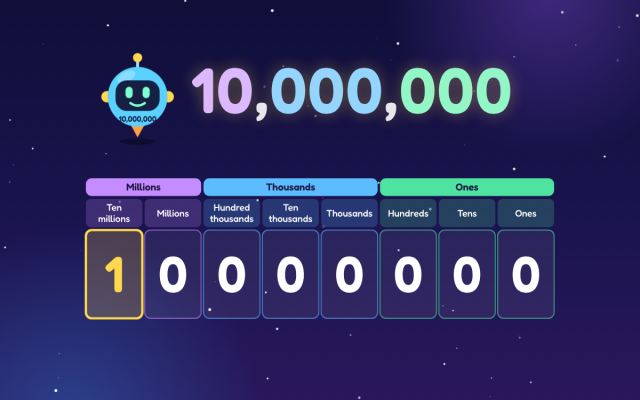
Place Value to 10 Million: A Space Mission with Digi
Learn place value to 10 million: read, write, compare and order big numbers by building millions on a chart a…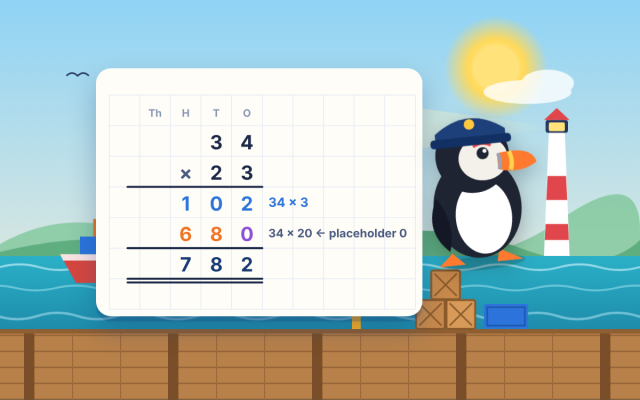
Long Multiplication and Division: A Puffin Harbour Job
Learn long multiplication and long and short division by two-digit numbers, then help Pip the puffin pack cra…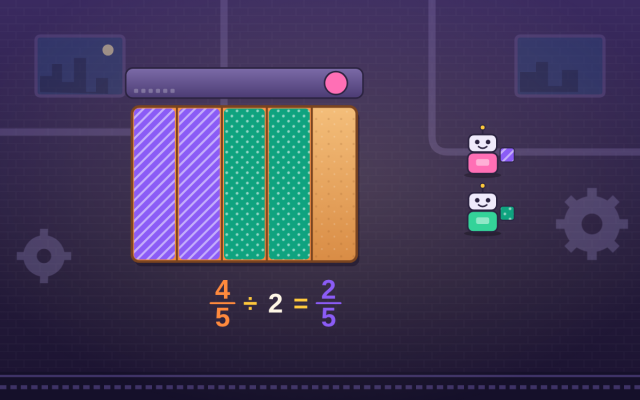
Multiplying and Dividing Fractions: A Fudge Factory Game
Learn multiplying and dividing fractions and how to turn fractions into decimals, by cutting, sharing and sim…
Ratio and Proportion: Sail Ratio Island with Pip
Learn ratio and proportion for Year 6: use 'for every' and a : b, scale recipes, enlarge similar shapes and s…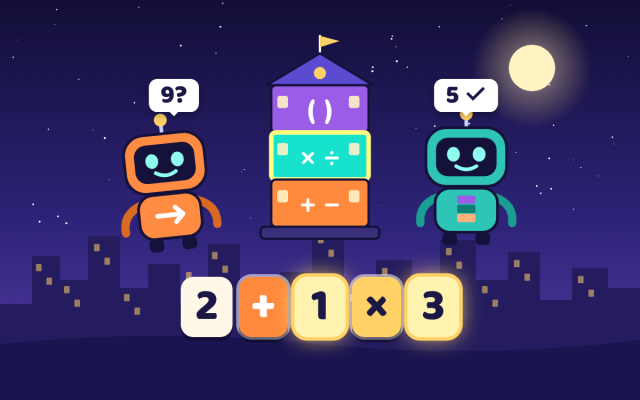
Order of Operations: Climb the Priority Tower with Ordo
Learn the order of operations: brackets, then multiply and divide, then add and subtract. Solve calculations…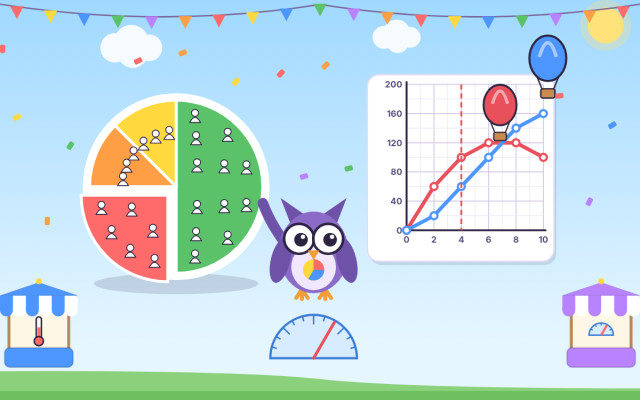
Pie Charts and Line Graphs: A Day at the Great Graph Fair
Learn to read and draw pie charts and line graphs, then solve problems with them as you visit six stalls at a…English in Year 6
- Reading: comparing books, telling fact from opinion, and backing up views with evidence from the text.
- Writing: choosing formal or informal language to suit the reader, and organising longer pieces.
- Grammar: the passive voice ("the window was broken"), the subjunctive ("if I were you"), and synonyms and antonyms.
- Punctuation: colons, semicolons and dashes between clauses, hyphens and bullet points.
- Spelling and handwriting: the rest of the Year 5 and 6 word list, and fast, legible handwriting.
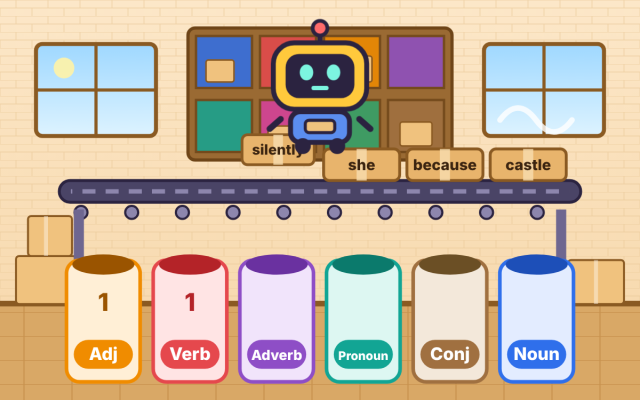
Word Classes: Sort Every Word with Dot the Robot
Learn the eight word classes, from nouns and verbs to determiners and conjunctions, by sorting word parcels i…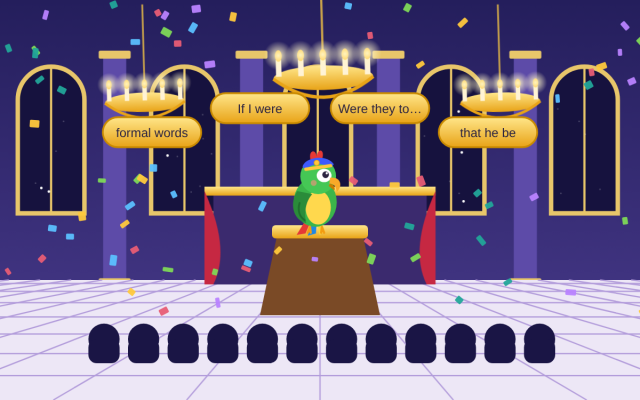
The Subjunctive Form: Help Percy Speak Like Royalty
Learn the subjunctive form, from If I were you to Were they to come, by helping Percy the parrot turn chatty…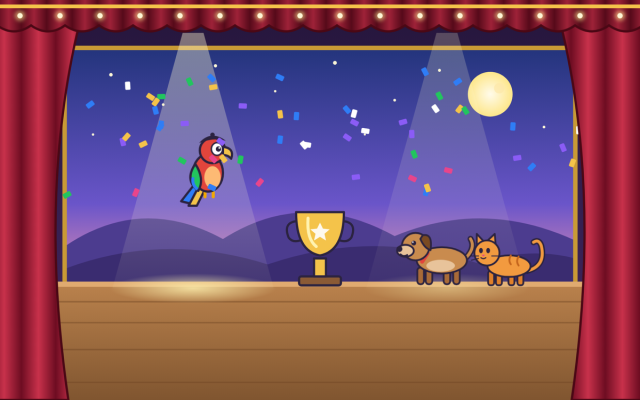
Active and Passive Voice: Showtime at the Voice Theatre
Learn active and passive voice: find the subject and object, then flip sentences around on a theatre stage wi…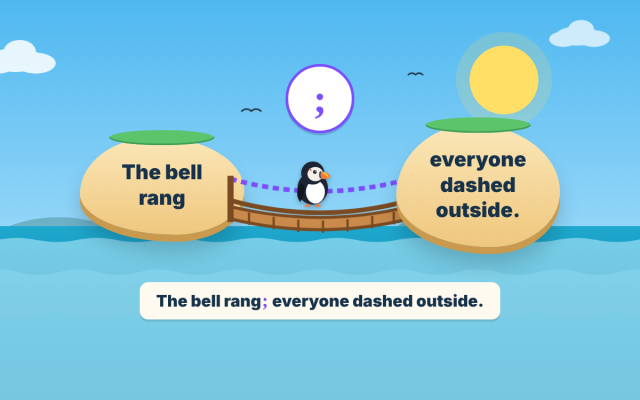
Colons, Semi-colons and Dashes: Bridge the Clause Islands
Learn how to use colons, semi-colons and dashes between clauses and in lists. Build punctuation bridges betwe…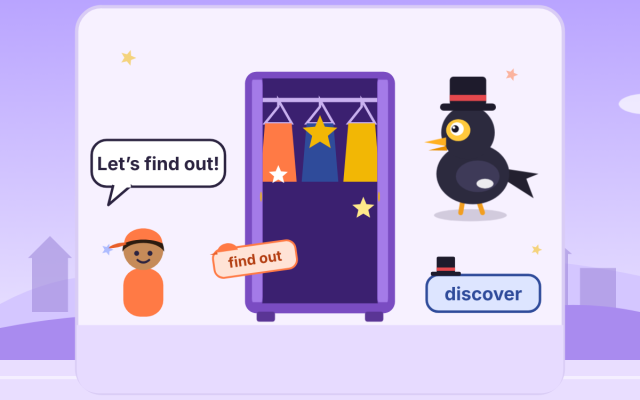
Formal and Informal Language: Swap Hats with Mina
Learn formal and informal language: swap chatty words for formal ones, spot question tags, use If I were and…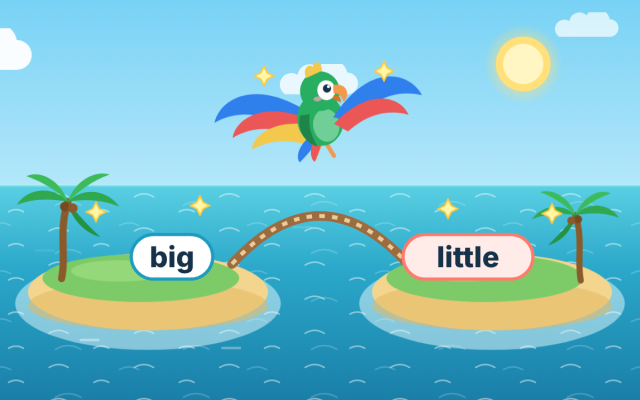
Synonyms and Antonyms: A Word Islands Adventure
Learn synonyms and antonyms, from big and large to big and little, by sailing round Word Islands, building br…Science and other subjects
Year 6 science covers classifying living things (including micro-organisms), the heart and circulation, and how diet, exercise and drugs affect the body, evolution and inheritance, how light travels, and electrical circuits. Other subjects carry on alongside the tests; schools choose topics, for example the Second World War or a study of a region of the world.
This year's topics, subject by subject
The roadmaps below show the order in which topics usually build up through Year 6, subject by subject. Schools teach in different orders, so treat them as a guide to what's coming rather than a timetable.
Maths 27 topics, 16 coming soon
- Place value (Year 6)
- Rounding and estimating (Year 6)
- Negative numbers (Year 6) coming soon
- Mental maths strategies (Year 6) coming soon
- Long multiplication and division (Year 6)
- Long division (Year 6) coming soon
- Factors, multiples and primes (Year 6)
- Order of operations
- Multi-step word problems (Year 6)
- Fractions: adding and subtracting (Year 6)
- Fractions: multiplying and dividing (Year 6)
- Decimals (Year 6) coming soon
- Percentages (Year 6) coming soon
- Ratio and proportion (Year 6)
- Word problems: percentages and ratio (Year 6) coming soon
- First steps in algebra coming soon
- Converting units (Year 6) coming soon
- Word problems: measures (Year 6) coming soon
- Area and perimeter (Year 6) coming soon
- Volume (Year 6) coming soon
- Angles (Year 6) coming soon
- Properties of shapes (Year 6) coming soon
- Parts of a circle (Year 6) coming soon
- Nets of 3D shapes (Year 6) coming soon
- Coordinates (Year 6) coming soon
- Pie charts and line graphs (Year 6)
- The mean (Year 6)
English 46 topics, 31 coming soon
- Speedy, neat handwriting (Years 5–6) coming soon
- Spelling patterns (Years 5–6) coming soon
- Endings –cial and –tial (Years 5–6) coming soon
- Prefixes and suffixes (Years 5–6)
- Homophones (Years 5–6)
- Statutory spelling words (Years 5–6)
- Must-know spellings (Year 6) coming soon
- Using a dictionary and thesaurus (Years 5–6) coming soon
- Synonyms and antonyms (Year 6)
- Must-know vocabulary (Year 6) coming soon
- Word classes (Year 6)
- Subject, verb and object (Year 6)
- Perfect tenses (Years 5–6)
- Active and passive voice
- Formal and informal language (Year 6)
- The subjunctive (Year 6)
- Colons, semicolons and dashes
- Hyphens and bullet points (Year 6)
- Writing great sentences (Year 6) coming soon
- Retrieval (Years 5–6) coming soon
- Words in context (Years 5–6) coming soon
- Figurative language (Years 5–6)
- Author's word choice (Years 5–6) coming soon
- Predicting from clues in the text (KS2) coming soon
- Reading detective: inference coming soon
- Summarising (Years 5–6) coming soon
- Themes and comparing books (Years 5–6) coming soon
- Myths and legends coming soon
- Speaking with confidence
- Thinking like a writer (Year 6) coming soon
- Planning your writing (Years 5–6) coming soon
- Cohesion and ellipsis (Year 6) coming soon
- Writing paragraphs (Year 6) coming soon
- Writing stories (Year 6) coming soon
- Write your own story (Years 5–6) coming soon
- Performing and acting coming soon
- Writing a playscript (KS2) coming soon
- Newspaper reports (Years 5–6) coming soon
- Writing a report (Years 5–6) coming soon
- Having a debate coming soon
- Persuasive writing coming soon
- Formal letters and emails (Years 5–6)
- Learning poems by heart (Years 5–6) coming soon
- Write a poem coming soon
- Editing your writing (Years 5–6) coming soon
- Making your writing amazing (Year 6) coming soon
Science 23 topics, 16 coming soon
- Planning enquiries and controlling variables (Years 5–6) coming soon
- Recording results: graphs and keys (Years 5–6) coming soon
- Using a microscope coming soon
- Classifying living things (Year 6) coming soon
- Micro-organisms
- The heart and circulation
- Diet, exercise and lifestyle coming soon
- How the brain works coming soon
- Inheritance
- Animal adaptations
- Ocean life coming soon
- Evolution and adaptation
- Charles Darwin
- Endangered animals coming soon
- How we see coming soon
- Colours of light coming soon
- Circuit symbols and voltage
- How electricity reaches our homes coming soon
- Stars and constellations coming soon
- How rockets work coming soon
- Life on the space station coming soon
- Exploring Mars coming soon
- Galaxies and black holes coming soon
History 8 topics, 6 coming soon
- Kings and queens: the changing power of monarchs (KS2) coming soon
- Isaac Newton coming soon
- The Victorians
- The first railways (KS2) coming soon
- Marie Curie coming soon
- The Second World War (KS2)
- Crime and punishment through time (KS2) coming soon
- The history of medicine coming soon
Earth & Geography 7 topics, 5 coming soon
- North and South America coming soon
- Region study: a region of North or South America (KS2) coming soon
- Tsunamis coming soon
- Crystals and minerals coming soon
- Energy resources
- Where our food comes from coming soon
- Trade around the world
Technology 8 topics, 8 coming soon
- Make your own game (KS2) coming soon
- Is it real? Checking online content coming soon
- Controlling things with code (KS2) coming soon
- Robots coming soon
- How electric cars work coming soon
- Solar panels and wind turbines coming soon
- How GPS finds you coming soon
- 3D printing coming soon
Schools teach topics in different orders, so use this as a guide. Open the roadmaps, pick the school year, and follow the steps.
How you can help at home
- Keep reading for pleasure going. It helps with the reading paper and much more.
- Short, regular practice on what your child finds hardest beats long revision sessions. See preparing for SATs without stress.
- Build independence for secondary: packing a bag, practising the route, managing a little money.
- Talk about worries, about tests or moving schools, and share them with the teacher.
- In SATs week, protect sleep and breakfast more than extra practice.
 TapLearn