Weather is day to day; climate is the usual weather over years
Why sunlight makes the Equator hotter than the poles
Where the tropical, temperate and polar climate zones are
How temperature and rainfall create biomes like rainforest, desert and tundra
The order of vegetation belts from the Equator to the North Pole
Why mountains get colder and change vegetation as you climb
Chapter by chapter
Weather and climate: what is a climate zone?Free to try
Years 3–6 geography · 1
Climate zones: tropical, temperate and polar
Years 3–6 geography · 1
Biomes: rainforest, desert, grassland, forests and tundra
Years 3–6 geography · 1
Vegetation belts: from the Equator to the poles
Years 3–6 geography · 1
Vegetation belts on mountains: higher means colder
Years 3–6 geography · 1
Big Explorer Challenge: climate zones, biomes and vegetation belts (10 questions)
What the chapters cover in the national curriculum in England:
Years 3–6 geography: Describe and understand key aspects of physical geography, including: climate zones, biomes and vegetation belts, rivers, mountains, volcanoes and earthquakes, and the water cycle
About this adventure
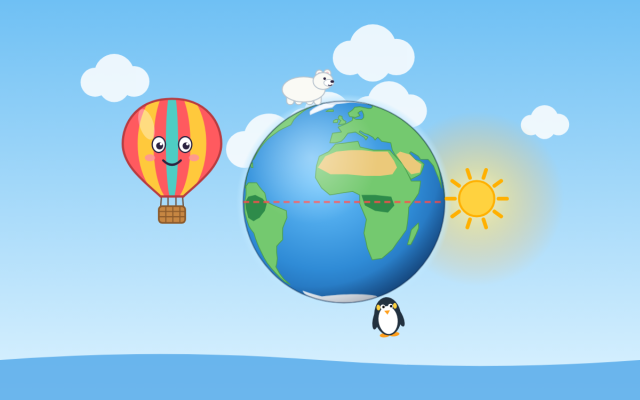
Climate Zones and Biomes is an interactive geography game that teaches children aged 8–11 the world's climate zones, biomes and vegetation belts, following the KS2 Geography curriculum. Children travel with Skye, a balloon explorer, from the Equator to the North Pole and up Mount Kilimanjaro.
Along the way they find out that weather is what happens day to day, while climate is the usual weather of a place over many years. A sunlight experiment shows why the Equator is hottest: sunlight hits it straight on, so its heat is concentrated on a small area. They paint the tropical, temperate and polar zones onto a world map, grow biomes by choosing the temperature and rainfall, and put vegetation belts in order.
Every line is read aloud, and a final ten-question challenge, including typed answers, checks what they remember.
Questions and answers
What is a biome, in simple words?
A biome is a huge area of the world with a similar climate, plants and animals, such as a tropical rainforest, desert, savanna, taiga or tundra. Temperature and rainfall are the two main things that decide which biome forms in a place.
What are the world's main climate zones?
The three main climate zones taught at primary school are tropical, temperate and polar. The tropical zone around the Equator is hot all year, the temperate zones are mild with four seasons, and the polar zones near the North and South Poles are freezing.
Why is it hotter at the Equator than at the poles?
It is hotter at the Equator because sunlight hits it straight on, so its heat is concentrated on a small area. Near the poles, sunlight arrives at a slant and spreads over a larger area, so it heats the ground less. Being closer to the Sun is not the reason.
What age is this climate zones and biomes game for?
The game is designed for children aged 8 to 11 and is pitched at Year 5, when climate zones, biomes and vegetation belts are usually taught in KS2 Geography. Younger children can enjoy it with a grown-up, because every line is read aloud.
What does the game include and how long does it take?
The game has five chapters and a ten-question final challenge, and takes about 45 minutes to play in full. Chapters cover weather and climate, climate zones, biomes, vegetation belts and mountain vegetation belts, and children can play them in any order.
Can we count your visit? We'd like to use one cookie, only on this site, to see how families find and use TapLearn, so we can make it better. No adverts, and nothing is shared. How we measure
Create a free family account and your child can play every chapter of every game for 7 days, with no card needed. Their progress is kept. After that, the free plan is free for ever, and membership is £6.99 a month if you'd like to keep every chapter.


 TapLearn