What you'll learn
- What a translation is and how it slides a shape without turning it
- How to give the new coordinates of a corner after a translation
- How to describe a translation by following one corner, not the gap
- How to reflect a shape in a vertical or horizontal mirror line
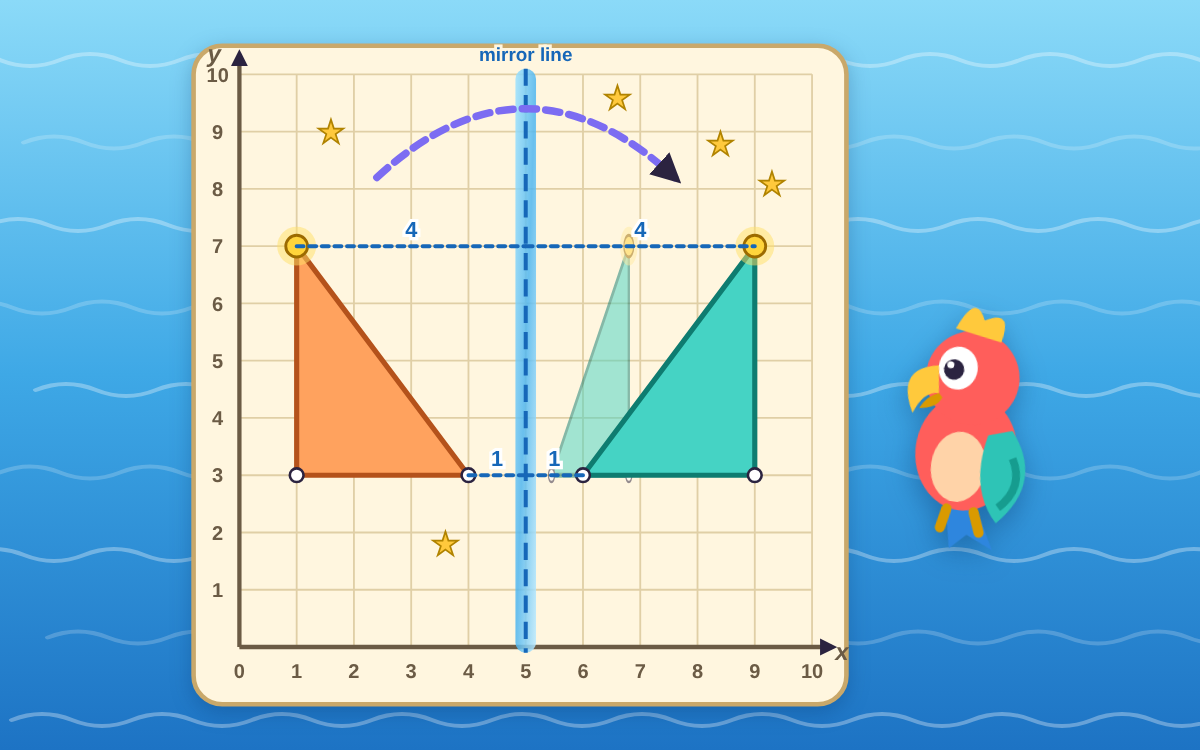
- Why each reflected corner is the same distance from the mirror line
- How to tell reflections from translations, and why the shape stays the same
Chapter by chapter
- Translation: sliding a shape left, right, up and down Free to try
Year 5 maths · 1
- Describing a translation: how many squares left, right, up or down
Year 5 maths · 1
- Reflection in a vertical mirror line
Year 5 maths · 1
- Reflection in a horizontal mirror line, with coordinates
Year 5 maths · 1
- Reflection or translation? The shape has not changed
Year 5 maths · 1
- Grand Island Challenge (10 questions) (10 questions)
What the chapters cover in the national curriculum in England:
- Year 5 maths: Identify, describe and represent the position of a shape following a reflection or translation, using the appropriate language, and know that the shape has not changed
About this adventure
Grid Island: Flip and Slide is an interactive maths game that teaches children aged 9–11 reflection and translation on a coordinate grid, matching the Year 5 position and direction curriculum in England. Pip the parrot reads every step aloud, with captions.
Players slide a raft across the grid and see that a translation moves every corner the same distance in the same direction. They describe moves such as 3 squares left and 4 squares up by following one corner, not by counting the gap between shapes.
At Mirror Lagoon they reflect shapes in vertical and horizontal mirror lines, keeping each corner the same distance from the line, and work out the new coordinates. Finally they decide whether shapes were reflected or translated. Then they measure the sides to show the shape is congruent: the same shape and the same size.
Questions and answers
What is a translation in maths?
A translation slides a shape to a new position without turning, flipping or resizing it. You describe it by how many squares it moves left or right and up or down, for example 5 squares right and 2 squares up.
How do you reflect a shape in a mirror line?
You reflect a shape one corner at a time. Count how far each corner is from the mirror line, count the same distance on the other side, then join the new corners. Any corner on the mirror line stays where it is.
What is the difference between a reflection and a translation?
A translation slides a shape so it still faces the same way, while a reflection flips it over a mirror line so it faces the other way. In both cases the shape keeps exactly the same size and shape.
What age is this reflection and translation game for?
The game is for children aged 9 to 11 and matches the Year 5 position and direction objective in England's maths curriculum. It also works as revision in Year 6, and every line is read aloud with captions for less confident readers.
What does the reflection and translation game include and how long does it take?
It includes a coordinates warm-up, five chapters with animated introductions and hands-on practice, and a 10-question Grand Island Challenge. Playing everything takes about 45 minutes, and children can start any chapter from the island map.

 TapLearn