Converting Metric Units: An Island Trek with Milli
Learn how converting metric units works for km, m, cm, mm, g, kg, l and ml, then solve measure, money and recipe-scaling problems with Milli.
- Ages 8–11
- About 80 min
- Some thinking
- Shapes & Measures
Learn how converting metric units works for km, m, cm, mm, g, kg, l and ml, then solve measure, money and recipe-scaling problems with Milli.
Year 5 maths · 1
Year 5 maths · 1
Year 5 maths · 1
Year 5 maths · 1
Year 5 maths · 2 Year 5 maths · 1
Year 5 maths · 2 Year 5 maths · 1
What the chapters cover in the national curriculum in England:
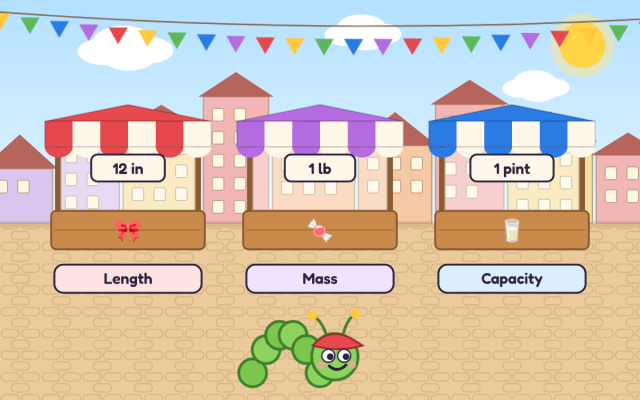
Converting Metric Units is an interactive maths game that teaches children aged 8–11 to convert between kilometres and metres, metres, centimetres and millimetres, grams and kilograms, and litres and millilitres. It follows the Year 5 maths curriculum in England, and Milli the meerkat reads every step aloud with captions.
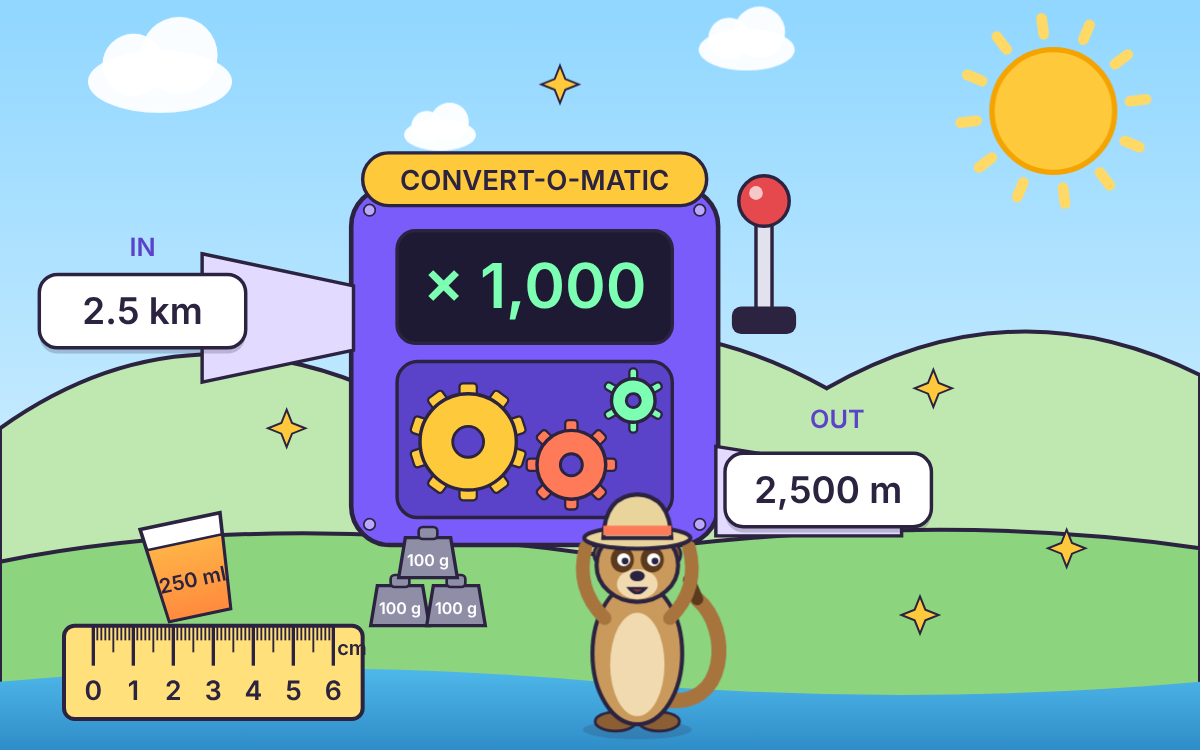
Children build each unit for themselves. They walk a 1 km trail in 100 m steps, zoom into a ruler to count millimetres, load 100 g weights onto a scale and pour cups into a litre jug. A conversion machine asks whether to multiply or divide, and a place value chart shows the digits sliding while the decimal point stays still.
Next, children solve measure and money problems with decimals by changing to the same unit and lining up the decimal points. They also scale recipes up and down. A 10-question summit challenge ends the game.
To convert kilometres to metres, multiply by 1,000, because 1 kilometre is 1,000 metres. So 3 km is 3,000 m and 2.5 km is 2,500 m. To change metres back into kilometres, divide by 1,000, so 4,000 m is 4 km.
There are 10 millimetres in 1 centimetre and 1,000 millimetres in 1 metre. A metre is 100 centimetres and each centimetre holds 10 millimetres, so 100 × 10 = 1,000.
Multiply when you change to a smaller unit and divide when you change to a bigger unit. You need more of a smaller unit to make the same amount, so 2 kg becomes 2,000 g, while 750 ml becomes 0.75 l.
The game is for children aged 8 to 11 and is pitched at Year 5 maths in England, where children learn to convert metric units. Every line is read aloud with captions, so less confident readers can follow along.
The game has six chapters, each with an animated introduction, hands-on activities, typed practice and a three-question check. It also has a 10-question summit challenge and an optional warm-up on multiplying and dividing by 10, 100 and 1,000. Playing everything takes about 80 minutes.

 TapLearn
Getting it ready…
Great work on chapter 1! To open the next chapters, ask a grown-up to take a look.
To play this game, ask a grown-up to take a look. There are lots of free games you can play right now too!
Create a free family account and your child can play every chapter of every game for 7 days, with no card needed. Their progress is kept. After that, the free plan is free for ever, and membership is £6.99 a month if you'd like to keep every chapter.
That's all the learning time for today. Great work! Flip will be ready to play again tomorrow.