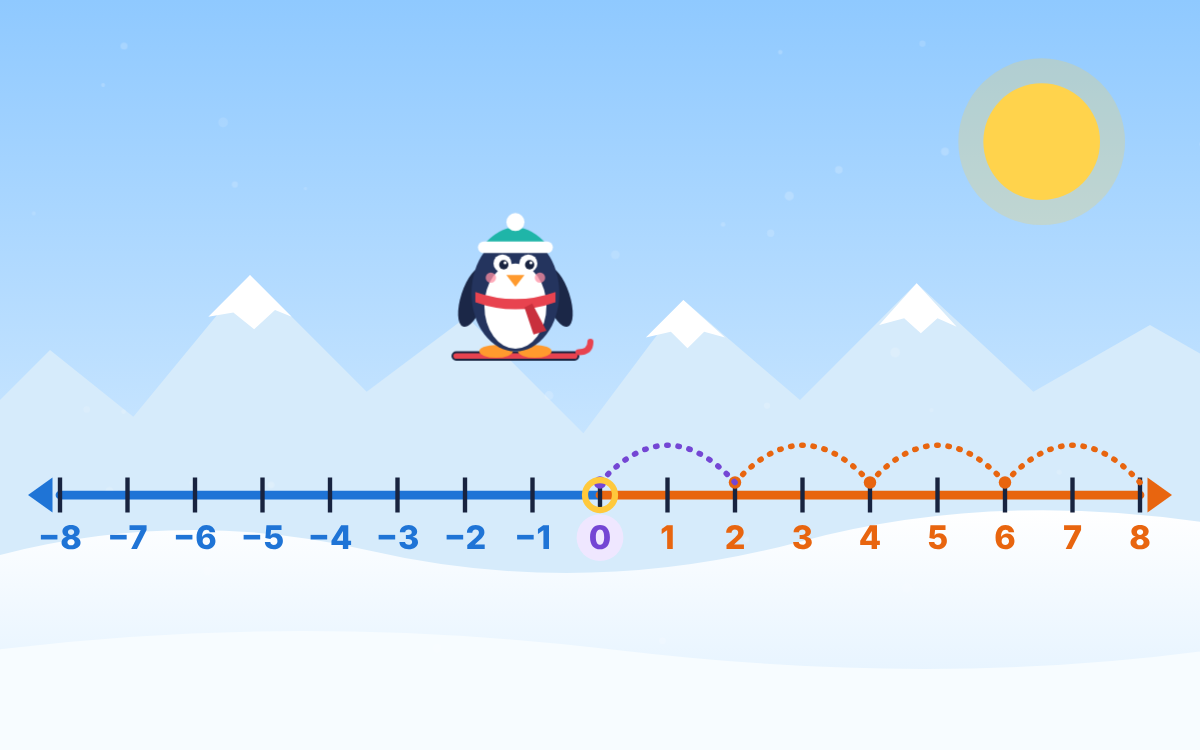
What you'll learn
- What a negative number is and how the minus sign shows it
- Where negative numbers sit on horizontal and vertical number lines
- How to read a thermometer showing temperatures below 0°C
- Why −8°C is colder than −3°C
- How to count forwards and backwards in ones through zero
- How to count in 2s, 5s and 10s past zero
Chapter by chapter
- Negative numbers: numbers below zero on a number line Free to try
Year 5 maths · 1
- Negative numbers in context: temperatures, lifts and sea level
Year 5 maths · 1
- Counting forwards and backwards through zero
Year 5 maths · 1
- Counting in steps through zero: 2s, 5s and 10s
Year 5 maths · 1
- Final challenge: negative numbers (10 questions)
What the chapters cover in the national curriculum in England:
- Year 5 maths: Interpret negative numbers in context, count forwards and backwards with positive and negative whole numbers, including through 0
About this adventure
Negative Numbers is an interactive maths game that teaches children aged 8–10 what negative numbers are, how to use them in real life and how to count forwards and backwards through zero. It follows the Year 5 maths curriculum for England.
Children join Pip the penguin to hop past zero on a number line, drag a thermometer down to −5°C, compare which snowy place is colder and ride a lift down to floor −2 in an underground car park. Along the way they learn that a negative number is less than zero and is written with a minus sign, and that zero itself is neither positive nor negative.
Every instruction is read aloud. Children answer by tapping, choosing or typing on a keypad with a minus key, and gentle hints help with common slips such as skipping zero or forgetting the minus sign.
Questions and answers
What are negative numbers, in simple words?
Negative numbers are numbers less than zero, written with a minus sign, like −3. On a number line they sit on the other side of zero from the positive numbers, so −3 is three steps from zero, just as 3 is.
Is −8 bigger or smaller than −3?
−8 is smaller than −3 because it is further below zero. On a thermometer, −8°C is colder than −3°C, even though the digit 8 is bigger than 3, which is a mix-up many children make.
How do you count backwards through zero?
Count back one step at a time and say zero on the way: 3, 2, 1, 0, −1, −2. A common mistake is jumping straight from 1 to −1, so remember that zero is a step too.
What age is this negative numbers game for?
It is made for children aged 8 to 10 and matches Year 5 of the national curriculum in England for KS2 maths. Children who met counting back past zero in Year 4 can also use it for practice.
What does the negative numbers game include and how long does it take?
It has four short chapters and a 10-question final challenge, taking about 40 minutes in total. Children tap number lines, drag a thermometer, ride a lift and type answers, with every instruction read aloud.
More to explore
See all
Subitising to 5: Spot It Quick with Dotty the Ladybird
Learn subitising to 5: seeing how many there are without counting. Spot dot patterns, dice, fingers and tens…
Odd and Even Numbers: Pair Up Puffins with Pip
Learn to spot odd and even numbers using pairs, the 2 times table and the ones digit, by pairing puffins in b…
Counting to 20 and Beyond: Hop the Lily Pond with Pip
Learn counting to 20 and beyond, past 10 and on to 30, by tapping lily pads as Pip the frog hops along and ch…
Roman Numerals to 1,000: A Roma Town Quest with Octavia
Learn to read Roman numerals to 1,000 and recognise years like MMXXVI by splitting numerals into chunks and s…
Factors, Multiples and Primes: A Number Isle Adventure
Learn to find common factors, common multiples and prime numbers by planting flower beds, timing lighthouse f…
Numbers to 20: Count, Read and Compare with Dotty
Learn to read, write and compare numbers to 20 by counting apples, filling ten frames, hopping a frog along a…
Place Value to 10 Million: A Space Mission with Digi
Learn place value to 10 million: read, write, compare and order big numbers by building millions on a chart a…
 TapLearn