What you'll learn
- Name the pivot, load and effort on any lever
- Pushing further from the pivot needs a smaller force
- A single fixed pulley changes the direction of a pull
- More ropes holding a load means a smaller pull
- Meshing gears turn in opposite directions
- A small gear turning a big gear gives more turning force
Chapter by chapter
- Levers: the pivot, the load and the effort Free to try
Year 5 science · 1
- Levers: how a lever lets a smaller force lift a heavy load
Year 5 science · 1
- Pulleys: a single fixed pulley changes the direction of a pull
Year 5 science · 1
- Pulley systems: more pulleys and ropes for a smaller pull
Year 5 science · 1
- Gears: how toothed wheels change speed, turning force and direction
Year 5 science · 1
- Levers, pulleys and gears in everyday machines
Year 5 science · 1
- Grand Mechanism Challenge (10 questions)
What the chapters cover in the national curriculum in England:
- Year 5 science: Recognise that some mechanisms including levers, pulleys and gears allow a smaller force to have a greater effect
About this adventure
Levers, Pulleys and Gears is an interactive science game that teaches children aged 8–11 how these simple machines let a smaller force have a greater effect. It follows the Year 5 Forces objective in the national curriculum for England.
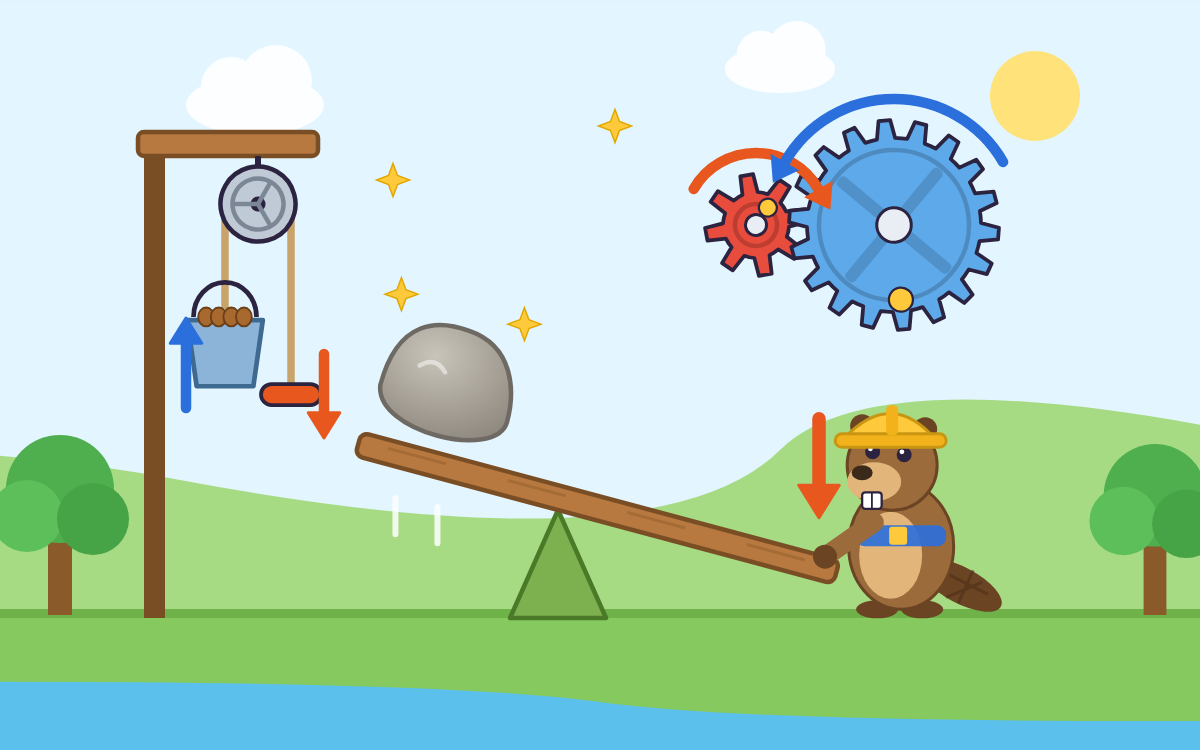
Players help Bolt the beaver at Beaver Bay Works. They slide a plank under a boulder and find the pivot, load and effort on levers. They read a forcemeter in newtons to see the push shrink as they press further from the pivot. They thread ropes over pulley wheels, count the ropes that hold up a crate, and turn meshing gears to compare their speed and turning force.
Each chapter has a short animated introduction, spoken narration and a quick check. Gentle hints point out common mix-ups, such as thinking one fixed pulley halves the pull.
Questions and answers
How do levers, pulleys and gears make work easier?
Levers, pulleys and gears let a smaller force have a greater effect. The catch is distance: you push or pull further, or turn more times, so a small effort can still move a heavy load.
What are the pivot, load and effort on a lever?
The pivot is the fixed point a lever turns on, the load is the object being moved and the effort is your push or pull. Pushing further from the pivot, or moving the pivot closer to the load, makes the effort smaller.
Does a single pulley make lifting easier?
A single fixed pulley does not make the pull smaller, but it changes its direction, so pulling down lifts the load up. To need a smaller pull, you add pulleys so that more ropes share the load's weight.
What age is this levers, pulleys and gears game for?
It is designed for children aged 8 to 11 and matches Year 5 science in the national curriculum for England. Spoken narration and step-by-step instructions help younger or less confident readers.
What does the game include and how long does it take?
The game has six chapters, two optional refreshers on forces and turning, and a 10-question Grand Mechanism Challenge. Playing everything takes about 50 minutes, and each chapter can be played on its own.


 TapLearn