What's new this year
The national curriculum expects children to recall all multiplication and division facts up to 12 × 12 by the end of Year 4. In June they take the multiplication tables check:
- Schools can use a "try it out" version from 26 April 2027.
- The check window is Monday 7 to Friday 18 June 2027, with a catch-up week after it.
- It's on screen: 25 timed questions on tables up to 12 × 12, and it takes only a few minutes.
- There's no pass mark, and results aren't published school by school. Your child's school must tell you their score by the end of the summer term.
Our multiplication tables check guide explains it in full.
Maths in Year 4
- Times tables to 12 × 12, and short multiplication of two- and three-digit numbers by a one-digit number.
- Place value in four-digit numbers, rounding to the nearest 10, 100 and 1,000, negative numbers and Roman numerals to 100.
- Decimals: tenths and hundredths, decimal equivalents of a quarter, a half and three quarters, and dividing by 10 and 100.
- Equivalent fractions, and adding and subtracting fractions with the same denominator.
- Area by counting squares, perimeter, converting units and between 12- and 24-hour time.
- Acute and obtuse angles, lines of symmetry, coordinates, and bar charts and time graphs.
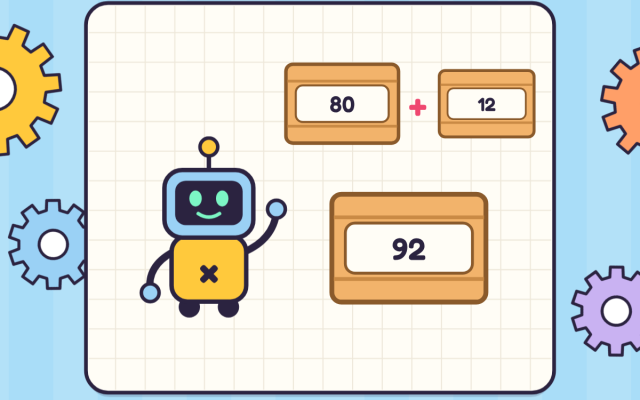
Short Multiplication: Run the Times Factory with Bolt
Learn short multiplication, the distributive law, scaling and combination problems by helping Bolt the robot…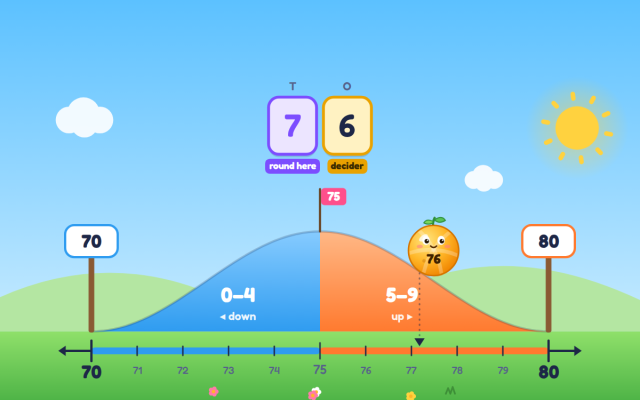
Rounding Numbers: A Hill-Rolling Adventure with Pip
Learn how rounding numbers works for 10, 100, 1,000 and decimals, then build number-line hills, roll Pip and…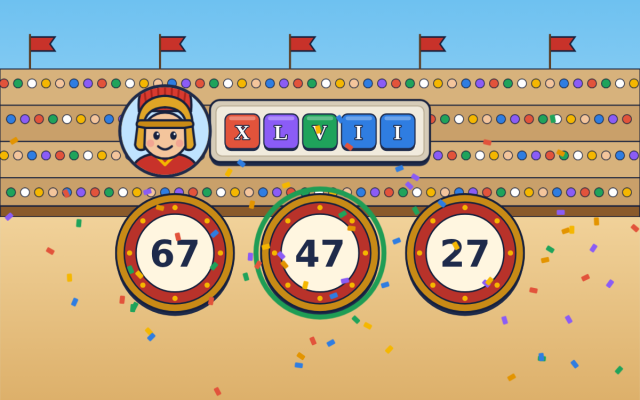
Roman Numerals: A Quest Through Ancient Rome with Cato
Learn to read Roman numerals from I to C by counting apples, calling up Roman soldiers, opening Colosseum gat…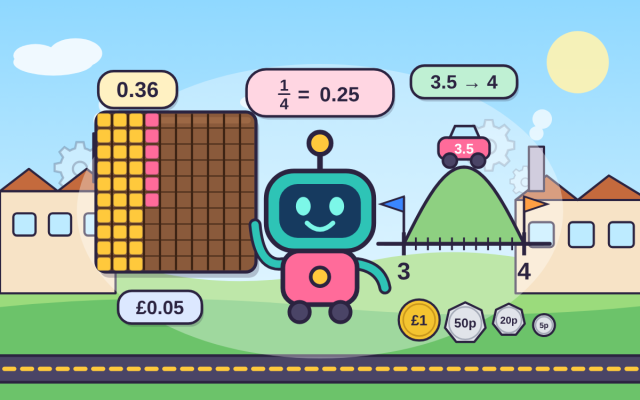
Year 4 Decimals: Chop, Count and Shop with Dot the Robot
Learn Year 4 decimals: tenths, hundredths, rounding and comparing. Chop a chocolate slab, roll cars down Roun…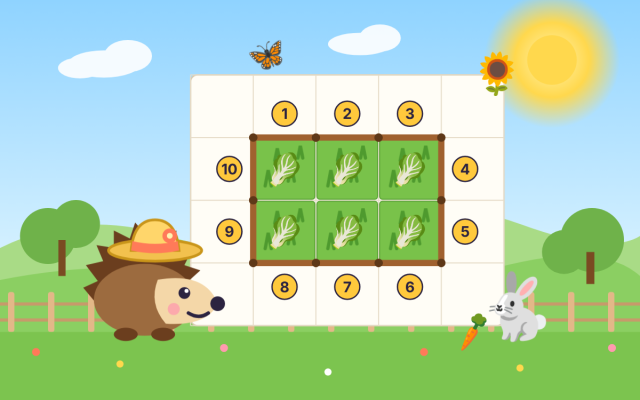
Area and Perimeter: Plan a Garden with Hattie the Hedgehog
Learn area and perimeter by counting squares and adding sides in cm and m. Lay turf, build fences and measure…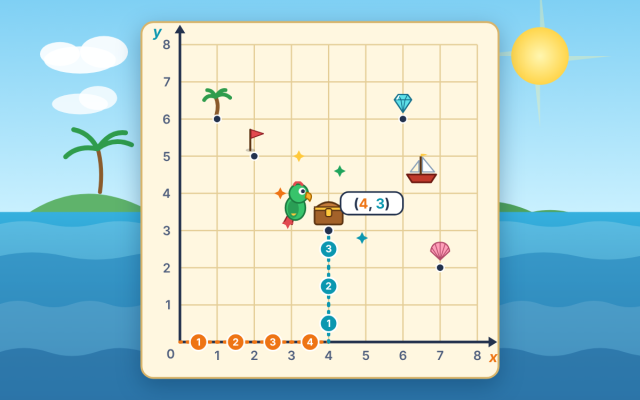
Coordinates: A Treasure Map Adventure with Pip the Parrot
Learn to read and plot coordinates, describe moves left, right, up and down, and complete shapes while sailin…Coming soon: vote for the games you'd like first
- Times tables (Year 4)Not made yet
- Telling the time (Year 4)Not made yet
- Times tables (Year 3)Being made now
English in Year 4
- Reading: inferring what characters think, summarising the main ideas of a passage, and performing poems.
- Grammar: fronted adverbials with a comma ("Later that day, ..."), determiners, and choosing nouns or pronouns so writing is clear.
- Standard English: "we were" rather than "we was", and "I did" rather than "I done".
- Punctuation: apostrophes for plural possession (the girls' coats) and full punctuation of speech.
- Spelling: the rest of the Year 3 and 4 word list, homophones and more prefixes and suffixes.

Year 3 and 4 Spelling Words: A Space Mission with Nova
Learn the Year 3 and 4 spelling words with a memory trick for each, then fly a rocket round nine planets of w…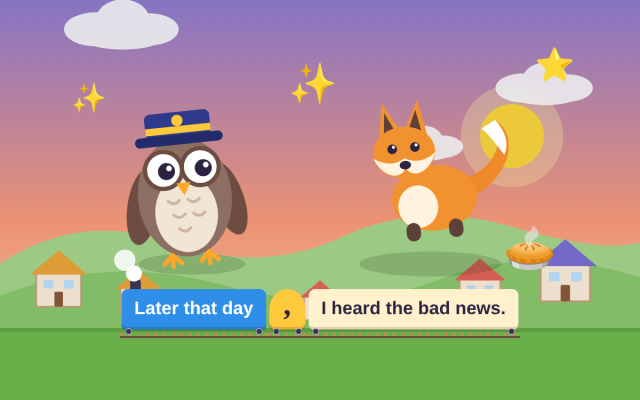
Fronted Adverbials: All Aboard the Sentence Train
Learn how to start sentences with fronted adverbials that say when, where or how, then build sentence trains…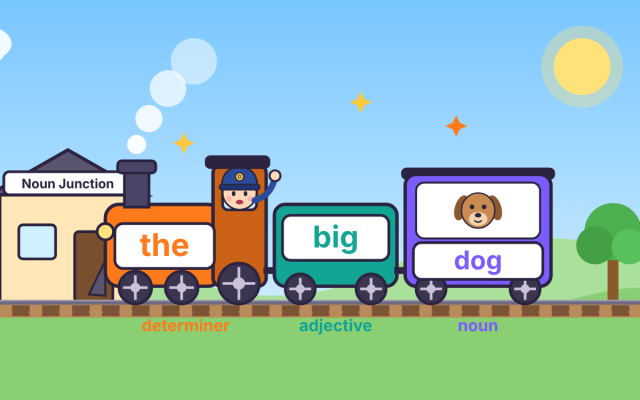
Determiners for Year 4: Ride the Determiner Express
Learn what determiners are, from a, an and the to my, some and every, by building word trains and spotting de…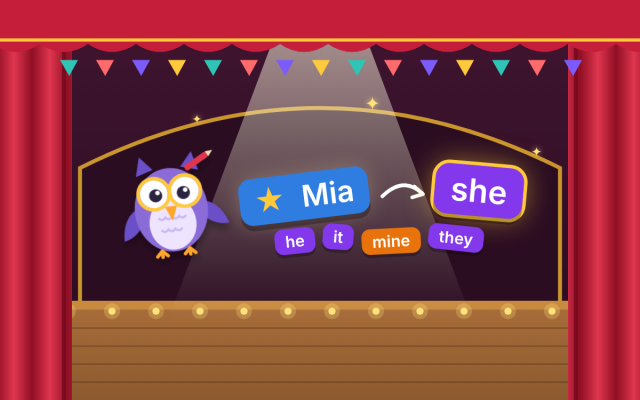
Pronouns for Kids: Clear Writing Adventure in Pronoun Town
Learn when to use a noun or a pronoun, including possessive pronouns like mine and theirs, by fixing echoes,…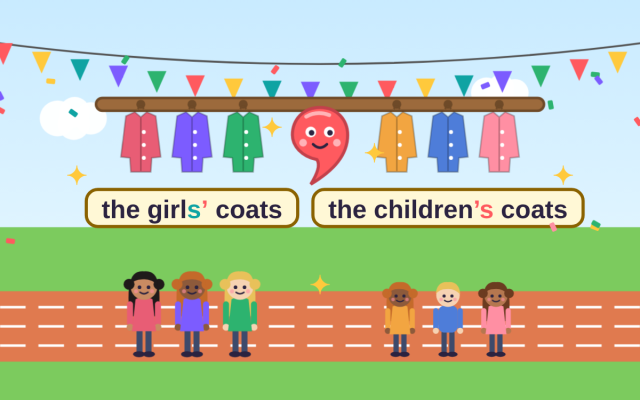
Possessive Apostrophes: Fix the Signs in Apostrophe Town
Learn possessive apostrophes for one owner and many, like the girls’ coats and the children’s coats, by label…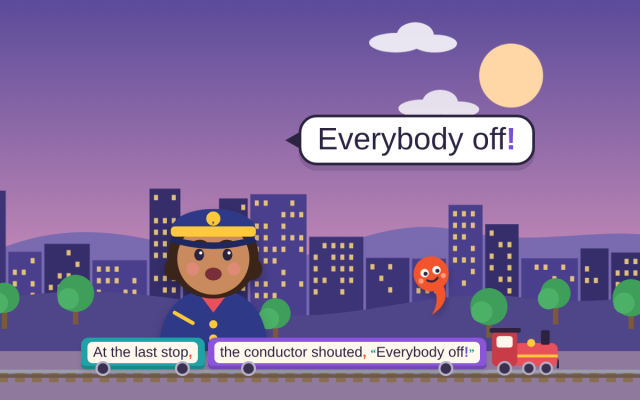
Commas and Speech Punctuation: All Aboard the Comma Express
Learn commas and speech punctuation for Year 4: commas after fronted adverbials and inverted commas, by punct…Science and other subjects
Year 4 science covers grouping living things and how environments change, the digestive system, teeth and food chains, solids, liquids and gases (including the water cycle), sound, and simple electrical circuits. History and geography topics vary, for example the Romans in Britain or rivers and settlements.
This year's topics, subject by subject
The roadmaps below show the order in which topics usually build up through Year 4, subject by subject. Schools teach in different orders, so treat them as a guide to what's coming rather than a timetable.
Maths 23 topics, 10 coming soon
- Place value (Year 4) coming soon
- Roman numerals (Year 4)
- Rounding (Year 4)
- Negative numbers (Year 4)
- Adding and subtracting (Year 4)
- Two-step word problems (Year 4) coming soon
- Times tables (Year 4) coming soon
- Mental maths strategies (Year 4) coming soon
- Written multiplication (Year 4)
- Word problems: multiplication and division (Year 4) coming soon
- Fractions (Year 4) coming soon
- Decimals (Year 4)
- Dividing by 10 and 100 (Year 4) coming soon
- Word problems: fractions and decimals (Year 4) coming soon
- Measuring (Year 4)
- Area and perimeter (Year 4)
- Telling the time (Year 4) coming soon
- Word problems: measures and time (Year 4) coming soon
- Angles (Year 4)
- Properties of shapes (Year 4)
- Symmetry (Year 4)
- Charts and graphs (Year 4)
- Coordinates (Year 4)
English 42 topics, 29 coming soon
- Joined handwriting (Years 3–4)
- Spelling patterns (Years 3–4)
- Sounds spelt ou, ei, eigh and ey (Years 3–4) coming soon
- Words from Greek, French and Latin: ch, gue, que and sc (Years 3–4) coming soon
- Prefixes and suffixes (Years 3–4)
- Homophones (Years 3–4) coming soon
- Statutory spelling words (Years 3–4)
- Must-know spellings (Year 4) coming soon
- Using a dictionary (Years 3–4) coming soon
- Must-know vocabulary (Year 4) coming soon
- Determiners (Year 4)
- Longer noun phrases (Year 4)
- Pronouns (Year 4)
- Standard English (Year 4) coming soon
- Apostrophes (Year 4)
- Dictation: listen and write (Years 3–4) coming soon
- Writing great sentences (Year 4) coming soon
- Finding information: retrieval (Years 3–4) coming soon
- Words in context (Years 3–4) coming soon
- Predicting from clues in the text (KS2) coming soon
- Reading detective: inference coming soon
- Summarising (Years 3–4) coming soon
- How texts are built (Years 3–4) coming soon
- Myths and legends coming soon
- Speaking with confidence
- Thinking like a writer (Year 4) coming soon
- Fronted adverbials
- Writing paragraphs (Year 4) coming soon
- Writing stories (Year 4) coming soon
- Punctuating speech (Year 4)
- Write your own story (Years 3–4) coming soon
- Performing and acting coming soon
- Writing a playscript (KS2) coming soon
- Diaries and recounts (Years 3–4) coming soon
- Writing a report (Years 3–4) coming soon
- Explanation texts (Years 3–4) coming soon
- Writing clear instructions (Years 3–4)
- Letters and emails (Years 3–4)
- Poetic tricks (Years 3–4) coming soon
- Write a poem coming soon
- Editing your writing (Years 3–4) coming soon
- Making your writing amazing (Year 4) coming soon
Science 24 topics, 16 coming soon
- Asking questions and fair tests (Years 3–4) coming soon
- Recording results: tables and bar charts (Years 3–4) coming soon
- Classifying living things (Year 4)
- Birds around us coming soon
- Bees and pollinators coming soon
- Ocean life coming soon
- Changing environments coming soon
- Endangered animals coming soon
- Dinosaurs coming soon
- Teeth coming soon
- The digestive system
- Food chains (Year 4)
- Solids, liquids and gases
- Melting, freezing and evaporating
- Floating and sinking coming soon
- How sound travels
- Pitch and volume (Year 4)
- Simple circuits coming soon
- Conductors and insulators
- Staying safe with electricity coming soon
- Stars and constellations coming soon
- How rockets work coming soon
- Life on the space station coming soon
- Exploring Mars coming soon
History 8 topics, 5 coming soon
- Ancient Greece
- Greek gods and myths coming soon
- The Roman Empire and its impact on Britain
- Anglo-Saxons and Scots coming soon
- The printing press coming soon
- Ada Lovelace coming soon
- From telephone to smartphone coming soon
- How computers changed
Earth & Geography 8 topics, 6 coming soon
- Grid references coming soon
- The water cycle coming soon
- Clouds coming soon
- Rivers from source to sea
- Coasts (KS2) coming soon
- Water: from cloud to tap
- Fieldwork coming soon
- Region study: a part of the UK (KS2) coming soon
Technology 8 topics, 7 coming soon
- Staying safe online: the basics (Years 3–4) coming soon
- How the internet works coming soon
- Frame and shell structures (KS2) coming soon
- How bridges stand up coming soon
- If and else
- Moving mechanisms in products coming soon
- How clocks work coming soon
- Collecting and presenting data (KS2) coming soon
Schools teach topics in different orders, so use this as a guide. Open the roadmaps, pick the school year, and follow the steps.
How you can help at home
- Little and often works for tables: five minutes a few times a week beats an hour on Sunday. See our times tables guide.
- Use fact families: if 7 × 8 = 56, then 56 ÷ 8 = 7.
- Spot decimals in prices and on the kitchen scales.
- When you read together, ask "How do you know?" to build inference.
- Keep it calm. A relaxed child recalls facts faster than a worried one.
 TapLearn