Why maths can look different from when you were at school
Many parents remember learning a method first and only later, if ever, finding out why it worked. Most primary schools now do it the other way round. Your child first learns why a method works, using objects and pictures, and then moves on to the quick written version. Many of the methods you learned are still taught, including column addition, but they tend to come a little later, once the understanding is in place.
The national curriculum in England says what children should learn in each year and which formal written methods they should use by when. It doesn't set out every step on the way, so each school writes a calculation policy. This shows the methods and the words it uses, year by year. It's often on the school website, and if it isn't, the school office or class teacher can usually share it.
Concrete, pictorial, abstract
You may hear this called "CPA". It means children meet a new idea in three ways:
- Concrete: real things to move around, such as counters, cubes, or the rods and squares called base 10 blocks.
- Pictorial: drawings of those things, ten frames, number lines and bar models.
- Abstract: digits and symbols, such as 34 + 25 = 59.
Children don't climb this ladder once and leave it behind. Even older children go back to objects and pictures when they start something new, such as fractions.
Number bonds and part-whole models
Number bonds are pairs of numbers that make a total, such as 7 + 3 = 10 or 12 + 8 = 20. By the end of Year 2, children should know the number bonds to 20. Number bonds make mental maths quicker. For example, to add 8 + 5, a child can make 10 first: 8 + 2 = 10, then add the 3 that's left to get 13.
A part-whole model is a picture of a number bond. It has one circle for the whole (10) joined to two circles for the parts (7 and 3). From that one picture a child can read four facts: 7 + 3 = 10, 3 + 7 = 10, 10 − 7 = 3 and 10 − 3 = 7. Later, the bar model does the same job with rectangles and helps children work out what a word problem is asking.
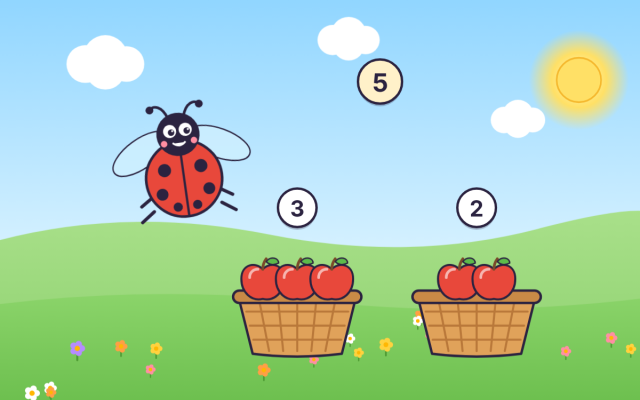
Number Bonds to 10: Split and Build with Dotty the Ladybird
Learn number bonds to 10 by building and splitting groups of apples, fingers, ten frames and part-whole pictu…
Number Bonds to 20: A Ladybird Meadow Maths Game
Learn number bonds to 20 and the subtraction facts that go with them, by flipping counters, balancing scales…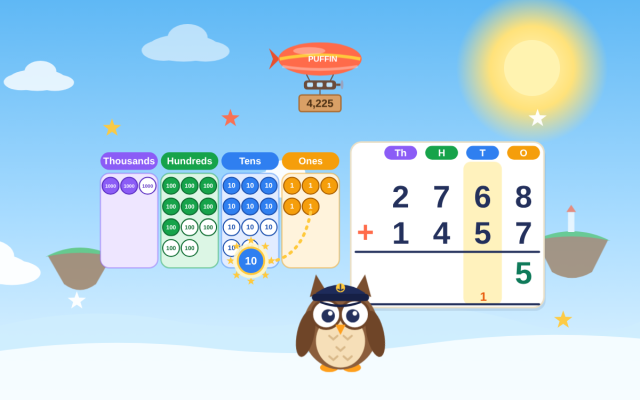
Column Addition and Subtraction: A Sky Harbour Adventure
Learn column addition and subtraction with up to 4 digits, exchanging, estimating and checking, by helping To…Column addition and subtraction
Children start using formal column methods in Year 3, with numbers up to three digits, and move on to four digits in Year 4. The digits are lined up in ones, tens and hundreds, and children start with the ones column on the right.
You may notice your child says "exchange" where you might say "carry" or "borrow". In 52 − 17, you can't take 7 ones from 2 ones, so you exchange one ten for ten ones. That leaves 4 tens and 12 ones. Then 12 − 7 = 5 and 4 tens − 1 ten = 3 tens, so the answer is 35. The word "exchange" describes what really happens to the number.
Multiplication and division methods
The grid method
Many schools use the grid method as a stepping stone, though the curriculum doesn't require it. To work out 34 × 6, your child splits 34 into 30 and 4. Then 30 × 6 = 180 and 4 × 6 = 24, and 180 + 24 = 204. It shows clearly why the answer is what it is.
Short and long multiplication
In Year 4, children learn the formal written layout for multiplying a two- or three-digit number by a one-digit number, often called short multiplication. Long multiplication, for multiplying by a two-digit number, comes in Years 5 and 6.
Short division: the "bus stop" method
It's called the bus stop because the bracket looks like a bus shelter with the number waiting under it. Children use it in Year 5 to divide by a one-digit number. In Year 6 they learn long division as well. Here is 96 ÷ 4 in words:
- Write 96 under the shelter and 4 outside it, on the left.
- How many 4s go into 9? Two, which makes 8, with 1 left over. Write 2 on the roof, above the 9.
- Carry the 1 over to sit in front of the 6, which makes 16.
- How many 4s go into 16? Four. Write 4 on the roof, above the 6.
- The answer is 24. Check it: 24 × 4 = 96.
Quick recall of times tables makes every one of these methods easier.
Short Multiplication: Run the Times Factory with Bolt
Learn short multiplication, the distributive law, scaling and combination problems by helping Bolt the robot…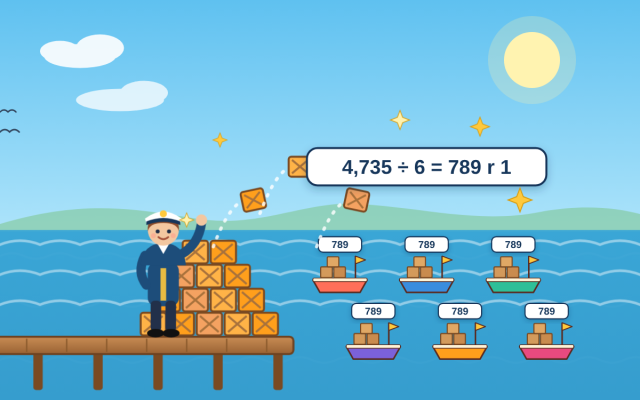
Year 5 Multiplication and Division: Harbour of Numbers
Learn Year 5 multiplication and division: long multiplication, short division and remainders, by loading boat…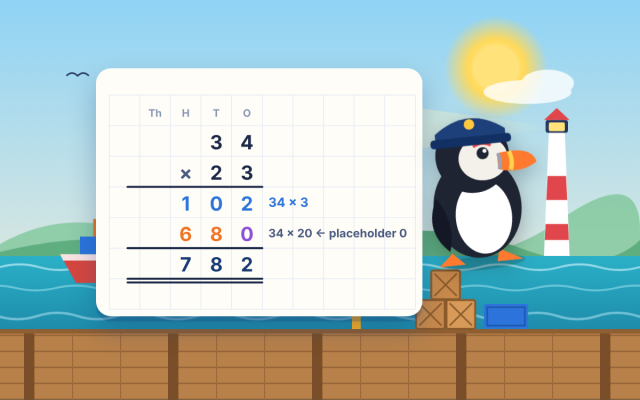
Long Multiplication and Division: A Puffin Harbour Job
Learn long multiplication and long and short division by two-digit numbers, then help Pip the puffin pack cra…How to help without confusing your child
- Ask for the calculation policy, and use the same words at home.
- Ask your child to teach you their method. Explaining it is good practice, and you'll find out what they've been taught.
- Hold back on "my way" until they're confident. Two methods at once can muddle a child who is still learning. Once they're secure, comparing methods can be interesting.
- Use objects and drawings. Coins, pasta and quick sketches all count as "concrete" and "pictorial" at home.
- Talk to the class teacher if homework uses a method you don't recognise. Most teachers are happy to explain.
 TapLearn