What you'll learn
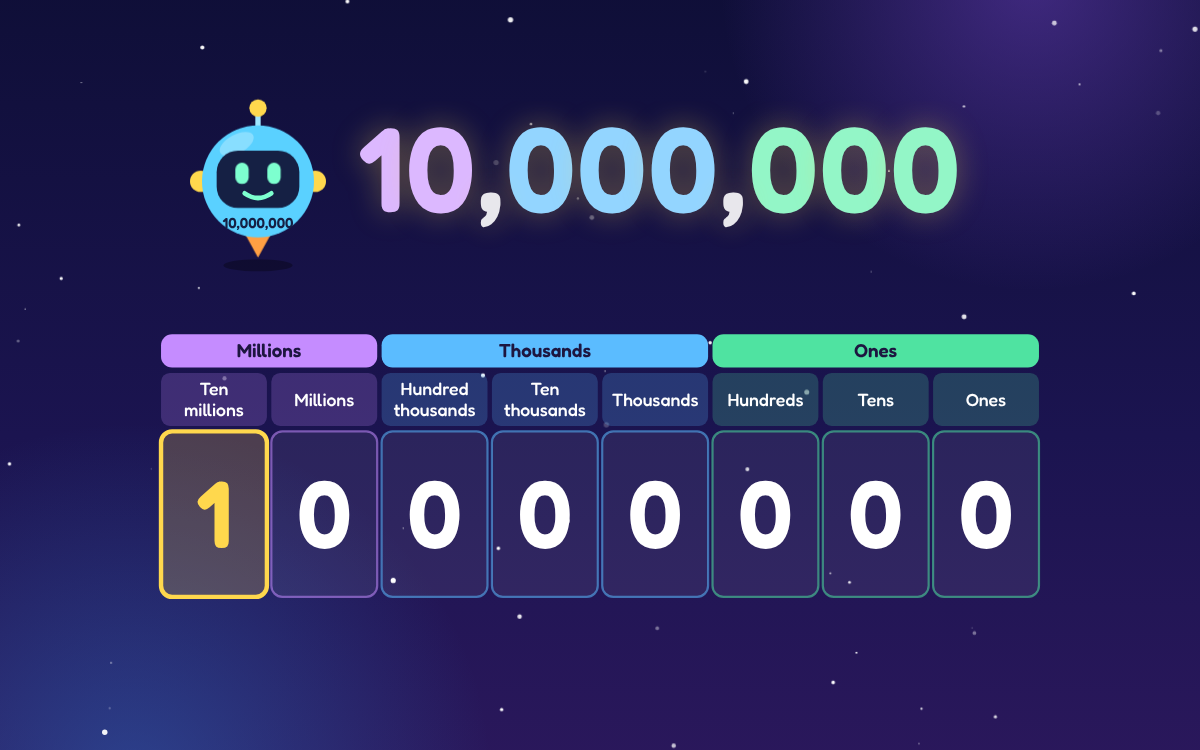
- Find the value of each digit in numbers up to 10,000,000
- Read and write seven-digit numbers in words and digits
- Use zero as a placeholder when a column is empty
- Compare numbers using the < and > signs
- Order large numbers in ascending and descending order
- Solve digit card puzzles and real-life place value problems
Chapter by chapter
- Millions on the chart: the value of each digit
Year 6 maths · 1
- Reading and writing numbers up to 10,000,000
Year 6 maths · 1
- Comparing and ordering numbers up to 10,000,000
Year 6 maths · 1
- Solving number problems with place value
Year 6 maths · 2
- Ten Million Challenge: mixed place value quiz (10 questions)
What the chapters cover in the national curriculum in England:
- Year 6 maths: Read, write, order and compare numbers up to 10,000,000 and determine the value of each digit
- Year 6 maths: Solve number and practical problems that involve all of the above
About this adventure
Place Value to 10 Million is an interactive maths game that teaches children aged 9–11 to read, write, compare and order numbers up to 10,000,000 and find the value of each digit. It follows the Year 6 national curriculum in England and ends with a 10-question challenge.
Guided by Digi the robot, players swap ten hundred-thousand counters for one million on a place value chart, tap where the commas go, and type the value of a glowing digit. They learn that each column is worth ten times the column on its right, and that a zero is a placeholder that keeps empty columns in their place.
Later they compare numbers by scanning from the left, choose the < and > signs, place numbers on a 0 to 10 million number line, and use digit cards and clues to solve puzzles, including real UK population figures.
Questions and answers
What does place value mean?
Place value means a digit's value depends on the column it sits in. In 4,739,152 the 7 is in the hundred thousands column, so it is worth 700,000, not 7.
How do you read a number like 7,254,813?
Split the digits into groups of three from the right, then read each group with its name. 7,254,813 is read as seven million, two hundred and fifty-four thousand, eight hundred and thirteen.
How do you tell which of two large numbers is bigger?
First count the digits: the number with more digits is greater. If they have the same number of digits, compare from the left until two digits differ, and the bigger digit decides.
What age is this place value game for?
It is written for children aged 9 to 11 and matches the Year 6 place value objectives in England. Confident Year 5 pupils can use it to stretch their understanding of numbers beyond one million.
What is in the game and how long does it take?
The game has four chapters and a 10-question final challenge, taking about 45 minutes in total. Each chapter has an animated introduction and practice with typed answers, and players can stop and continue later.
More to explore
See all
Subitising to 5: Spot It Quick with Dotty the Ladybird
Learn subitising to 5: seeing how many there are without counting. Spot dot patterns, dice, fingers and tens…
Odd and Even Numbers: Pair Up Puffins with Pip
Learn to spot odd and even numbers using pairs, the 2 times table and the ones digit, by pairing puffins in b…
Counting to 20 and Beyond: Hop the Lily Pond with Pip
Learn counting to 20 and beyond, past 10 and on to 30, by tapping lily pads as Pip the frog hops along and ch…
Roman Numerals to 1,000: A Roma Town Quest with Octavia
Learn to read Roman numerals to 1,000 and recognise years like MMXXVI by splitting numerals into chunks and s…
Negative Numbers: Counting Below Zero with Pip the Penguin
Learn what negative numbers are, read temperatures below zero and count through zero, helping Pip the penguin…
Factors, Multiples and Primes: A Number Isle Adventure
Learn to find common factors, common multiples and prime numbers by planting flower beds, timing lighthouse f…
Numbers to 20: Count, Read and Compare with Dotty
Learn to read, write and compare numbers to 20 by counting apples, filling ten frames, hopping a frog along a…
 TapLearn