What you'll learn
- How to multiply two proper fractions by multiplying numerators and denominators
- Why multiplying by a proper fraction makes the answer smaller
- How to write an answer in its simplest form using a common factor
- Dividing a proper fraction by a whole number, like 1/3 ÷ 2
- That a fraction is a division, so 3/4 means 3 ÷ 4
- How to use short division to change 3/8 into 0.375
Chapter by chapter
- Multiplying fractions: finding a fraction of a fraction Free to try
Year 6 maths · 1
- Multiplying fractions and writing the answer in its simplest form
Year 6 maths · 1
- Dividing a proper fraction by a whole number
Year 6 maths · 2
- Fractions as division: 3/4 is the same as 3 ÷ 4
Year 6 maths · 3
- Fractions to decimals: dividing to find 3/8 = 0.375
Year 6 maths · 3
- Head Fudge-Maker Challenge (10 questions) (10 questions)
What the chapters cover in the national curriculum in England:
- Year 6 maths: Multiply simple pairs of proper fractions, writing the answer in its simplest form
- Year 6 maths: Divide proper fractions by whole numbers
- Year 6 maths: Associate a fraction with division and calculate decimal fraction equivalents for a simple fraction
About this adventure
Fraction Fudge Factory is an interactive maths game that teaches children aged 10–11 multiplying and dividing fractions, and how to change a fraction into a decimal, following the Year 6 curriculum in England. Fizz the robot reads every step aloud with captions.
Players cut slabs of fudge into columns and rows to see that 1/4 of 1/2 is 1/8, then discover the rule: multiply the numerators (top numbers) and multiply the denominators (bottom numbers). They simplify answers by dividing the top and bottom by a common factor, and slice fudge for robots to find that 1/3 ÷ 2 = 1/6.
Dealing fudge bars to robots shows that a fraction is a division, so 3/4 means 3 ÷ 4. Children then use short division to work out that 3/8 = 0.375, typing answers on a keypad and getting hints that match their mistake.
Questions and answers
How do you multiply two fractions?
Multiply the two numerators to get the new numerator, and multiply the two denominators to get the new denominator. For example, 2/3 × 4/5 = 8/15, and 1/4 × 1/2 = 1/8, which is smaller than both of the fractions you started with.
How do you divide a fraction by a whole number?
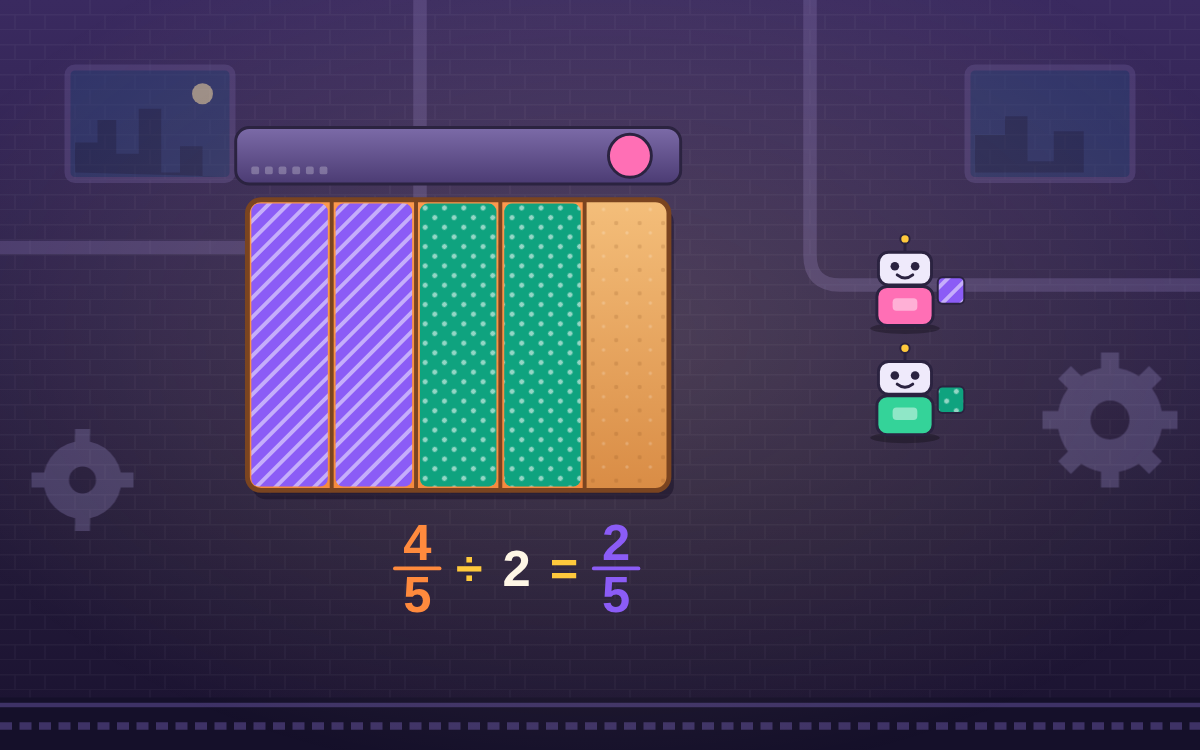
Keep the numerator and multiply the denominator by the whole number, because each piece is split into smaller equal parts. So 1/3 ÷ 2 = 1/6 and 3/4 ÷ 2 = 3/8. If the whole number divides the numerator exactly, you can divide the numerator instead: 4/5 ÷ 2 = 2/5.
How do you change a fraction into a decimal?
Divide the numerator by the denominator, because the line in a fraction means divided by. For 3/8, work out 3 ÷ 8 with short division, writing 3 as 3.000, to get 0.375. Some are worth remembering: 1/2 = 0.5, 1/4 = 0.25 and 3/5 = 0.6.
What age is this fractions game for?
The game is for children aged 10 to 11 and matches Year 6 maths in England, where multiplying and dividing fractions is taught. Every line is read aloud with captions, and two optional warm-ups refresh fraction basics and short division before the harder chapters.
What does the Fraction Fudge Factory game include and how long does it take?
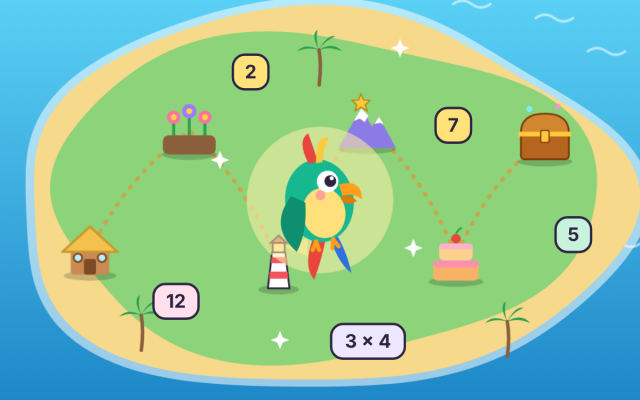
It includes five chapters with animated introductions, hands-on fudge-cutting activities and typed practice questions, plus two optional warm-ups and a 10-question final challenge. Playing everything takes about an hour, and children can start any chapter from the factory map.
 TapLearn