What you'll learn
- The recognised symbols for a cell, battery, lamp, buzzer, motor and switch
- How to draw a circuit diagram with straight wires and a complete loop
- Why more cells or a higher voltage make a lamp brighter
- That voltage, measured in volts, is the size of a cell's push
- Why more bulbs or buzzers on the same cells are dimmer or quieter
- How open and closed switches turn a circuit off and on
Chapter by chapter
- Circuit symbols: cells, batteries, lamps, buzzers, motors and switches Free to try
Year 6 science · 1
- Drawing circuit diagrams with recognised symbols and a complete loop
Year 6 science · 1
- Lamp brightness: how the number and voltage of cells change it
Year 6 science · 2
- Buzzer volume: how the number and voltage of cells change it
Year 6 science · 2 Year 6 science · 3
- Comparing components: reasons for brighter or dimmer bulbs and louder or quieter buzzers
Year 6 science · 3 Year 6 science · 2
- Switches: how the on and off positions open and close a circuit
Year 6 science · 3 Year 6 science · 1
- Grand Circuit Challenge (10 questions) (10 questions)
What the chapters cover in the national curriculum in England:
- Year 6 science: Use recognised symbols when representing a simple circuit in a diagram
- Year 6 science: Associate the brightness of a lamp or the volume of a buzzer with the number and voltage of cells used in the circuit
- Year 6 science: Compare and give reasons for variations in how components function, including the brightness of bulbs, the loudness of buzzers and the on/off position of switches
About this adventure
Circuit Symbols and Voltage is an interactive science game that teaches children aged 9–11 to draw circuits with recognised symbols and to explain how the number and voltage of cells change a lamp's brightness and a buzzer's loudness.
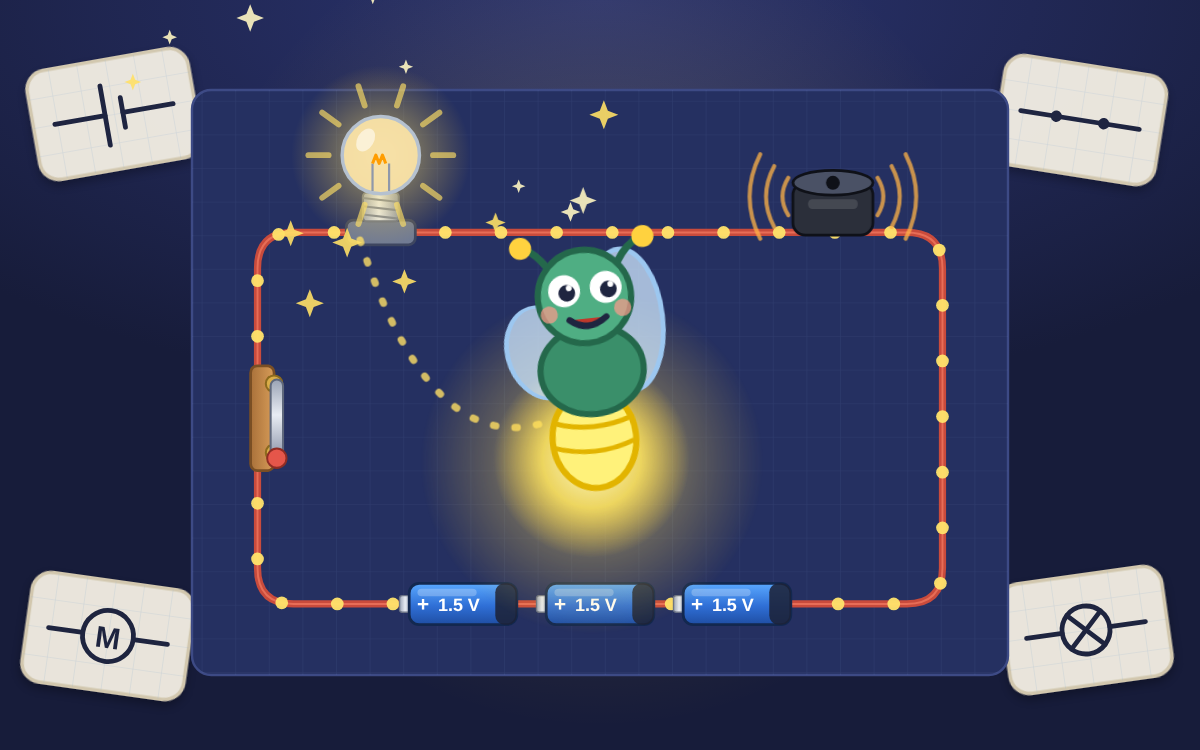
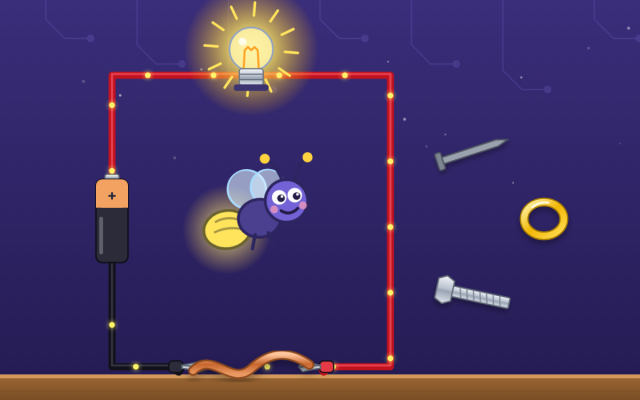
Guided by Lumi the firefly, players flip picture cards to reveal the symbols for a cell, battery, lamp, buzzer, motor and switch, then turn real circuits into diagrams with straight wires and a complete loop. They add 1.5 V cells to watch a lamp glow brighter and hear a buzzer grow louder.
Voltage is explained as the size of the push a cell gives, measured in volts (V). Children find out why two bulbs sharing one cell are dimmer, why a 3 V lamp blows on 6 V, and why an open switch stops the whole circuit.
Questions and answers
What are circuit symbols and why do we use them?
Circuit symbols are simple drawings that stand for the parts of a circuit, such as a circle with a cross for a lamp. Everyone draws them the same way, so anyone can read a circuit diagram and build the circuit it shows.
Why does adding more batteries make a bulb brighter?
More cells give a bigger push, called voltage, so the bulb glows brighter. An ordinary cell gives 1.5 volts, so two cells give 3 volts, but too much voltage for a bulb can make its thin filament snap.
Why are two bulbs dimmer than one bulb on the same battery?
In a series circuit, two bulbs share the push from the same cells, so each one gets less and glows more dimly. Adding another cell gives them a bigger push and makes them bright again.
What age is this circuit symbols game for?
It is made for children aged 9 to 11 and follows the Year 6 electricity unit of the KS2 science curriculum in England. An optional Year 4 refresher reminds children about complete circuits before they start.
What does the game include and how long does it take?
It has six chapters, an optional refresher and a 10-question final challenge, with spoken narration and sound effects throughout. Playing everything takes about 50 minutes, and children can start from any chapter.




 TapLearn