Multiply numbers up to 4 digits by a two-digit number
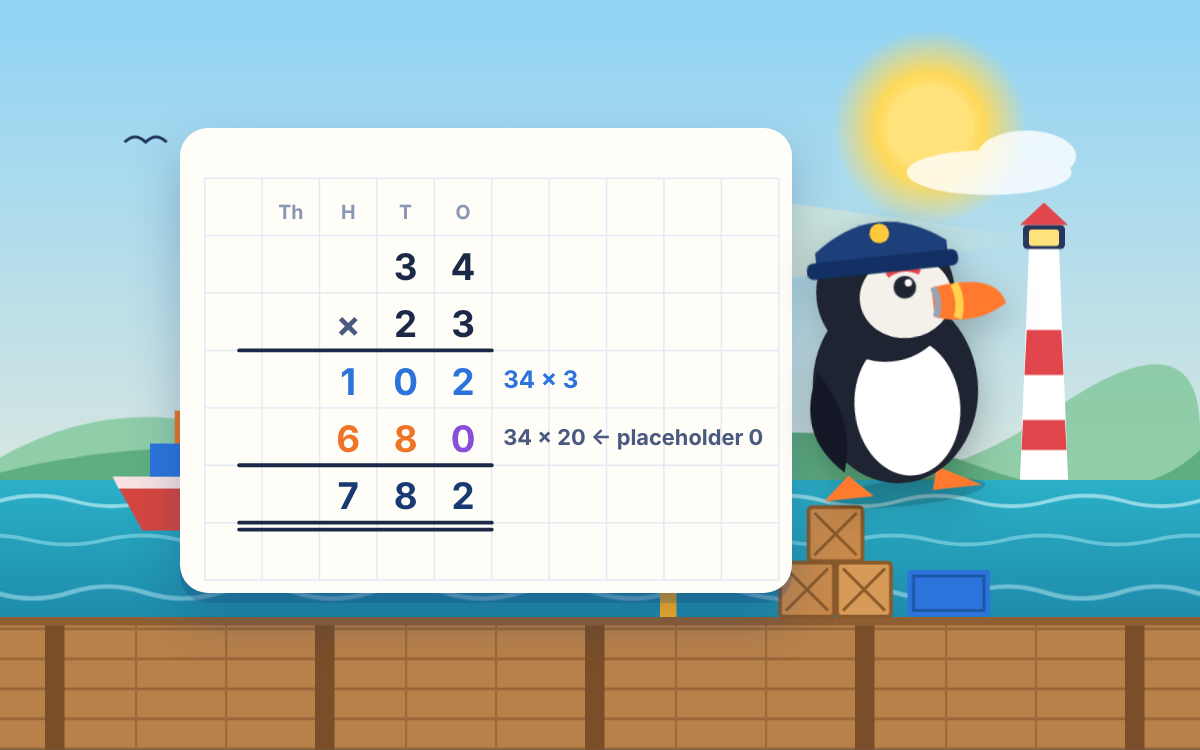
Why the tens row needs a placeholder zero
Estimate first to check a long multiplication answer makes sense
Divide using long division: divide, multiply, subtract, bring down
Use short division when you know the divisor's multiples
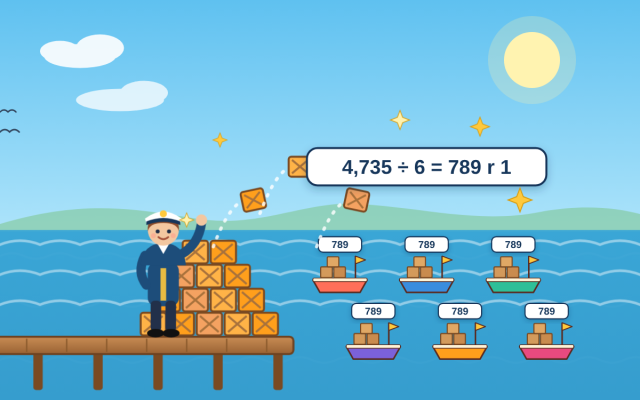
Show a remainder as a whole number, a fraction, or by rounding
Chapter by chapter
Long multiplication by a two-digit number: the ones row and the tens rowFree to try
Year 6 maths · 1
Long multiplication of 4-digit numbers: exchanging and estimating
Year 6 maths · 1
Long division by a two-digit number: divide, multiply, subtract, bring down
Year 6 maths · 2
Short division by a two-digit number (the bus stop method)
Year 6 maths · 3
Remainders as whole numbers, fractions or rounding to suit the problem
Year 6 maths · 2Year 6 maths · 3
Harbour Master Challenge: long multiplication and division quiz (10 questions)
What the chapters cover in the national curriculum in England:
Year 6 maths: Multiply multi-digit numbers up to 4 digits by a two-digit whole number using the formal written method of long multiplication
Year 6 maths: Divide numbers up to 4 digits by a two-digit whole number using the formal written method of long division, and interpret remainders as whole number remainders, fractions, or by rounding, as appropriate for the context
Year 6 maths: Divide numbers up to 4 digits by a two-digit number using the formal written method of short division where appropriate, interpreting remainders according to the context
About this adventure
Long Multiplication and Division is an interactive maths game that teaches children aged 10–11 the Year 6 written methods for multiplying and dividing by a two-digit number. Players work at a busy harbour with Pip the puffin, typing each row of their working into squared paper on screen.
Children split a crate wall to see why long multiplication has a ones row and a tens row, and why the tens row starts with a placeholder zero. They estimate before calculating, build a list of multiples for long division, and carry remainders across in short division, often called the bus stop method.
The final chapter shows that one division can have several answers: a whole-number remainder, a fraction, or a rounded number, depending on the question. When a child makes a classic slip, such as missing a zero, Pip gives a hint that targets that exact mistake.
Questions and answers
What is long multiplication, in simple words?
Long multiplication is a written method for multiplying by a two-digit number. You multiply by the ones digit to make one row, then by the tens digit to make a second row that starts with a placeholder zero, and add the two rows together.
What is the difference between short division and long division?
Short division carries each remainder across to the next digit and keeps the subtracting in your head, while long division writes every multiply and subtract step underneath. Short division suits divisors whose multiples you know well, such as 12 or 25.
What do you do with a remainder in a word problem?
It depends on the question: you might give the remainder, round up, round down, or write it as a fraction. For example, 995 eggs in boxes of 12 fills 82 boxes, but 83 boxes are needed to pack every egg.
What age is this long multiplication and division game for?
It is designed for children aged 10–11 in Year 6, matching the national curriculum in England for KS2 maths. Children who know their times tables and short multiplication can use the optional warm-up to get ready.
What does the game include and how long does it take?
The game has five chapters, an optional warm-up and a ten-question final challenge, taking about an hour in total. Children type their working into on-screen written methods, with spoken guidance and hints aimed at common mistakes.
Can we count your visit? We'd like to use one cookie, only on this site, to see how families find and use TapLearn, so we can make it better. No adverts, and nothing is shared. How we measure
Create a free family account and your child can play every chapter of every game for 7 days, with no card needed. Their progress is kept. After that, the free plan is free for ever, and membership is £6.99 a month if you'd like to keep every chapter.

 TapLearn