What you'll learn
- How to find the subject, verb and object in a clause
- Why a comma alone can't join two independent clauses
- When to use a semi-colon, colon or dash between clauses
- How to use a colon after a complete sentence to introduce a list
- When semi-colons separate list items that already contain commas
- The difference between a hyphen, a dash and an ellipsis
Chapter by chapter
- Independent clauses: subject, verb and object Free to try
Year 6 english · 1 Year 6 english · 2
- Semi-colons between independent clauses
Years 5–6 english · 3 Year 6 english · 1 Year 6 english · 2
- Colons and dashes between independent clauses
Years 5–6 english · 3 Year 6 english · 1 Year 6 english · 2
- A colon to introduce a list, and bullet points
Years 5–6 english · 4 Year 6 english · 5 Year 6 english · 2
- Semi-colons within lists
Year 6 english · 5 Year 6 english · 2
- Punctuation words: colon, semi-colon, dash, hyphen, ellipsis and bullet points
Year 6 english · 2
- Clause Islands Grand Challenge (10 questions)
What the chapters cover in the national curriculum in England:
- Year 6 english: Punctuation: use of the semi-colon, colon and dash to mark the boundary between independent clauses
- Year 6 english: Terminology: subject, object, active, passive, synonym, antonym, ellipsis, hyphen, colon, semi-colon, bullet points
- Years 5–6 english: Indicate grammatical and other features by: using semicolons, colons or dashes to mark boundaries between independent clauses
- Years 5–6 english: Indicate grammatical and other features by: using a colon to introduce a list
- Year 6 english: Punctuation: use of the colon to introduce a list and use of semi-colons within lists
About this adventure
Island Links is an interactive punctuation game that teaches children aged 9–11 how to use colons, semi-colons and dashes, matching the Year 6 English curriculum in England. Pip the puffin narrates every step aloud, with captions on screen.
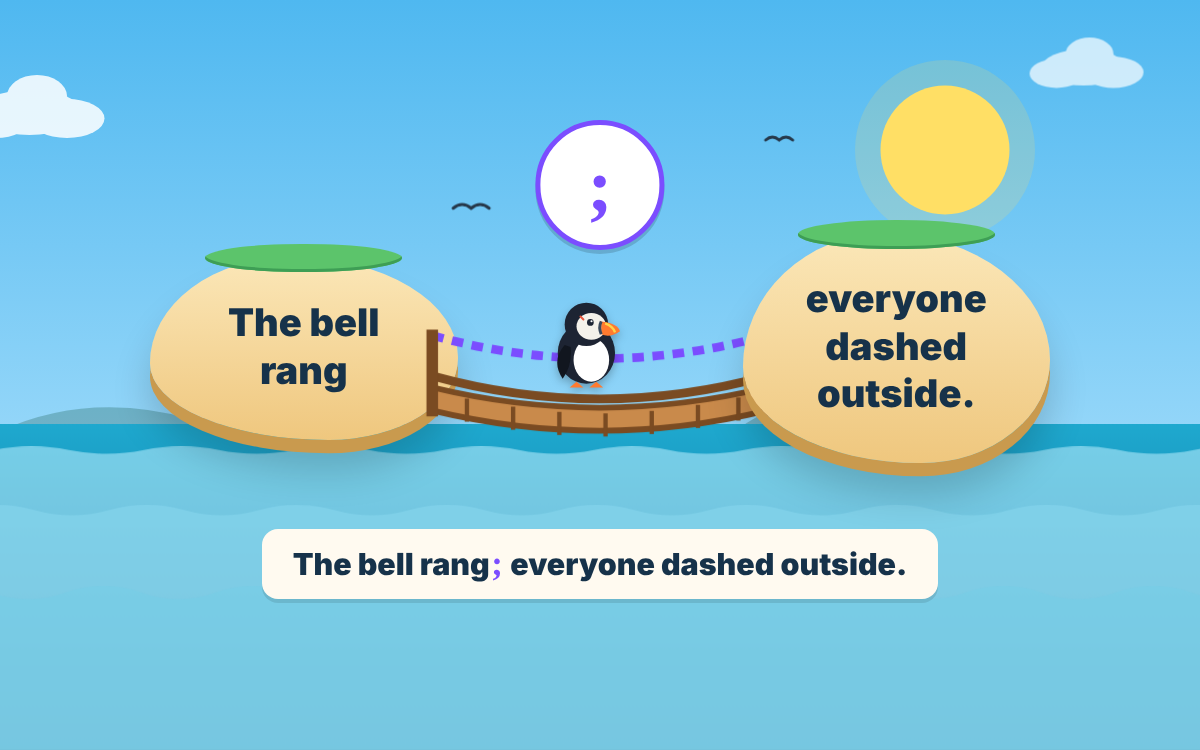
Each independent clause (a group of words with a subject and a verb that makes sense on its own) is an island. Players choose the mark that can bridge two islands. A semi-colon joins closely related clauses, a colon works when the second clause explains the first, and a dash gives a chattier break. If they pick a comma, the bridge collapses: that mistake is called a comma splice.
Players also load list boats with a colon, use semi-colons between list items that already contain commas, and type their own punctuated sentences. An optional warm-up recaps clauses, and a 10-question Grand Challenge ends the game.
Questions and answers
How do you use a semi-colon, in simple words?
A semi-colon joins two closely related clauses that could each be a sentence on their own, such as "It's raining; I'm fed up." The word after a semi-colon usually starts with a small letter.
When should you use a colon instead of a semi-colon?
Use a colon when the second clause explains or adds to the first, as in "I was soaked: it had rained all day." A colon also introduces a list, but only after a complete sentence.
When do you use semi-colons in a list?
Use semi-colons between list items when the items already contain commas, for example "Paris, France; Rome, Italy; and Oslo, Norway." A simple list of single words only needs commas.
What age is this colons and semi-colons game for?
The game is for children aged 9 to 11 and matches Year 6 English in England, where these marks are taught. Every line is read aloud and shown as a caption, which helps less confident readers.
What does the punctuation game include and how long does it take?
It has an optional warm-up, six chapters with animated introductions and hands-on tasks, and a 10-question Grand Challenge. Playing everything takes about an hour, and children can start any chapter from the island map.
 TapLearn