Subject, Verb and Object: A Sentence Theatre Show
Learn to find the subject, verb and object in a sentence, switch active to passive and make verbs agree, by directing plays in a theatre.
- Ages 10–11
- About 40 min
- Some thinking
- Grammar & Punctuation
Learn to find the subject, verb and object in a sentence, switch active to passive and make verbs agree, by directing plays in a theatre.
Year 6 english · 1
Year 6 english · 1
Year 6 english · 1
Years 5–6 english · 2
Years 5–6 english · 2
What the chapters cover in the national curriculum in England:
Subject, Verb and Object is an interactive grammar game for children aged 10–11 that teaches how to find the subject and object of a sentence, tell active from passive, and make the subject and verb agree. It follows the Year 6 English curriculum in England.
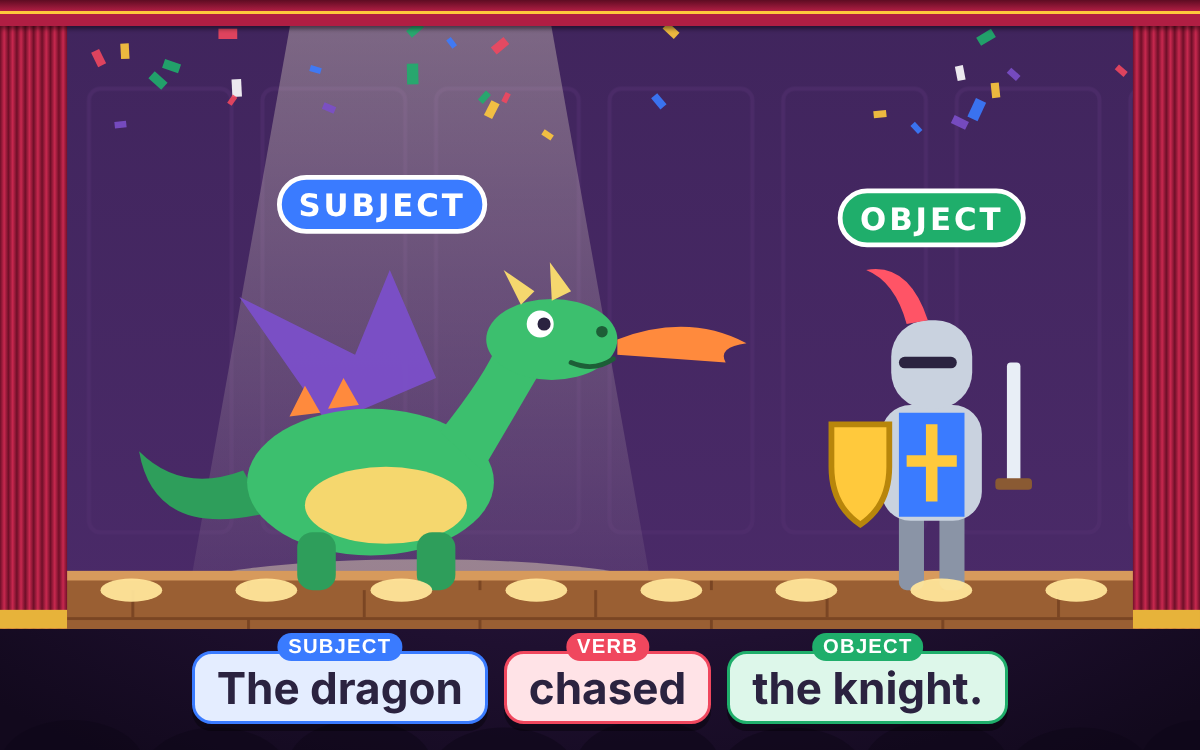
Every sentence is a short play on a theatre stage, directed by Olive the owl. Players tap and label sentence parts: the subject (who or what does the verb), the verb (the action) and the object (who or what the verb is done to). They watch a dragon-and-knight sentence spin round into the passive, where the object moves to the front.
Later shows turn the player into an editor. They fix agreement mistakes such as "The box of crayons are", type the correct verb, and choose between chatty speech and formal Standard English for different readers.
The subject is the person or thing that does the verb. In "The dog chased the ball", the dog is the subject. A quick way to find it is to spot the verb first, then ask who or what did it.
The object is the person or thing the verb is done to. In "The dog chased the ball", the ball is the object. Not every sentence has one: in "The baby slept", nothing is slept, so there is no object.
In an active sentence the subject does the action, as in "The dragon chased the knight". In a passive sentence the subject has the action done to it, as in "The knight was chased by the dragon". The "by" part can be left out.
Subject–verb agreement means a singular subject takes a singular verb and a plural subject takes a plural verb, such as "the dog barks" but "the dogs bark". The verb matches the real subject, so "the box of crayons is" is correct.
The game is designed for children aged 10–11 in Year 6, matching the English national curriculum. It has an optional warm-up, five short shows and a ten-question Grand Finale quiz, taking about 40 minutes in total.
 TapLearn
Getting it ready…
Great work on chapter 1! To open the next chapters, ask a grown-up to take a look.
To play this game, ask a grown-up to take a look. There are lots of free games you can play right now too!
Create a free family account and your child can play every chapter of every game for 7 days, with no card needed. Their progress is kept. After that, the free plan is free for ever, and membership is £6.99 a month if you'd like to keep every chapter.
That's all the learning time for today. Great work! Flip will be ready to play again tomorrow.