What you'll learn
- How a hyphen joins two describing words, as in man-eating shark
- Why leaving out a hyphen can change what a sentence means
- When to write re-cover or recover, and re-sign or resign
- How to write a lead-in line that ends with a colon
- How to turn a sentence of information into bullet points
- How to punctuate bullet points consistently, with or without full stops
Chapter by chapter
- Hyphens to avoid ambiguity: man-eating shark or man eating shark?
Years 5–6 english · 1 Year 6 english · 2
- Hyphens with prefixes to avoid ambiguity: re-cover or recover?
Years 5–6 english · 1 Year 6 english · 2
- Bullet points to list information: a lead-in line and a colon
Year 6 english · 3
- Punctuating bullet points consistently: capital letters and full stops
Years 5–6 english · 4 Year 6 english · 3
- Putting it together: hyphens and bullet points in a leaflet
Years 5–6 english · 1 Years 5–6 english · 4 Year 6 english · 3 Year 6 english · 2
- Harbour Master Challenge (10 questions) (10 questions)
What the chapters cover in the national curriculum in England:
- Years 5–6 english: Indicate grammatical and other features by: using hyphens to avoid ambiguity
- Year 6 english: Punctuation: how hyphens can be used to avoid ambiguity
- Year 6 english: Punctuation: punctuation of bullet points to list information
- Years 5–6 english: Indicate grammatical and other features by: punctuating bullet points consistently
About this adventure
Hyphens and Bullet Points is an interactive game that teaches children aged 10–11 how hyphens avoid ambiguity and how to punctuate bullet points consistently, matching the Year 6 English curriculum in England.
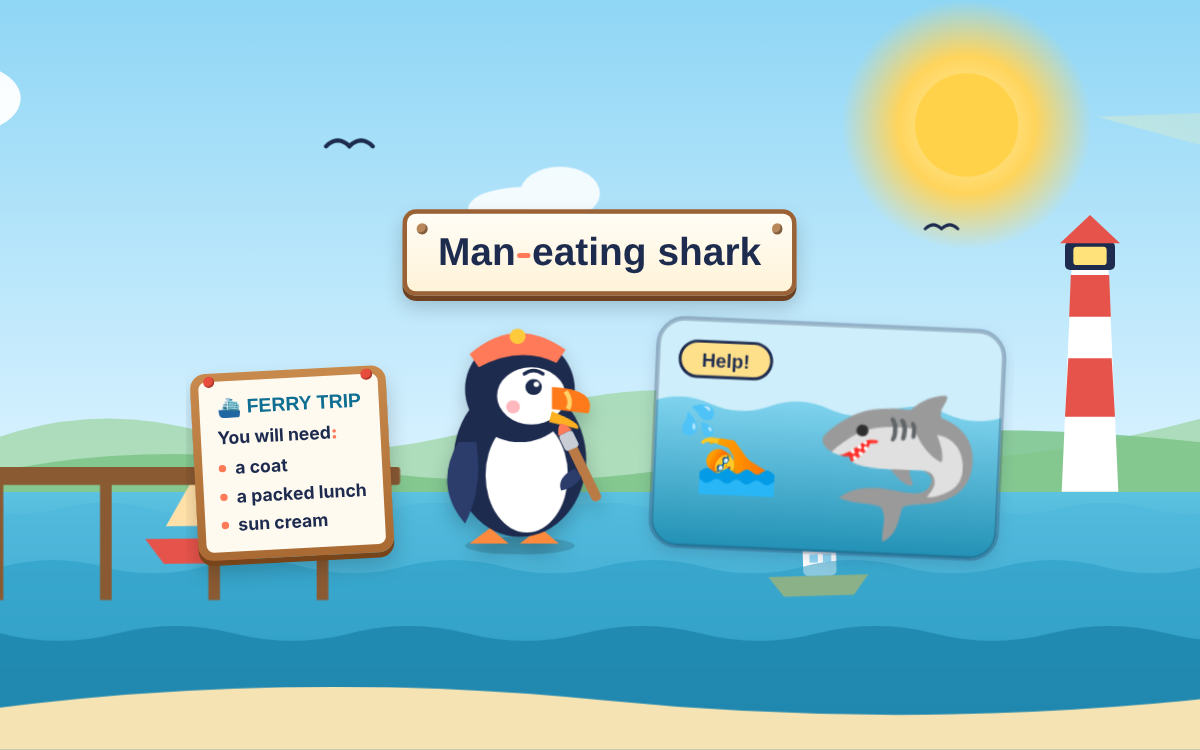
Pip the puffin, the harbour's sign painter, reads every line aloud with captions. Players tap a hyphen into a beach sign and watch a man eating a shark turn into a man-eating shark. They then choose between pairs such as re-cover and recover, where the hyphen shows that the prefix re- means again.
Later, players turn a long sentence into a bullet-point list with a lead-in line that ends in a colon. They fix notice boards so every bullet starts and ends the same way, then correct five mistakes in a seaside leaflet before it goes to print.
Questions and answers
When do you use a hyphen to avoid ambiguity?
You use a hyphen to join two words that work together as one describing word, so the reader gets the right meaning. A man-eating shark eats people, but a man eating shark describes a man having a shark for dinner.
What is the difference between recover and re-cover?
Recover means to get better or to get something back, while re-cover means to cover again. The hyphen shows that the prefix re- means again, so the word is not confused with a different word spelt with the same letters.
Do bullet points need full stops?
Bullet points only need full stops when each one is a full sentence, and then every bullet ends with one. Short notes after a lead-in line usually start with a small letter and have no full stops, including the last bullet.
What age is this hyphens and bullet points game for?
The game is for children aged 10 to 11 and follows the Year 6 English curriculum in England, where both topics are taught. It also suits Year 6 pupils revising for the KS2 grammar, punctuation and spelling test.
What does the game include and how long does it take?
It includes five chapters, each with an animated introduction, hands-on activities and a recap, plus a 10-question Harbour Master Challenge. Playing everything takes about 40 minutes, and children can start any chapter from the harbour map.
 TapLearn