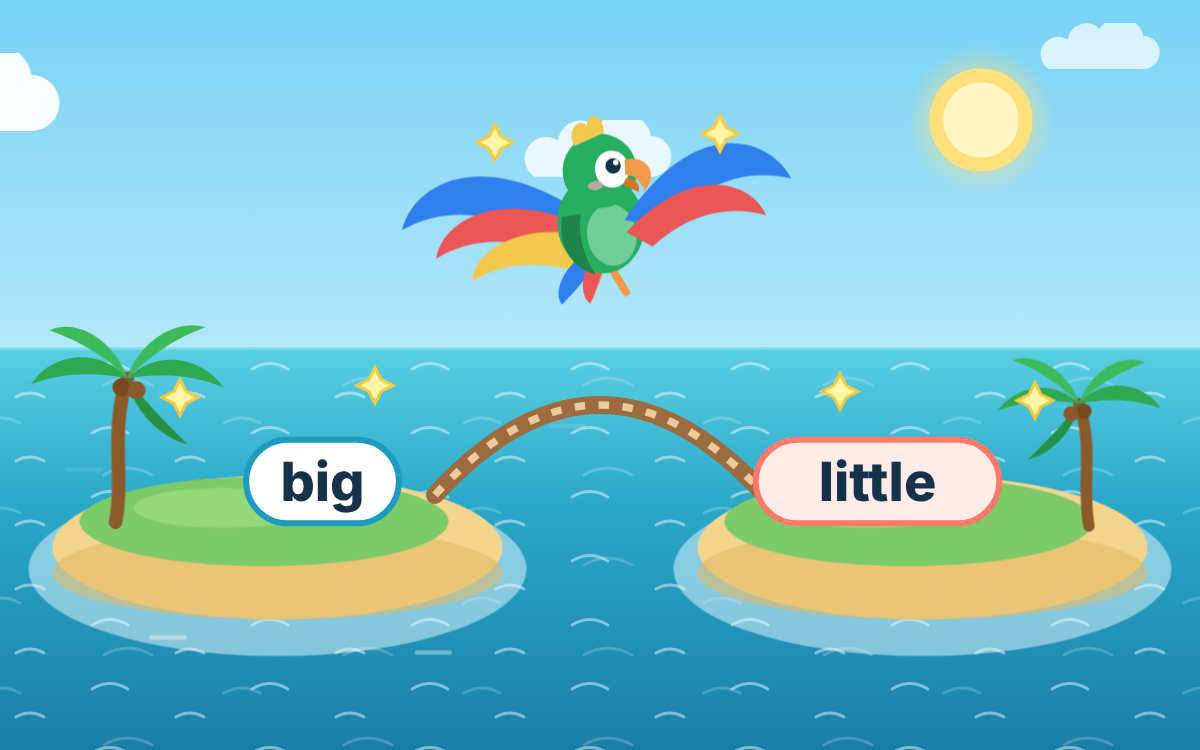
Synonyms and Antonyms: A Word Islands Adventure
Learn synonyms and antonyms, from big and large to big and little, by sailing round Word Islands, building bridges and choosing the best word.
- Ages 9–11
- About 45 min
- Some thinking
- Vocabulary
Learn synonyms and antonyms, from big and large to big and little, by sailing round Word Islands, building bridges and choosing the best word.
Year 6 english · 1 Year 6 english · 2
Year 6 english · 1 Year 6 english · 2
Year 6 english · 1 Year 6 english · 2
Year 6 english · 1
Year 6 english · 2
Year 6 english · 2
What the chapters cover in the national curriculum in England:
Synonyms and Antonyms is an interactive game that teaches children aged 9–11 how words are related by meaning, matching the Year 6 English national curriculum in England. A synonym is a word with the same or a similar meaning, like big and large; an antonym is a word with the opposite meaning, like big and little.
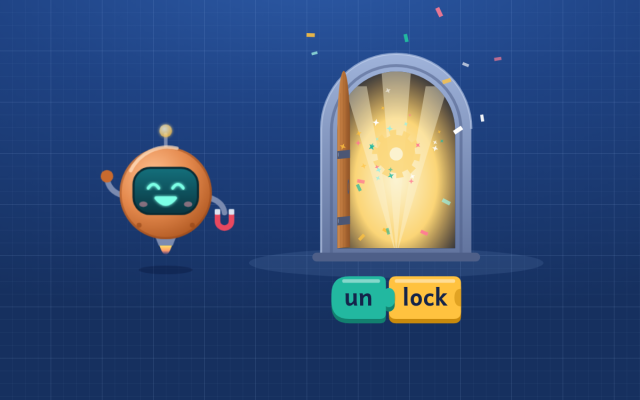
Guided by Echo the parrot, players swap words in sentences, sort word pairs, make opposites with the prefixes un-, dis-, in- and im-, and type their own synonyms and antonyms. They also find out that synonyms can be stronger or weaker, and that a word like light needs a different opposite in different sentences.
The game also covers the Year 6 grammar terms subject, object, active, passive, ellipsis, hyphen, colon, semi-colon and bullet points. Every line is read aloud, and a 10-question challenge checks what has been learnt.
A synonym is a word with the same or a similar meaning to another word, while an antonym has the opposite meaning. Big and large are synonyms; big and little are antonyms. A handy trick: S for similar, A for against.
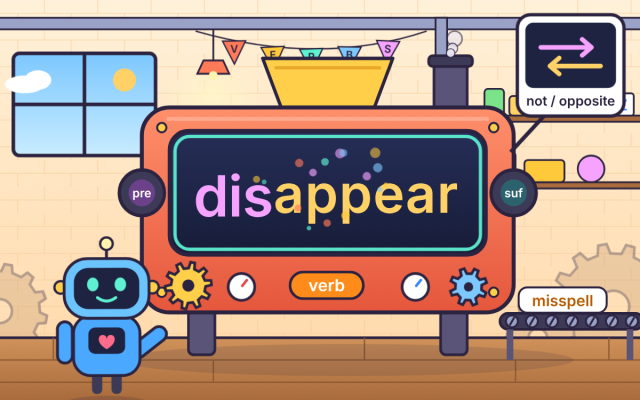
Yes, many antonyms are made by adding a prefix meaning not, such as un-, dis-, in- or im-. Tidy becomes untidy, agree becomes disagree and possible becomes impossible. Other antonyms are completely different words, like hot and cold.
Yes, a word can have several antonyms, and the right one depends on the sentence. A light bag is the opposite of a heavy one, but a light sky is the opposite of a dark one, so children need to read the context first.
It is made for children aged 9 to 11 and follows the Year 6 English national curriculum in England. Younger confident readers can enjoy the first chapters, because every instruction is read aloud and the early tasks use everyday words.
Playing everything takes about 45 minutes. There are six chapters, each with an animated introduction, hands-on tasks and typed answers, followed by a 10-question challenge. Children can start from any chapter and stop between them.
 TapLearn
Getting it ready…
Great work on chapter 1! To open the next chapters, ask a grown-up to take a look.
To play this game, ask a grown-up to take a look. There are lots of free games you can play right now too!
Create a free family account and your child can play every chapter of every game for 7 days, with no card needed. Their progress is kept. After that, the free plan is free for ever, and membership is £6.99 a month if you'd like to keep every chapter.
That's all the learning time for today. Great work! Flip will be ready to play again tomorrow.