Factors, Multiples and Primes: A Number Isle Adventure
Learn to find common factors, common multiples and prime numbers by planting flower beds, timing lighthouse flashes and sifting primes to 100.
- Ages 9–11
- About 45 min
- Some thinking
- Calculation
Learn to find common factors, common multiples and prime numbers by planting flower beds, timing lighthouse flashes and sifting primes to 100.
Year 6 maths · 1
Year 6 maths · 1
Year 6 maths · 1
Year 6 maths · 1
What the chapters cover in the national curriculum in England:
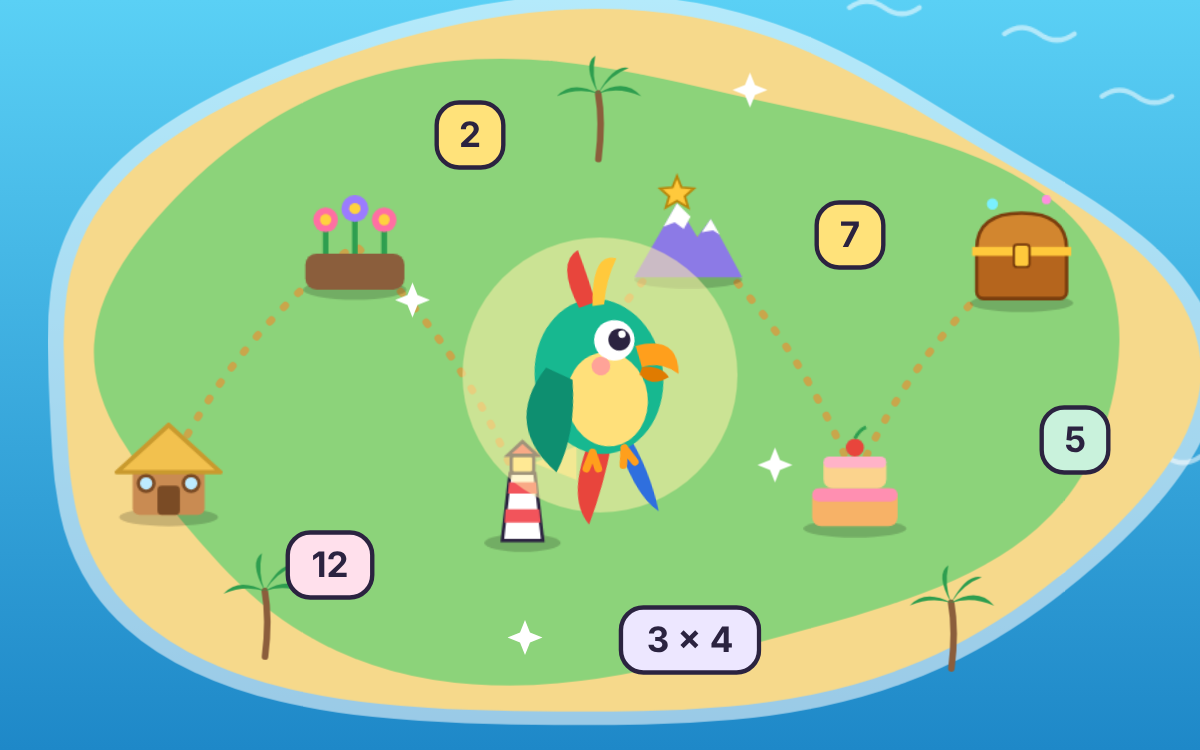
Factors, Multiples and Primes is an interactive maths game that teaches children aged 9–11 to identify common factors, common multiples and prime numbers, following the Year 6 national curriculum in England. Kiki the parrot guides players around Number Isle, explaining each idea and asking them to try it straight away.
A factor divides into a number exactly, and a common factor divides into two numbers. A multiple is in a number's times table, and a common multiple is in both tables. Players find the highest common factor and lowest common multiple, learn that a prime number has exactly two factors, and use the Sieve of Eratosthenes to find every prime up to 100.
Finally, they use these skills with fractions: finding a common denominator and simplifying. Spoken narration, typed answers and hints help children practise until the methods stick.
A factor divides into a number exactly, while a multiple is in that number's times table. For example, 3 is a factor of 12 because 12 ÷ 3 = 4, and 12 is a multiple of 3. A handy rule: factors fit into a number, multiples come out of times tables.
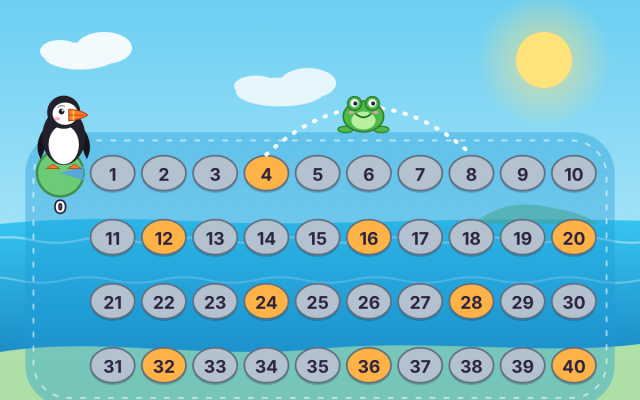
Count up in the bigger number's times table and stop at the first number the smaller number divides into exactly. For 4 and 6, counting in sixes gives 6 and then 12, and 12 is in the 4 times table, so 12 is the lowest common multiple.
1 is not a prime number because a prime has exactly two factors, 1 and itself, and 1 has only one factor. The smallest prime number is 2, which is also the only even prime.
The game is designed for children aged 9 to 11. It follows the Year 6 maths curriculum in England, and it also suits confident Year 5 pupils who know their times tables and want a challenge.
The game has four chapters, an optional refresher of Year 5 ideas, and a 10-question Treasure Challenge that includes typed answers. Playing everything takes about 45 minutes, and children can start any chapter from the island map.

 TapLearn
Getting it ready…
Great work on chapter 1! To open the next chapters, ask a grown-up to take a look.
To play this game, ask a grown-up to take a look. There are lots of free games you can play right now too!
Create a free family account and your child can play every chapter of every game for 7 days, with no card needed. Their progress is kept. After that, the free plan is free for ever, and membership is £6.99 a month if you'd like to keep every chapter.
That's all the learning time for today. Great work! Flip will be ready to play again tomorrow.