The Mean Average: Fair Shares at the Funfair
Learn how to find the mean average by levelling towers, adding and dividing, and comparing teams in a funfair game for Year 6 maths.
- Ages 9–11
- About 35 min
- Some thinking
- Data & Chance
Learn how to find the mean average by levelling towers, adding and dividing, and comparing teams in a funfair game for Year 6 maths.
Year 6 maths · 1
Year 6 maths · 1
Year 6 maths · 1
What the chapters cover in the national curriculum in England:
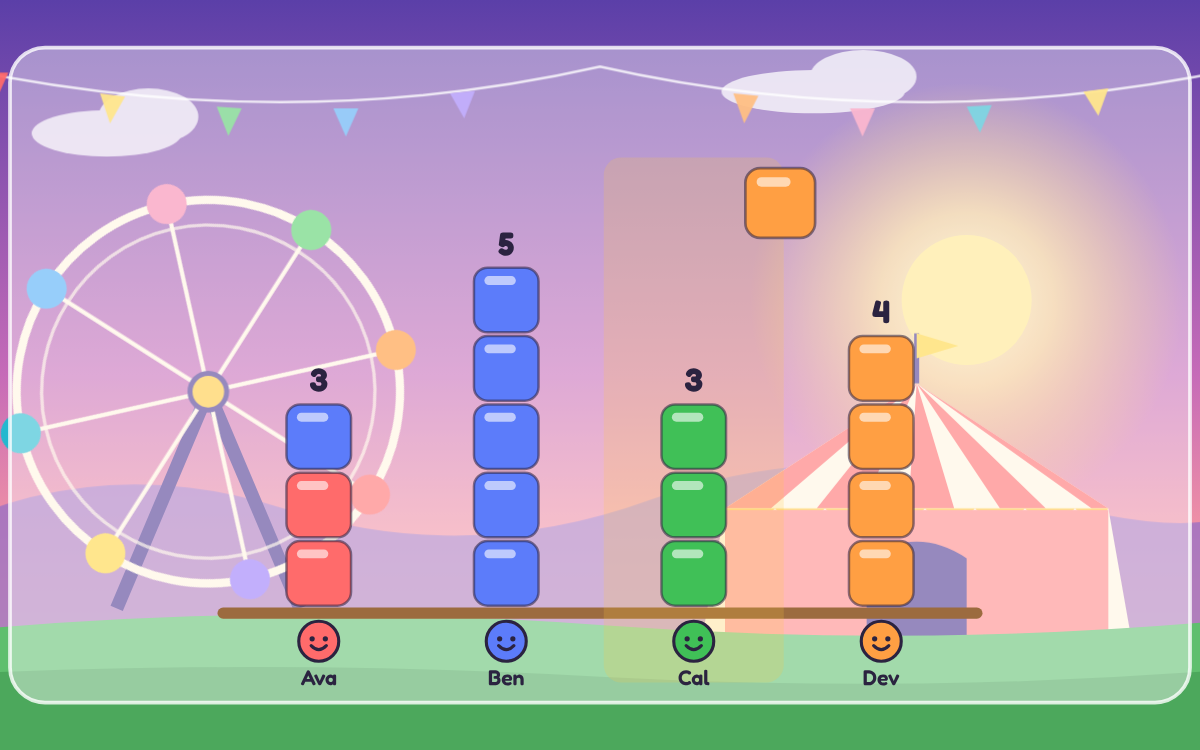
The Mean Average: Fair Shares at the Funfair is an interactive maths game that teaches children aged 9–11 how to calculate the mean and explain what it tells you, matching the Year 6 statistics objective in England. Children visit stalls at a funfair with Mo the robot as their guide.
Players first drag cubes between friends' towers until every tower is the same height, seeing that the mean is the fair share and that the total never changes. They then calculate means step by step: find the total, count how many values there are (zeros included), then divide.
Later stalls show that a mean can be a decimal and need not be one of the values. Children compare teams of different sizes, work back from a mean to a missing number, and see how one very large value pulls the mean up. Every line is read aloud, and an optional warm-up recaps adding and sharing equally.
Add all the numbers together to get the total, then divide by how many numbers there are. For example, the mean of 6, 9, 5 and 8 is 28 divided by 4, which is 7.
The mean tells you the fair share each one would get if everything were shared out equally. It gives a typical amount for a group, even though some values are higher and some are lower.
Yes, a zero is still a value, so you count it when you divide. Goals of 3, 0, 2, 4 and 1 make 10 over 5 matches, so the mean is 2, not 2.5.
It is designed for children aged 9 to 11 and matches the Year 6 statistics objective to calculate and interpret the mean. Younger confident children can start with the optional warm-up on adding and sharing equally.
It has an optional warm-up, three chapters and an eight-question final challenge, taking about 35 minutes to play through. Questions use typed answers and multiple choice, with spoken explanations when an answer is wrong.
 TapLearn
Getting it ready…
Great work on chapter 1! To open the next chapters, ask a grown-up to take a look.
To play this game, ask a grown-up to take a look. There are lots of free games you can play right now too!
Create a free family account and your child can play every chapter of every game for 7 days, with no card needed. Their progress is kept. After that, the free plan is free for ever, and membership is £6.99 a month if you'd like to keep every chapter.
That's all the learning time for today. Great work! Flip will be ready to play again tomorrow.