What you'll learn
- Round any whole number to the nearest 10, 100, 1,000 or million
- Use the digit to the right of the rounding digit to decide
- Why halfway numbers round up and why you never round in steps
- Estimate by rounding to check whether an answer is sensible
- Choose a sensible degree of accuracy and when to round up or down
- Round decimals to one or two decimal places and money to the penny
Chapter by chapter
- Rounding to the nearest 10, 100 and 1,000 on a number line Free to try
Year 6 maths · 1
- Rounding large numbers to the nearest 10,000, 100,000 and 1,000,000
Year 6 maths · 1
- Using estimation to check answers to calculations
Year 6 maths · 2
- Choosing an appropriate degree of accuracy in real-life problems
Year 6 maths · 2
- Solving problems with answers rounded to a specified degree of accuracy
Year 6 maths · 3
- Summit Challenge: rounding and estimating quiz (10 questions)
What the chapters cover in the national curriculum in England:
- Year 6 maths: Round any whole number to a required degree of accuracy
- Year 6 maths: Use estimation to check answers to calculations and determine, in the context of a problem, an appropriate degree of accuracy
- Year 6 maths: Solve problems which require answers to be rounded to specified degrees of accuracy
About this adventure
Rounding Ridge is an interactive rounding and estimating game that teaches children aged 9–11 to round any whole number, use estimation to check answers and round answers to the accuracy a problem needs. It follows the Year 6 maths curriculum in England.
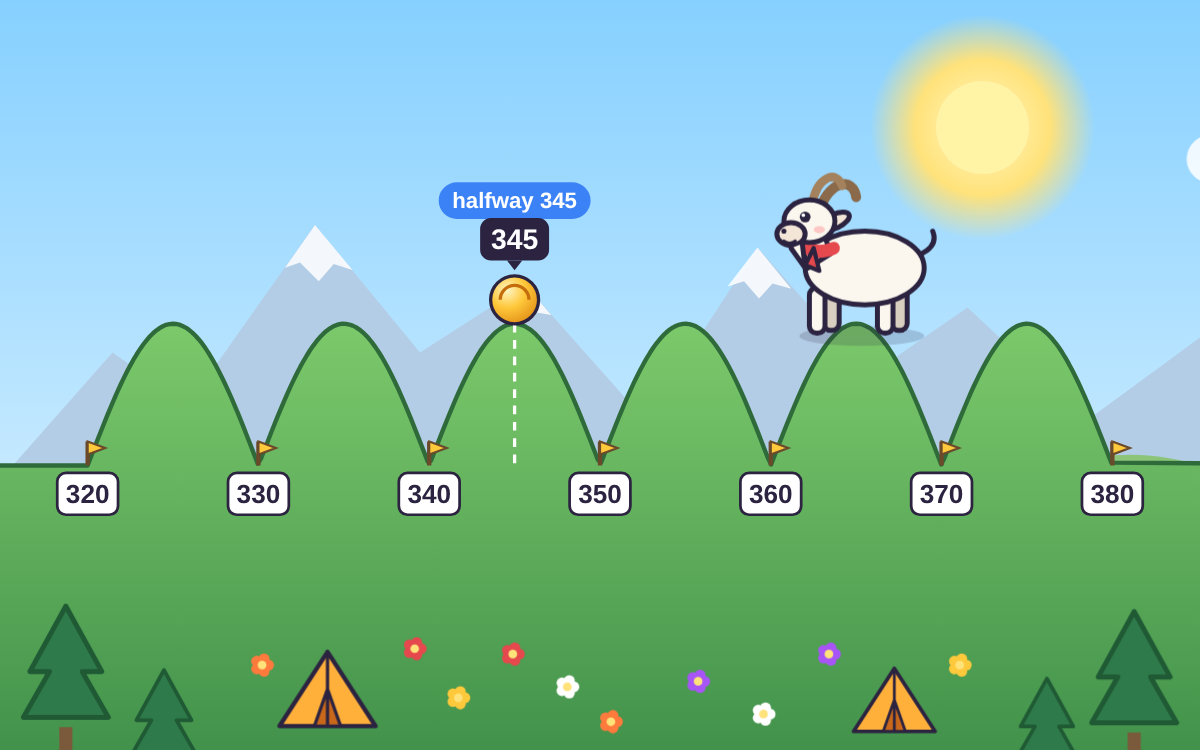
With Rory the mountain goat as their guide, players drop number balls onto hills where the valleys are multiples and the hilltops are halfway points, so they can see which multiple each number is nearest to. On a place value chart they find the rounding digit and the digit to its right that decides. They also check a calculating robot's work with estimates and round decimals and money to the nearest penny.
The game looks out for common mistakes, such as rounding in steps or forgetting to carry when a 9 goes up. Optional warm-ups refresh place value and decimals, and a ten-question Summit Challenge brings everything together.
Questions and answers
How do you round a number, in simple words?
Find the digit in the place you are rounding to, then look at the digit just to its right. If that digit is 5 or more, the rounding digit goes up by one; if it is 4 or less, it stays the same. Every digit after it becomes zero.
Why does a number ending in 5 round up?
A number ending in 5 is exactly halfway between two multiples, so mathematicians agreed that halfway always rounds up. That way everyone gets the same answer: 345 rounded to the nearest 10 is 350, and 2,450 rounded to the nearest 100 is 2,500.
How does estimating help you check an answer?
An estimate is a quick answer worked out with rounded numbers, such as 300 × 20 = 6,000 for 298 × 21. If the real answer is nowhere near the estimate, for example about ten times too big, there is probably a mistake to look for.
What age is this rounding game for?
The game is designed for children aged 9 to 11 and matches the Year 6 maths curriculum in England. Confident Year 5 pupils can play too, and short warm-ups on place value and decimals help anyone who needs a refresher first.
What does the rounding game include and how long does it take?
It has five chapters, two optional warm-ups and a ten-question Summit Challenge quiz. Playing everything takes about 45 minutes, and children can choose any chapter from the map and return to it whenever they like.
More to explore
See all
Subitising to 5: Spot It Quick with Dotty the Ladybird
Learn subitising to 5: seeing how many there are without counting. Spot dot patterns, dice, fingers and tens…
Odd and Even Numbers: Pair Up Puffins with Pip
Learn to spot odd and even numbers using pairs, the 2 times table and the ones digit, by pairing puffins in b…
Counting to 20 and Beyond: Hop the Lily Pond with Pip
Learn counting to 20 and beyond, past 10 and on to 30, by tapping lily pads as Pip the frog hops along and ch…
Roman Numerals to 1,000: A Roma Town Quest with Octavia
Learn to read Roman numerals to 1,000 and recognise years like MMXXVI by splitting numerals into chunks and s…
Negative Numbers: Counting Below Zero with Pip the Penguin
Learn what negative numbers are, read temperatures below zero and count through zero, helping Pip the penguin…
Factors, Multiples and Primes: A Number Isle Adventure
Learn to find common factors, common multiples and prime numbers by planting flower beds, timing lighthouse f…
Numbers to 20: Count, Read and Compare with Dotty
Learn to read, write and compare numbers to 20 by counting apples, filling ten frames, hopping a frog along a…
 TapLearn