Order of Operations: Climb the Priority Tower with Ordo
Learn the order of operations: brackets, then multiply and divide, then add and subtract. Solve calculations step by step with Ordo the robot.
- Ages 10–11
- About 40 min
- Some thinking
- Calculation
Learn the order of operations: brackets, then multiply and divide, then add and subtract. Solve calculations step by step with Ordo the robot.
Year 6 maths · 1
Year 6 maths · 1
Year 6 maths · 1
Year 6 maths · 1
Year 6 maths · 1
What the chapters cover in the national curriculum in England:
The Priority Tower is an interactive order of operations game that teaches children aged 10–11 (Year 6) to work out calculations with all four operations and brackets in the right order.
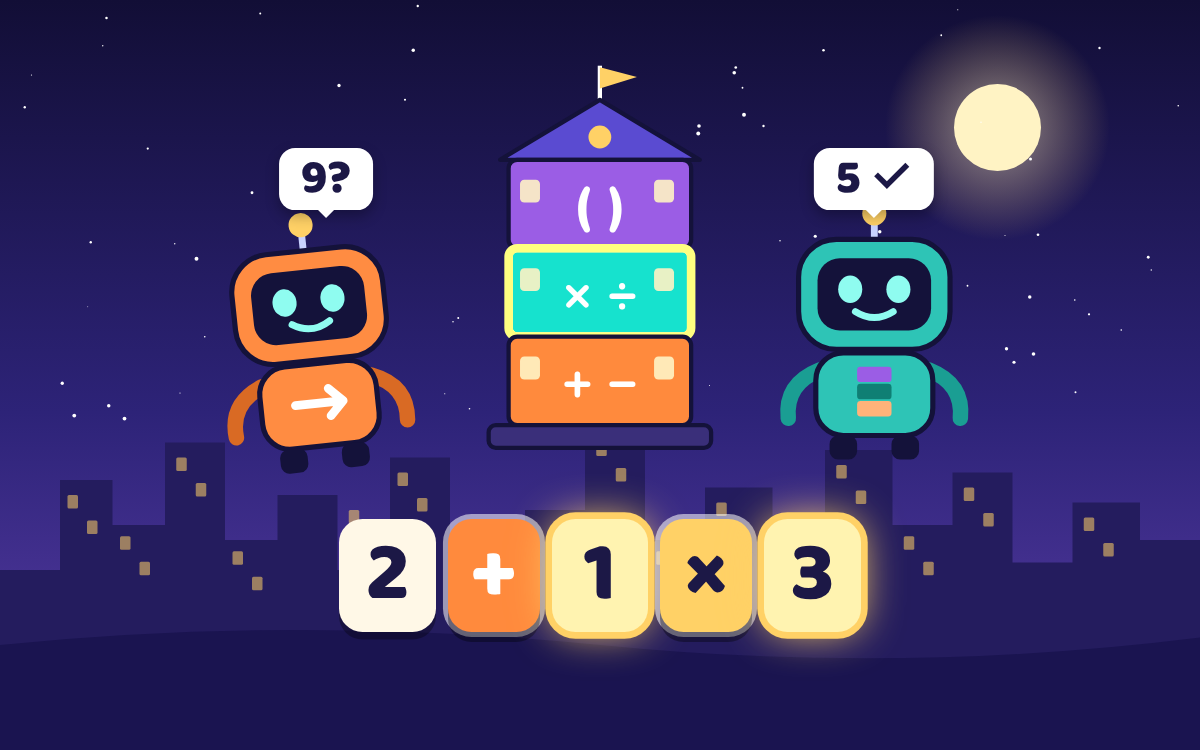
Players climb a tower whose floors show the order: brackets at the top, multiplication and division in the middle, addition and subtraction at the bottom. They tap the operation that goes first, type each step on a keypad and watch the calculation shrink. Everyday scenes show why the rules matter, such as counting coins in bags to see that 2 + 3 × 4 is 14, not 20.
Along the way they learn that operations with equal priority are worked from left to right, that BODMAS does not mean division always comes before multiplication, and how moving brackets changes an answer: 2 + 1 × 3 = 5, but (2 + 1) × 3 = 9.
The order of operations is the agreed order for working out a calculation: brackets first, then multiplication and division, then addition and subtraction. Following it means everyone gets the same answer, so 2 + 1 × 3 is 5, not 9.
No, division and multiplication have equal priority, even though D comes before M in the word BODMAS. When both appear, you work from left to right, so 12 ÷ 3 × 2 = 8. Addition and subtraction work the same way.
Brackets show which part of a calculation to work out first, before anything else. They can change the answer completely: 2 + 1 × 3 = 5, but (2 + 1) × 3 = 9 because the addition inside the brackets is done first.
The game is designed for children aged 10 to 11, matching Year 6 maths in the national curriculum in England, where pupils first learn the order of operations. Older pupils revising for the KS2 arithmetic paper can use it too.
It has an optional warm-up on the four operations, five chapters and a ten-question challenge, taking about 40 minutes in total. Children tap operations, type answers on a keypad and place brackets, with spoken narration throughout.

 TapLearn
Getting it ready…
Great work on chapter 1! To open the next chapters, ask a grown-up to take a look.
To play this game, ask a grown-up to take a look. There are lots of free games you can play right now too!
Create a free family account and your child can play every chapter of every game for 7 days, with no card needed. Their progress is kept. After that, the free plan is free for ever, and membership is £6.99 a month if you'd like to keep every chapter.
That's all the learning time for today. Great work! Flip will be ready to play again tomorrow.