Multi-Step Word Problems: Crack Cases as a Maths Detective
Learn to solve multi-step word problems with all four operations by cracking detective cases, drawing bar models and checking every answer.
- Ages 9–11
- About 50 min
- Some thinking
- Calculation
Learn to solve multi-step word problems with all four operations by cracking detective cases, drawing bar models and checking every answer.
Year 6 maths · 1
Year 6 maths · 1
Year 6 maths · 2
Year 6 maths · 2 Year 6 maths · 1
What the chapters cover in the national curriculum in England:
Multi-Step Word Problems is an interactive maths game that teaches children aged 9–11 to solve word problems needing more than one calculation, using addition, subtraction, multiplication and division. It follows the Year 6 national curriculum in England.
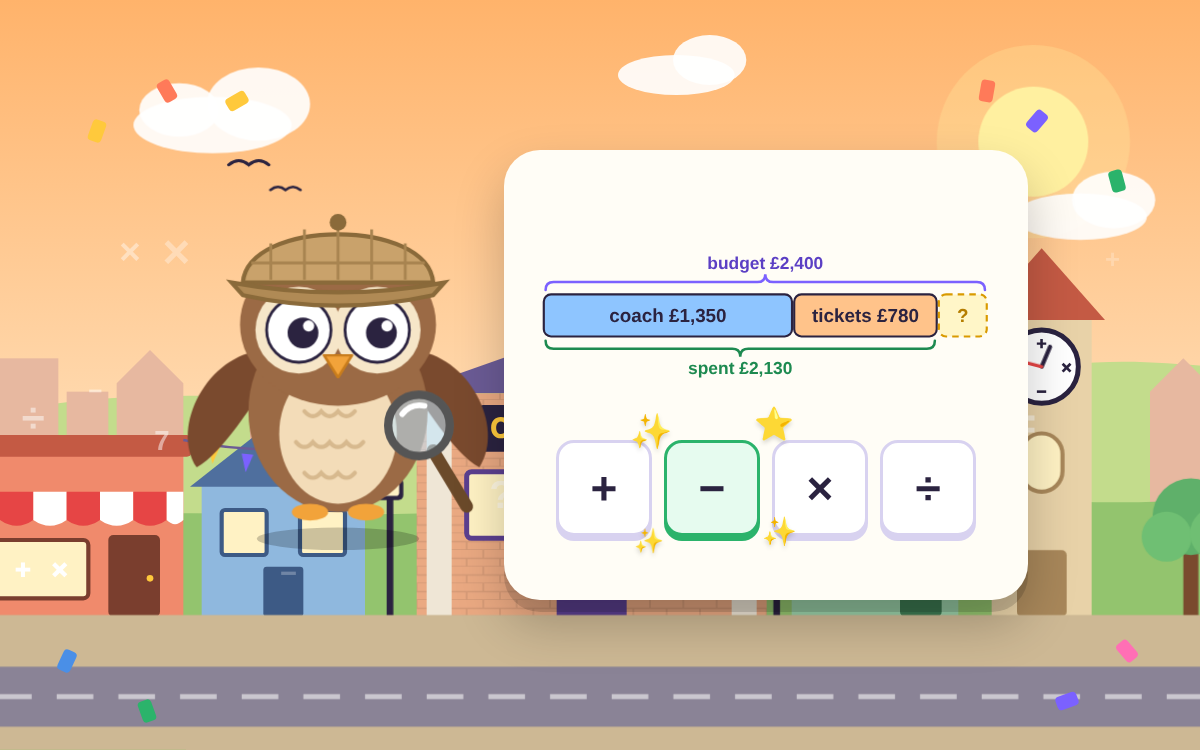
Guided by Inspector Ivy, a detective owl, players treat each problem as a case to crack. They build bar models piece by piece to see the parts and the whole, choose the operation for every step and type their answers on a number pad. Along the way they pick between mental and column methods, estimate by rounding, check results with inverse operations (the calculation that undoes another) and decide whether a remainder should be rounded up or down.
Hints appear after a wrong answer, an optional warm-up refreshes the four operations, and an eight-question final challenge mixes everything together.
A multi-step word problem is a maths question that needs two or more calculations, where the answer to one step is used in the next. For example, finding the change after buying 28 tickets at £7 each means multiplying first, then subtracting.
Think about what is really happening in the story rather than relying on single words like 'more'. Add when you know the parts, subtract when you know the whole and one part, multiply for equal groups, and divide to share or group a total.
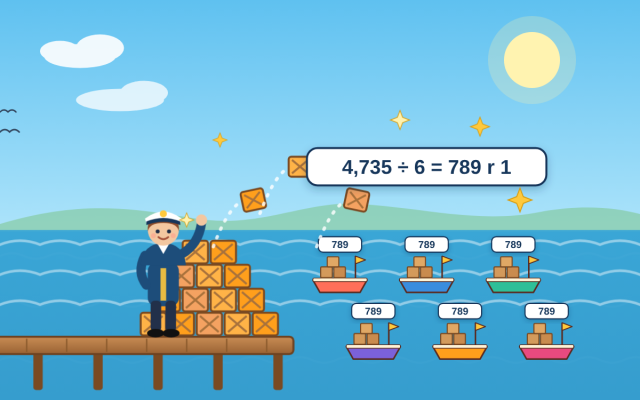
Whether you round a remainder up or down depends on what the story asks. If everyone must fit, round up, such as booking an extra minibus for leftover people; if the question asks for full groups, round down, such as counting only full egg boxes.
The game is designed for children aged 9 to 11 and matches Year 6 maths in England (Key Stage 2). Confident Year 5 pupils can also play it, especially after the optional warm-up on the four operations.
The game has an optional warm-up, four chapters with animated introductions and guided cases, and an eight-question final challenge. Playing everything takes about 50 minutes, and children can start any chapter from the case board.


 TapLearn
Getting it ready…
Great work on chapter 1! To open the next chapters, ask a grown-up to take a look.
To play this game, ask a grown-up to take a look. There are lots of free games you can play right now too!
Create a free family account and your child can play every chapter of every game for 7 days, with no card needed. Their progress is kept. After that, the free plan is free for ever, and membership is £6.99 a month if you'd like to keep every chapter.
That's all the learning time for today. Great work! Flip will be ready to play again tomorrow.