Conductors and Insulators: Light the Bulb with Lumi
Learn which materials are conductors and insulators and why metals conduct, by testing everyday objects in a circuit to see if the bulb lights.
- Ages 7–10
- About 40 min
- Easy start
- Electricity
Learn which materials are conductors and insulators and why metals conduct, by testing everyday objects in a circuit to see if the bulb lights.
Year 4 science · 1
Year 4 science · 1
Year 4 science · 1
Year 4 science · 1
Year 4 science · 1
What the chapters cover in the national curriculum in England:
Conductors and Insulators is an interactive science game that teaches children aged 7–10 which materials let electricity flow through them and why metals are good conductors. It follows the Year 4 electricity curriculum for England.
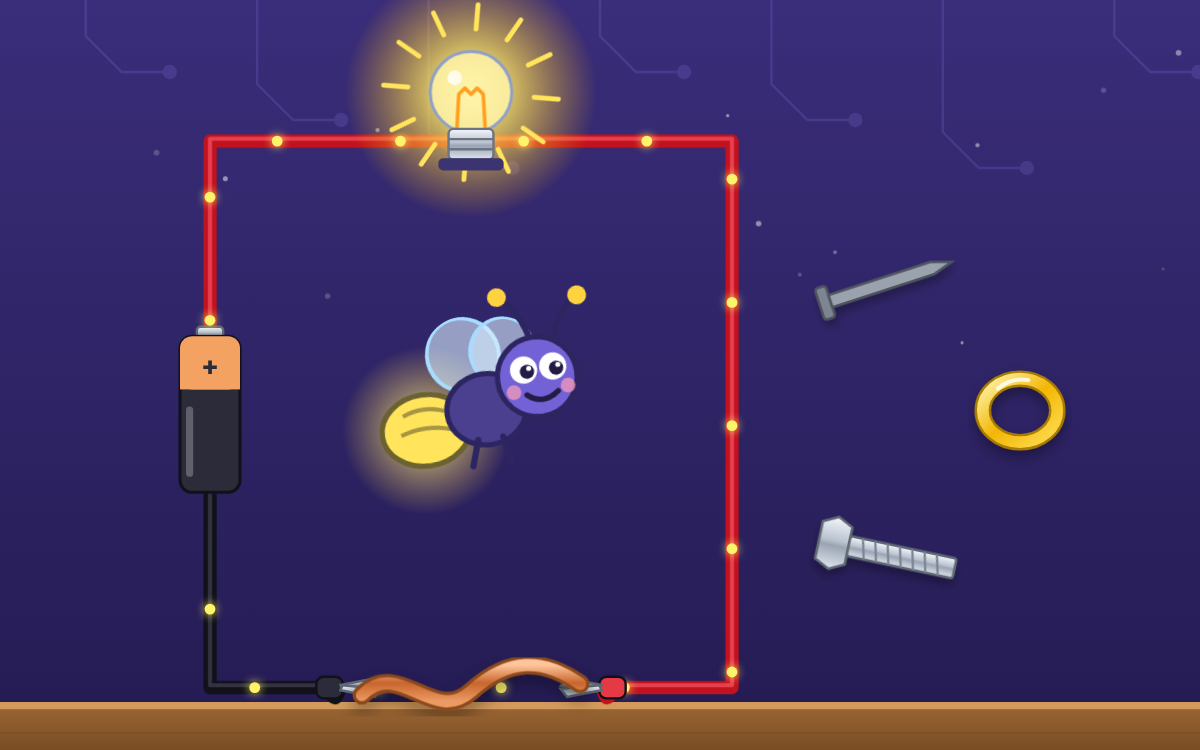
Lumi the firefly runs a light lab with a simple circuit: a battery, wires, a bulb and a gap between two crocodile clips. Children drag keys, spoons, foil, rubber, glass and more into the gap. If the bulb lights, the material is a conductor; if it stays dark, it is an insulator. They predict before each test and record the results in a table.
Tricky cases check real understanding: a shiny bead that turns out to be plastic, spoons of the same shape made of different materials, and a plastic-coated paper clip. Spoken narration, short quick checks and a 10-question challenge round it off.
A conductor is a material that lets electricity flow through it, and an insulator is a material that stops electricity flowing. In a simple circuit, a conductor placed across a gap makes the bulb light, while an insulator leaves it dark.
Metals are good conductors because electricity can flow through them easily, so copper, iron, steel and aluminium all light a bulb in a circuit. That is why the wires inside cables are made of copper.
Plastic, wood, rubber, glass and fabric are common insulators found around the home. A plastic cup, a wooden spoon, a rubber duck, a glass jar and a woolly sock will all stop electricity flowing through them.
The game is designed for children aged 7 to 10. It matches the Year 4 electricity unit of the national curriculum in England, and narration reads every line aloud for younger or less confident readers.
The game includes a short warm-up on circuits, five lab stations with hands-on tests and quick checks, and a 10-question final challenge. Playing everything takes about 40 minutes, and children can start at any station.

 TapLearn
Getting it ready…
Great work on chapter 1! To open the next chapters, ask a grown-up to take a look.
To play this game, ask a grown-up to take a look. There are lots of free games you can play right now too!
Create a free family account and your child can play every chapter of every game for 7 days, with no card needed. Their progress is kept. After that, the free plan is free for ever, and membership is £6.99 a month if you'd like to keep every chapter.
That's all the learning time for today. Great work! Flip will be ready to play again tomorrow.