What the check is for
By the end of Year 4, the national curriculum expects children to recall their multiplication and division facts up to 12×12. The multiplication tables check is how schools in England find out how fluent each child is, so teachers can see who needs more support before Year 5, when those facts are used in long multiplication, fractions and much more.
It is a check, not an exam. It takes only a few minutes, and most children do it on a laptop or tablet at school as part of an ordinary day.
What the check looks like
- 25 questions, all multiplication (no division), from the tables up to 12×12.
- 6 seconds to answer each question, typed with an on-screen or ordinary keyboard.
- Three practice questions first, so your child knows what to expect.
- The whole check takes only about five minutes.
Schools can let children use a "try it out" version from 26 April 2027, so many classes practise the screen before the real thing. Children with additional needs can have adjustments to how the check is given; the school will talk to you about this if it applies.
When is the multiplication tables check in 2027?
Schools choose when to give the check during a two-week window, Monday 7 June to Friday 18 June 2027. Children who are absent can catch up between 21 and 25 June. Your child's teacher will know the exact day.
Is there a pass mark?
No. There is no pass mark and no expected standard. Each child gets a score out of 25. Your child's school must tell you the score by the end of the summer term, usually in the annual report.
Results for individual schools are not published. The government publishes only national and local authority figures. In 2025, the national average score was 21.0 out of 25, and 37% of children scored full marks. Figures for 2026 are usually published in late November.
A score below 25 is not a fail. It simply shows which facts need more practice, which is useful for you and the teacher.
Which times tables are learned in which year?
Times tables build up over three years in the national curriculum:
- Year 2: the 2, 5 and 10 times tables.
- Year 3: the 3, 4 and 8 times tables.
- Year 4: all the times tables up to 12×12, ready for the check.
Knowing the related division facts matters too, even though the check itself only asks multiplication questions. For a fuller plan, see how to help your child learn their times tables.
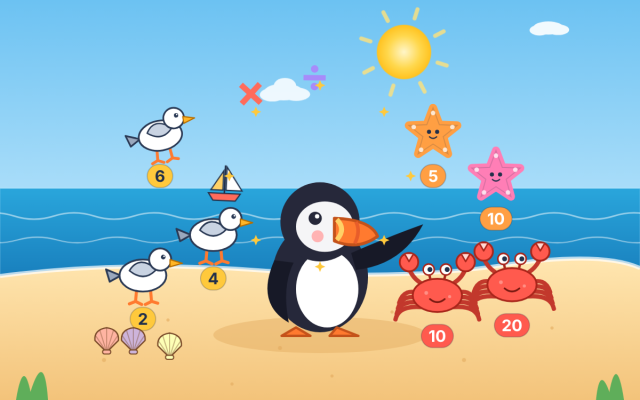
2, 5 and 10 Times Tables: A Beach Adventure with Pip
Learn the 2, 5 and 10 times tables, their division facts and odd and even numbers by calling seagulls, crabs…
Year 3 Multiplication and Division: Pip's Times Market
Learn Year 3 multiplication and division, from times-table facts to written methods, by baking, sharing and s…
Short Multiplication: Run the Times Factory with Bolt
Learn short multiplication, the distributive law, scaling and combination problems by helping Bolt the robot…
Multiplication and Division Word Problems in Times Town
Learn to solve multiplication and division word problems with equal groups, arrays and sharing, by filling pl…Coming soon: vote for the games you'd like first
- Times tables (Year 4)Not made yet
- Times tables (Year 3)Being made now
Calm ways to practise at home
- Little and often. Five minutes a few times a week does more than a long session at the weekend.
- Use what they know. If your child knows 5×7, they can work out 6×7 by adding one more 7. Patterns like this make the harder facts feel less random.
- Say them out loud. Chant a table on the walk to school, or take turns asking each other a fact in the car.
- Focus on the tricky few. Most children know the 2s, 5s and 10s. Spend your time on the handful of facts that still trip them up, and come back to them over the following weeks.
- Keep the clock gentle. Speed comes from knowing a fact, not from rushing. Practise for accuracy first and let speed follow.
- Talk to the teacher if your child is worried. They can tell you how the class is preparing and which tables to focus on.
The MTC applies in England only. Northern Ireland is introducing its own low-stakes Year 5 multiplication check, and Scotland and Wales do not have one.
 TapLearn