Joined Handwriting: Learn the Joins with Loopy the Pencil
Learn joined handwriting with diagonal and horizontal joins, which letters stay unjoined and how to write neatly, by tracing joins on screen.
- Ages 7–9
- About 35 min
- Easy start
- Handwriting
Learn joined handwriting with diagonal and horizontal joins, which letters stay unjoined and how to write neatly, by tracing joins on screen.
Years 3–4 english · 1
Years 3–4 english · 1
Years 3–4 english · 1
Years 3–4 english · 2
Years 3–4 english · 2
What the chapters cover in the national curriculum in England:
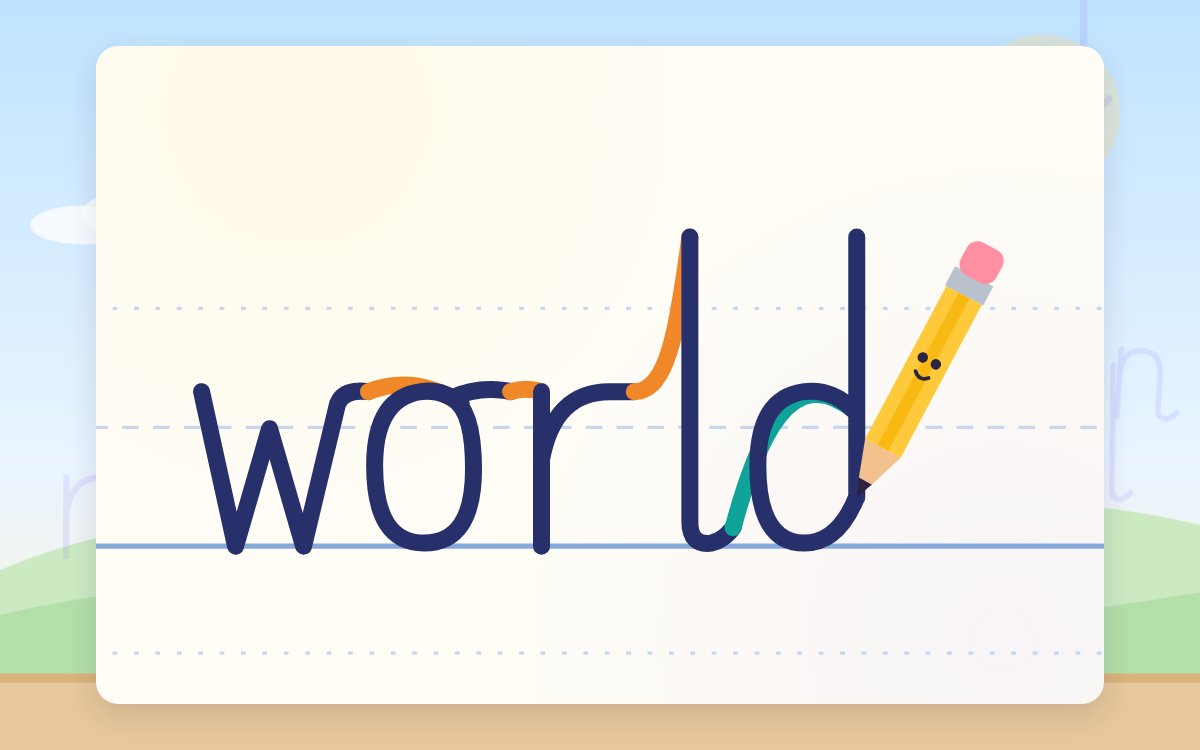
Joined Handwriting is an interactive game that teaches children aged 7–9 how to join letters with diagonal and horizontal strokes, which letters are best left unjoined, and how to make their writing neat and easy to read. It follows the Year 3 and 4 handwriting objectives in the national curriculum in England.
Children trace each join with a finger or mouse while Loopy the pencil talks them through it. Diagonal joins slant up from the bottom of a letter. Horizontal joins run flat across the top after o, r, v and w. Children also practise leaving a small gap after tail letters and capitals.
Later activities focus on legibility. Children learn to keep downstrokes parallel and evenly spaced and letters a consistent size. They also learn to space lines so ascenders (the tall parts of letters) and descenders (the tails) never touch.
Joined handwriting is writing where small joining strokes link the letters, so the pencil moves from one letter to the next without lifting. In England, children are expected to use joined handwriting throughout their independent writing in Years 3 and 4.
A diagonal join slants up from the bottom of a letter such as a, i or n to the start of the next letter. A horizontal join runs flat across the top from letters that finish high, such as o, r, v and w.
Letters with tails below the line, such as g, j and y, are usually left unjoined to the next letter. So are x, z and capital letters. Some schools also leave b, p and q unjoined, so children should follow their own school's style.
The game is designed for children aged 7 to 9, matching Years 3 and 4 of the national curriculum in England. An optional warm-up on tall, short and tail letters helps less confident writers get started.
Playing everything takes about 35 minutes, and children can start with any chapter. The game includes an optional warm-up, five chapters of tracing and sorting activities, and an eight-question champion quiz at the end.

 TapLearn
Getting it ready…
Great work on chapter 1! To open the next chapters, ask a grown-up to take a look.
To play this game, ask a grown-up to take a look. There are lots of free games you can play right now too!
Create a free family account and your child can play every chapter of every game for 7 days, with no card needed. Their progress is kept. After that, the free plan is free for ever, and membership is £6.99 a month if you'd like to keep every chapter.
That's all the learning time for today. Great work! Flip will be ready to play again tomorrow.