What you'll learn
- What a line of symmetry is and how to test it by folding
- Why a rectangle's diagonal is not a line of symmetry
- Find vertical, horizontal and diagonal lines of symmetry in turned shapes
- How many lines of symmetry squares, rectangles and equilateral triangles have
- Complete symmetric patterns by counting squares from the mirror line
- Reflect each corner across a mirror line to complete a shape
Chapter by chapter
- Lines of symmetry: the fold and mirror test Free to try
Year 4 maths · 1
- Lines of symmetry in different orientations: turned shapes
Year 4 maths · 1
- Completing symmetric patterns on squared paper
Year 4 maths · 2
- Completing symmetric shapes about a mirror line
Year 4 maths · 2
- Symmetry challenge: lines of symmetry and symmetric figures (8 questions)
What the chapters cover in the national curriculum in England:
- Year 4 maths: Identify lines of symmetry in 2-D shapes presented in different orientations
- Year 4 maths: Complete a simple symmetric figure with respect to a specific line of symmetry
About this adventure
Lines of Symmetry is an interactive maths game that teaches children aged 7–10 how to find lines of symmetry in 2-D shapes and how to complete symmetric figures, following the Year 4 national curriculum for England.
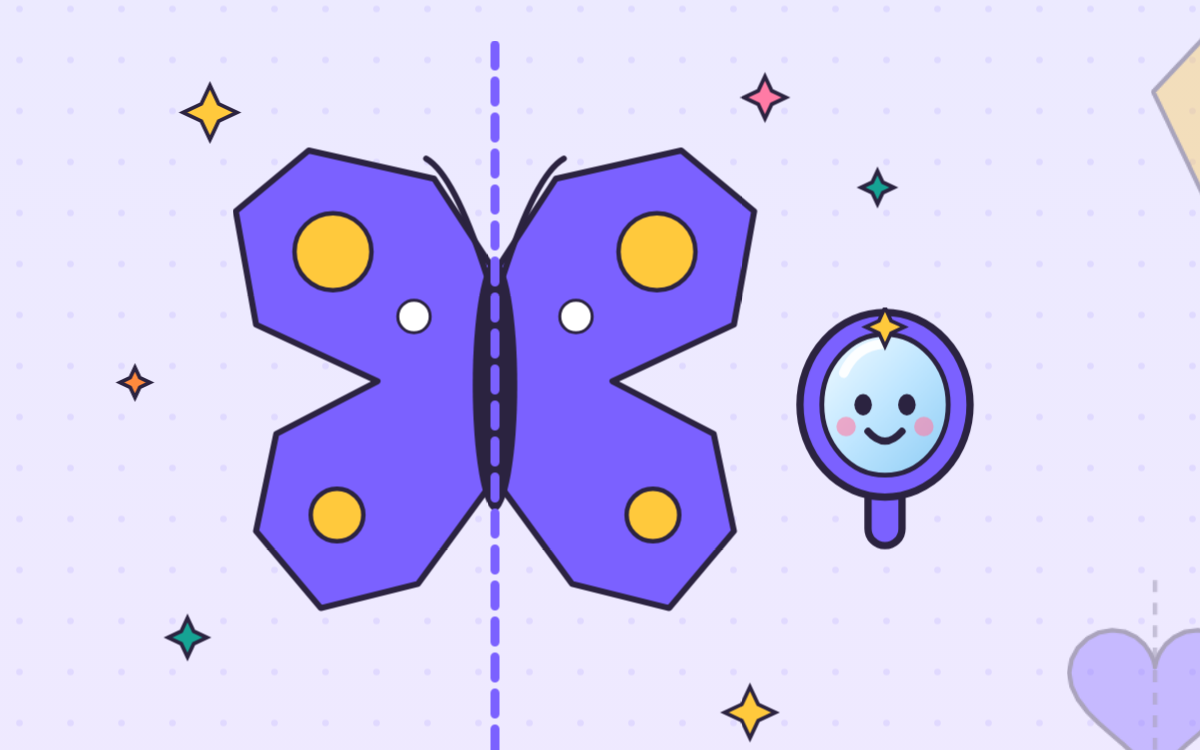
Guided by Mira, a talking magic mirror, players fold paper shapes to see whether both halves match exactly, slide a mirror until a half-drawn rocket looks whole, and turn shapes to watch their lines of symmetry turn with them. Later they colour squares on squared paper and plot corners on dotty paper to finish shapes, then fold them over to check.
The key ideas: a line of symmetry, or mirror line, splits a shape into two mirror-image halves; lines can be vertical, horizontal or diagonal; and turning a shape never changes how many lines it has.
Questions and answers
What is a line of symmetry, in simple words?
A line of symmetry is a line that splits a shape into two halves that are mirror images of each other. If you fold the shape along that line, the two halves match exactly. It is also called a mirror line.
Is the diagonal of a rectangle a line of symmetry?
No, the diagonal of a rectangle that is not a square is not a line of symmetry. It cuts the rectangle into two equal triangles, but when you fold along it the corners stick out, so the halves are not mirror images.
How do you complete a symmetrical pattern on squared paper?
Count how many squares each shaded square is from the mirror line, then shade the square the same distance away on the other side. Always count from the mirror line, not from the edge of the grid, and keep each square's colour the same.
What age is this symmetry game for?
The game is designed for children aged 7 to 10 and matches the Year 4 symmetry objectives in the national curriculum for England. Children a little younger who know their shape names, or older children revising for tests, can play it too.
What does the symmetry game include and how long does it take?
It includes an optional warm-up, four guided chapters and an eight-question final challenge, with a spoken narrator and sound effects. Playing everything takes about 45 minutes, and children can start any chapter from the map.

 TapLearn