Short Multiplication: Run the Times Factory with Bolt
Learn short multiplication, the distributive law, scaling and combination problems by helping Bolt the robot fill orders in the Times Factory.
- Ages 8–10
- About 55 min
- Some thinking
- Calculation
Learn short multiplication, the distributive law, scaling and combination problems by helping Bolt the robot fill orders in the Times Factory.
Year 4 maths · 1
Year 4 maths · 2
Year 4 maths · 2
Year 4 maths · 1
Year 4 maths · 1
What the chapters cover in the national curriculum in England:
Short Multiplication: Run the Times Factory is an interactive maths game that teaches children aged 8–10 to multiply two- and three-digit numbers by a one-digit number using the formal written method, matching Year 4 of the national curriculum in England. Players help Bolt the robot fill factory orders. They type answers on a number pad and get hints aimed at common slips, such as forgetting to add a carried digit.
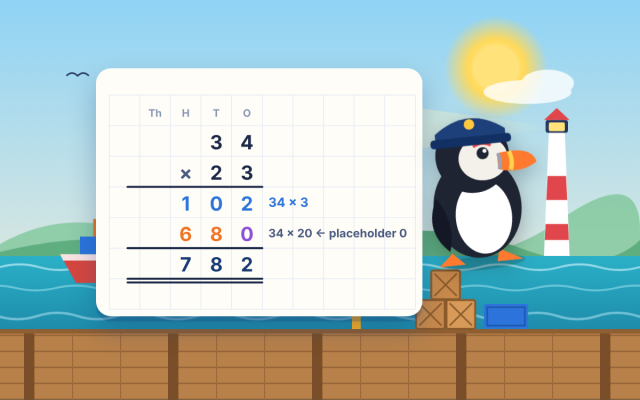
Along the way they meet the distributive law: splitting 23 into 20 and 3, multiplying each part, then adding. They then see that short multiplication is the same idea written in tidy columns. Bar models help with 'times as many' scaling problems. Correspondence problems show that when every hat goes with every scarf, you multiply to count the outfits. Spoken narration reads every instruction aloud.
Short multiplication means writing the numbers in columns and multiplying one digit at a time, starting with the ones. If a column makes ten or more, write the ones digit and carry the tens digit to the next column, adding it after you multiply.
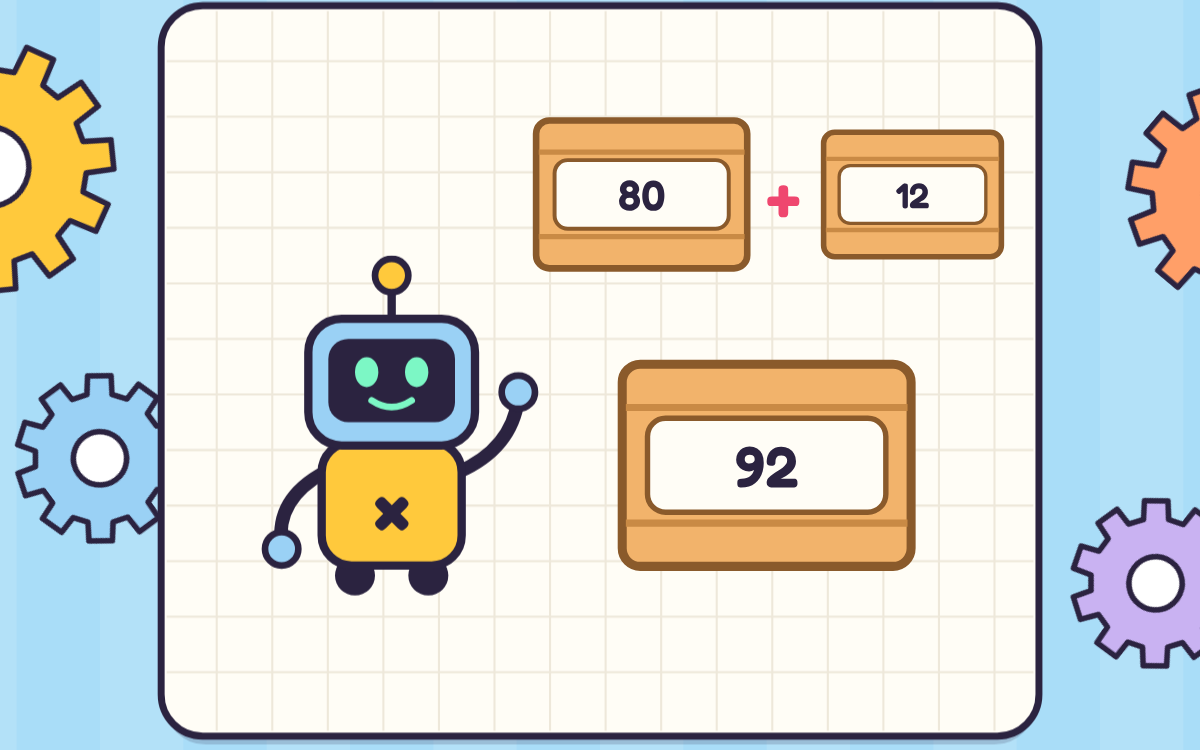
The distributive law means you can split a number into parts, multiply each part, then add the answers together. For example, 23 × 4 is the same as 20 × 4 plus 3 × 4, which is 80 + 12 = 92.
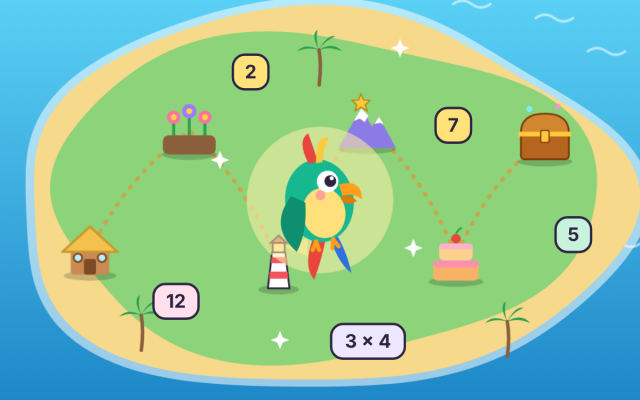
A correspondence problem asks how many combinations you can make when every item in one group can go with every item in another. With 3 hats and 4 scarves there are 3 × 4 = 12 different outfits, not 3 + 4.
The game is designed for children aged 8 to 10. It follows the Year 4 maths curriculum in England (KS2) and also works well as revision for children in Year 5 who need more practice with carrying.
The game has five chapters and a 10-question Factory Boss Challenge, and takes about an hour to play in full. Each chapter has an animated introduction, hands-on activities, typed answers with hints and an animated recap, and the first two chapters offer an optional warm-up.

 TapLearn
Getting it ready…
Great work on chapter 1! To open the next chapters, ask a grown-up to take a look.
To play this game, ask a grown-up to take a look. There are lots of free games you can play right now too!
Create a free family account and your child can play every chapter of every game for 7 days, with no card needed. Their progress is kept. After that, the free plan is free for ever, and membership is £6.99 a month if you'd like to keep every chapter.
That's all the learning time for today. Great work! Flip will be ready to play again tomorrow.