Which times tables should my child know, and when?
The national curriculum in England spreads times tables across three school years:
- Year 2: the 2, 5 and 10 times tables, including the matching division facts (if 5 × 4 = 20, then 20 ÷ 5 = 4).
- Year 3: the 3, 4 and 8 times tables.
- Year 4: all the tables up to 12 × 12.
Before that, in Year 1, children count in 2s, 5s and 10s, which is the groundwork for everything that follows.
In June of Year 4, children in England take the multiplication tables check. It has 25 timed questions on screen, up to 12 × 12, and there is no pass mark. In 2027 the check runs between 7 and 18 June. It helps the school see who needs more practice. It is not a test your child passes or fails. (Scotland, Wales and Northern Ireland have their own curricula and checks.)
What order should times tables be learned in?
School usually follows the order above, and it works well at home too, because each new table leans on one your child already knows:
- 10, then 2, then 5. These have clear patterns. The 10s end in 0, the 2s are doubles, and the 5s end in 5 or 0. Also, 5 × 7 is half of 10 × 7.
- 4 and 8. These are the doubling family: double the 2s fact to get the 4s, then double again to get the 8s.
- 3, then 6, then 12. The 6s are double the 3s, and the 12s are double the 6s.
- 9 and 11. 9 × 7 is 10 × 7 take away one 7, which is 70 − 7 = 63. The 11s are easy up to 9 × 11.
- 7 last. By now your child already knows most of the 7s from other tables, which leaves only a handful of new facts.
Patterns that make it easier
- Turn-arounds. 3 × 8 is the same as 8 × 3. Once your child really believes this, there are nearly half as many facts to learn.
- Doubling: ×2 → ×4 → ×8. To find 8 × 7, start from 2 × 7 = 14. Double it to get 4 × 7 = 28, then double again to get 8 × 7 = 56.
- Halving: ×10 → ×5. 10 × 6 = 60, so 5 × 6 is half of that: 30.
- Division comes free. Show your child that 6 × 8 = 48 also tells them 48 ÷ 8 = 6 and 48 ÷ 6 = 8.
- Square numbers. Facts like 6 × 6, 7 × 7 and 8 × 8 are worth learning as a set, because many other facts sit next to them.
Little and often: how to practise
A few minutes on most days does more than one long session at the weekend. Times tables are facts to remember, and they stick best when your child meets them again after a gap: the next day, then a few days later, then the following week.
- Work on a few facts at a time. Mix two or three tricky ones in with facts your child already knows, so practice feels successful.
- Ask facts out of order. Chanting a table from the start is a good beginning. Your child also needs to answer 7 × 8 without counting up from 7 × 1, so ask facts in a jumbled order.
- Understanding first, speed last. Make sure your child can work a fact out (for example by doubling), then that they get it right every time, and only then aim for speed.
- Watch for the usual mix-ups. Facts like 6 × 8, 7 × 8 and 6 × 7 get muddled with each other, so give these a little extra practice.
Games and everyday ideas
- Ping-pong: you ask a fact, your child answers and then asks you one back. Get one wrong now and then on purpose.
- Dice times: roll two dice and multiply the numbers. Use 10-sided dice once your child moves on to bigger tables.
- Real groups: packs of yoghurts, egg boxes, legs on three spiders, wheels on four cars.
- Counting steps: count up the stairs in 3s or 4s, one step per number.
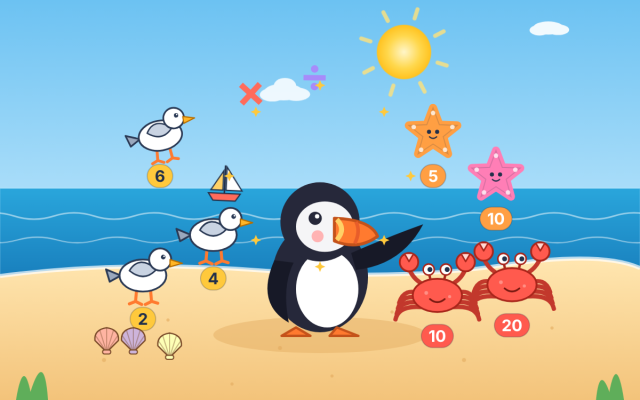
2, 5 and 10 Times Tables: A Beach Adventure with Pip
Learn the 2, 5 and 10 times tables, their division facts and odd and even numbers by calling seagulls, crabs…
Year 3 Multiplication and Division: Pip's Times Market
Learn Year 3 multiplication and division, from times-table facts to written methods, by baking, sharing and s…
Multiplication and Division: Share, Group and Grow a Garden
Learn multiplication and division with equal groups, sharing, grouping and arrays, then help Dotty the ladybi…
Multiplication and Division Word Problems in Times Town
Learn to solve multiplication and division word problems with equal groups, arrays and sharing, by filling pl…On TapLearn, Flip's quick review brings back facts your child practised earlier, after a gap, so you don't have to keep track yourself. The skills report shows which facts are secure and which mix-ups to watch for. A game for the tables up to 12 × 12 isn't ready yet:
Coming soon: vote for the games you'd like first
- Times tables (Year 4)Not made yet
- Telling the time (Year 4)Not made yet
- Times tables (Year 3)Being made now
Keeping it calm
Some children learn their tables quickly. Others need most of Year 4, and some keep practising after that, which is normal. If timed questions make your child anxious, take the clock away at home and focus on getting facts right. Speed tends to follow. If a table just isn't sticking, ask the class teacher how they're teaching it at school, so you can use the same words and methods at home.
 TapLearn