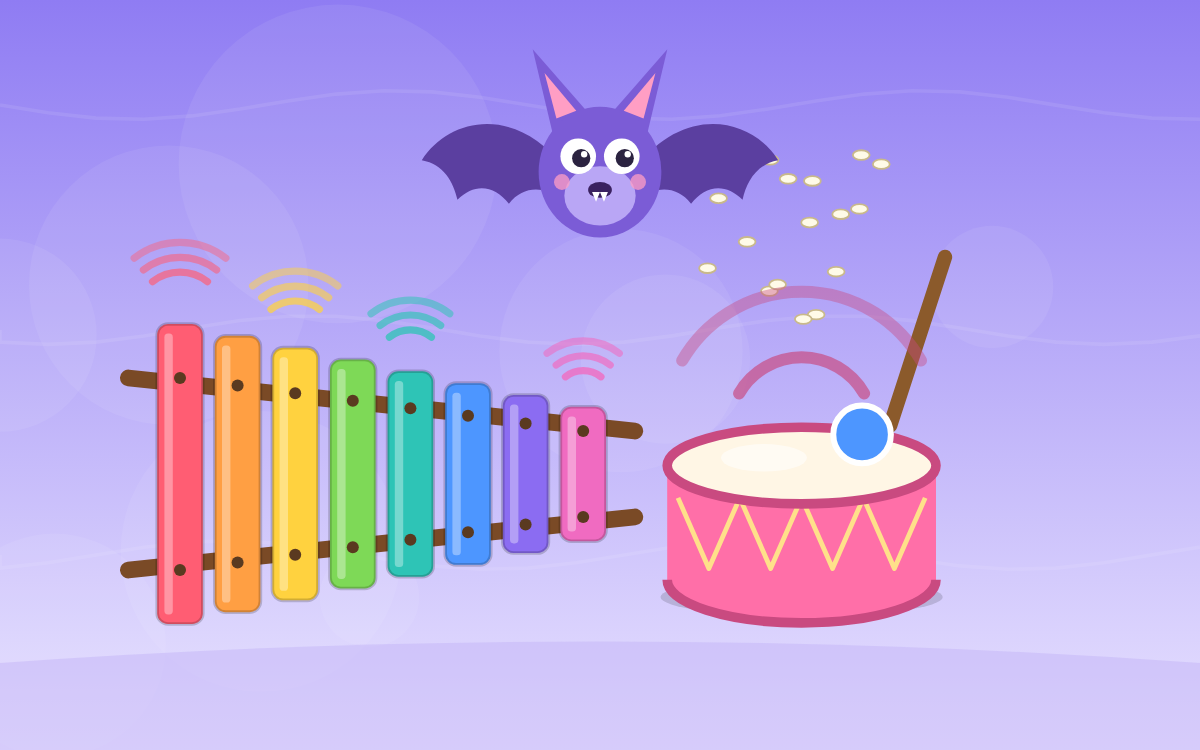
Pitch and Volume: A Sound Lab Adventure with Echo the Bat
Learn what changes the pitch and volume of a sound by plucking strings, tuning drums, ordering pan pipes and making rice jump in a sound lab.
- Ages 7–10
- About 45 min
- Easy start
- Light & Sound
Learn what changes the pitch and volume of a sound by plucking strings, tuning drums, ordering pan pipes and making rice jump in a sound lab.
Year 4 science · 1
Year 4 science · 1
Year 4 science · 1
Year 4 science · 2
Year 4 science · 1 Year 4 science · 2
What the chapters cover in the national curriculum in England:
Pitch and Volume is an interactive science game that teaches children aged 7–10 what makes a sound high or low, and what makes it loud or quiet. It follows the Year 4 Sound unit of the national curriculum in England.
Guided by Echo the bat, players make real sounds and listen to how they change. They twang rulers, tap xylophone bars, tighten elastic bands on a box guitar and tune a drum skin to a target note. Along the way they discover that pitch is how high or low a sound is, and that shorter, smaller, tighter or thinner objects vibrate faster and sound higher.
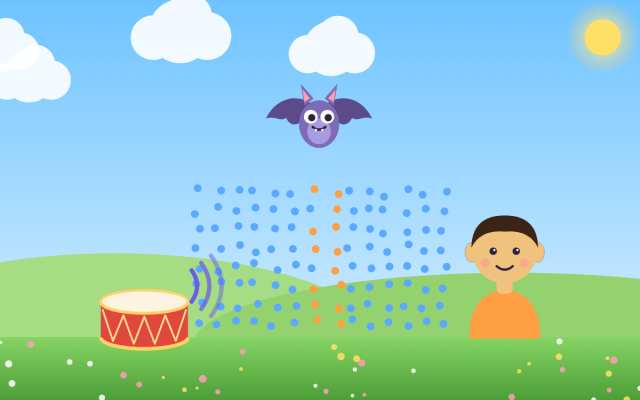
Players then pull back a drum beater to see that stronger vibrations make louder sounds, read a decibel scale and learn why very loud sounds can harm hearing. A sound desk and detective cases help them tell pitch and volume apart.
Pitch is how high or low a sound is, like a squeaky mouse compared with a mooing cow. Volume is how loud or quiet a sound is. A note can stay the same pitch while it gets louder or quieter.
A sound is high pitched when the object making it vibrates quickly, and low pitched when it vibrates slowly. Shorter, smaller, tighter or thinner objects usually vibrate faster, so they make higher sounds than longer, bigger, looser or thicker ones.
Hitting a drum harder makes its skin vibrate more strongly, with bigger movements. Stronger vibrations make louder sounds, while a gentle tap makes small vibrations and a quiet sound. The pitch of the drum stays the same.
The game is made for children aged 7 to 10 and matches the Year 4 Sound unit taught at Key Stage 2 in England. A short optional warm-up about vibrations helps younger or newer players get started.
It includes an optional warm-up, five chapters with hands-on sound experiments and a ten-question final challenge. Playing everything takes about 45 minutes, and children can choose any chapter from the map and come back to it later.
 TapLearn
Getting it ready…
Great work on chapter 1! To open the next chapters, ask a grown-up to take a look.
To play this game, ask a grown-up to take a look. There are lots of free games you can play right now too!
Create a free family account and your child can play every chapter of every game for 7 days, with no card needed. Their progress is kept. After that, the free plan is free for ever, and membership is £6.99 a month if you'd like to keep every chapter.
That's all the learning time for today. Great work! Flip will be ready to play again tomorrow.