How Sound Travels: A Vibration Adventure with Echo the Bat
Learn how sound travels, from the vibration that makes it to your ear. Tap drums, test a string telephone and watch sounds fade with distance.
- Ages 7–10
- About 35 min
- Easy start
- Light & Sound
Learn how sound travels, from the vibration that makes it to your ear. Tap drums, test a string telephone and watch sounds fade with distance.
Year 4 science · 1
Year 4 science · 2
Year 4 science · 2
Year 4 science · 3
What the chapters cover in the national curriculum in England:
How Sound Travels is an interactive science game that teaches children aged 7–10 how sounds are made, how they reach the ear and why they get fainter with distance. It follows the Year 4 Sound topic in the national curriculum for England.
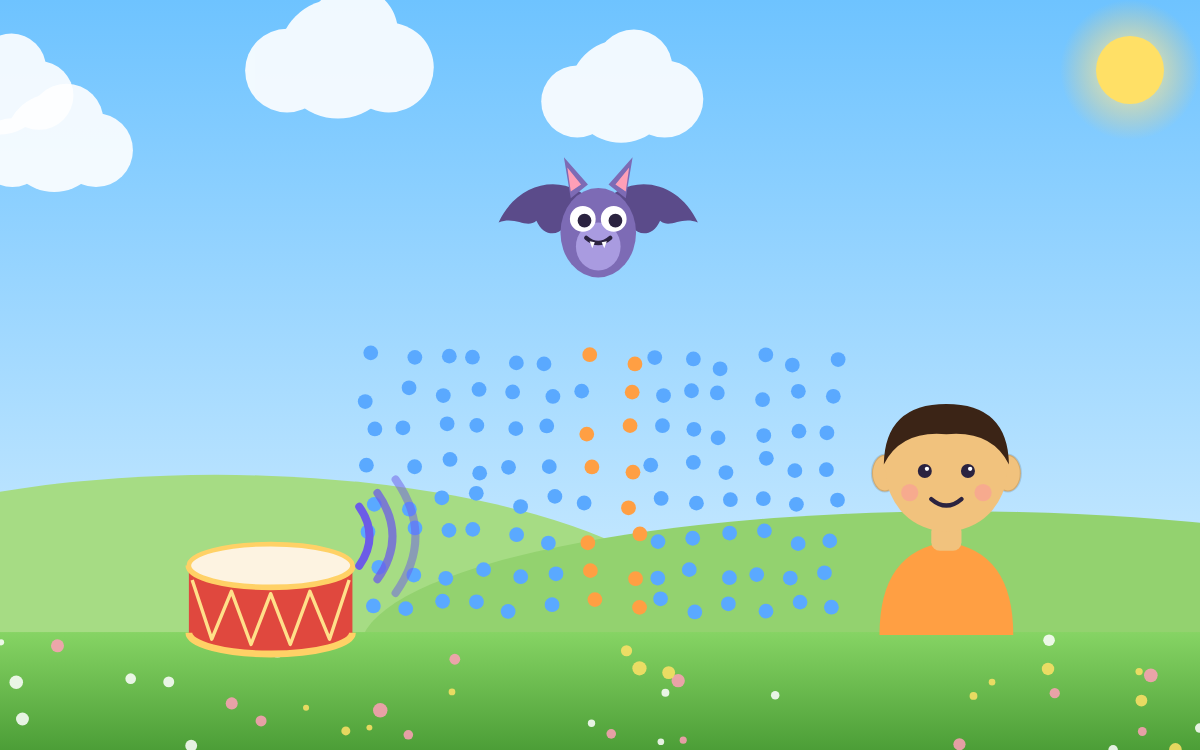
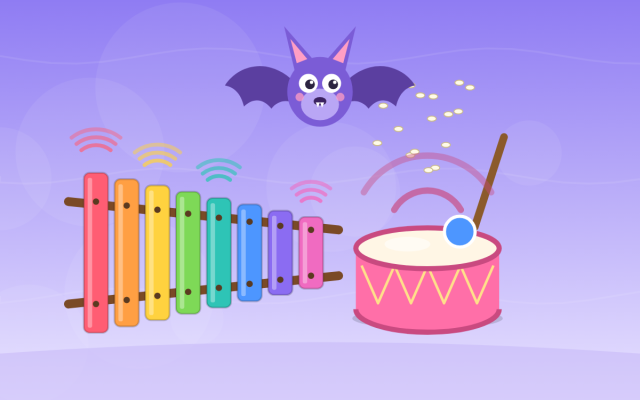
Guided by Echo the bat, players tap a drum covered in rice, pluck rubber bands and dip a ringing tuning fork in water to see that every sound comes from something vibrating. They pass a vibration through tiny air particles, learn that the stuff sound travels through is called a medium, and follow the vibration to the eardrum and brain.
Players also send sound through solids and liquids, drag a listener away from a drum to hear it fade, and measure the sound at different distances on a bar chart. A final eight-question quiz checks what they have learned.
Sound travels as vibrations passed from particle to particle. When something vibrates, it bumps the air particles next to it, they bump the next ones, and the vibration travels on until it reaches your ear and makes your eardrum vibrate.
Sounds get fainter with distance because the vibrations spread out as they travel, so they get weaker. Weaker vibrations make your eardrum vibrate less, so the sound seems quieter. It fades gradually rather than stopping suddenly.
Yes, sound travels through solids, liquids and gases, because they are all made of particles that can pass on vibrations. Sound moves about four times faster through water than through air, but it cannot travel through empty space, where there are no particles.
The game is designed for children aged 7 to 10 and matches the Year 4 Sound topic in the national curriculum for England. Spoken narration, short captions and hands-on tasks help younger readers follow along.
The game has four chapters and an eight-question quiz, and takes about 35 minutes to play through. Each chapter opens and closes with an animated scene, includes hands-on experiments with sound effects, and ends with quick check questions.
 TapLearn
Getting it ready…
Great work on chapter 1! To open the next chapters, ask a grown-up to take a look.
To play this game, ask a grown-up to take a look. There are lots of free games you can play right now too!
Create a free family account and your child can play every chapter of every game for 7 days, with no card needed. Their progress is kept. After that, the free plan is free for ever, and membership is £6.99 a month if you'd like to keep every chapter.
That's all the learning time for today. Great work! Flip will be ready to play again tomorrow.