What you'll learn
- Line up digits by place value before adding or subtracting
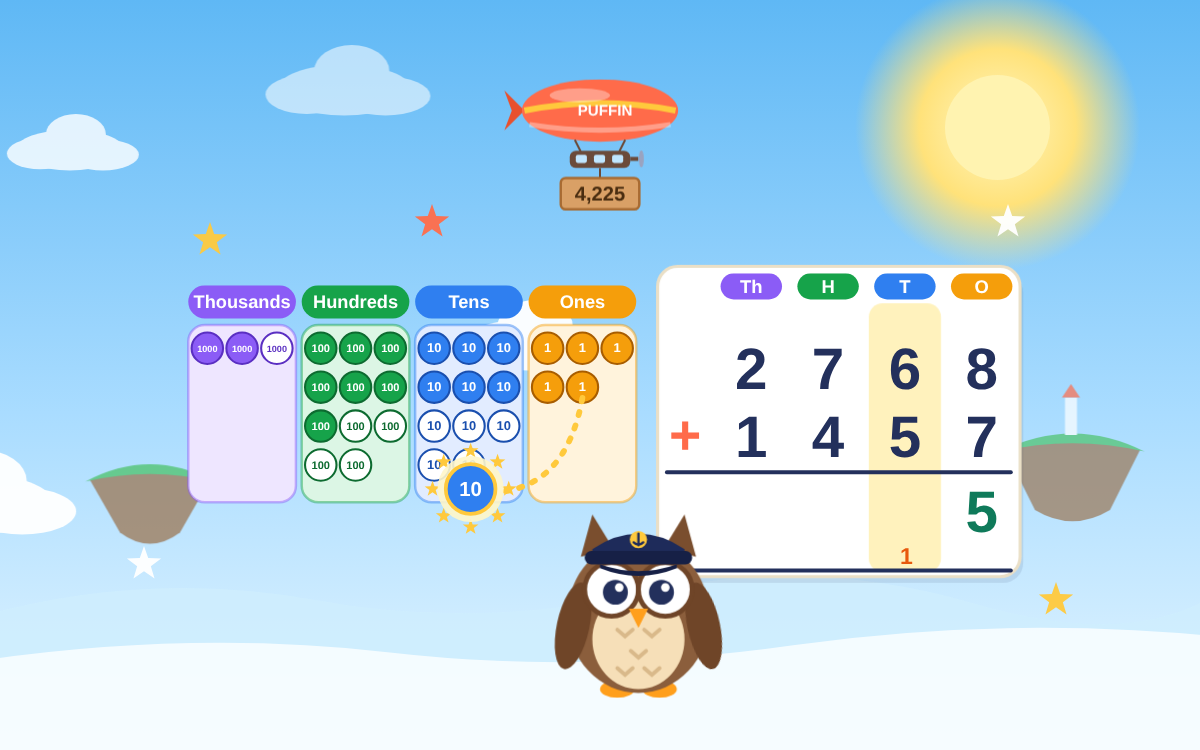
- Use column addition, exchanging ten ones for one ten
- Use column subtraction, exchanging across zeros when needed
- Estimate answers by rounding to the nearest 100 or 1,000
- Check answers using the inverse operation
- Solve two-step word problems by choosing add or subtract
Chapter by chapter
- Column addition: lining up and adding 4-digit numbers Free to try
Year 4 maths · 1
- Column addition with exchanging (carrying ten)
Year 4 maths · 1
- Column subtraction: subtracting 4-digit numbers with an exchange
Year 4 maths · 1
- Column subtraction with more than one exchange and with zeros
Year 4 maths · 1
- Estimating answers by rounding
Year 4 maths · 2
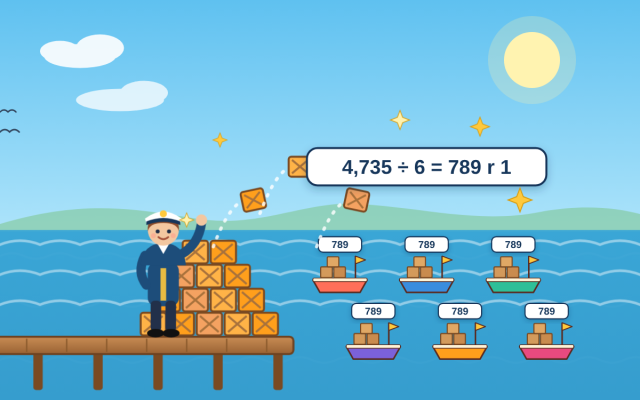
- Checking answers with the inverse: add to check subtraction, subtract to check addition
Year 4 maths · 2
- Two-step problems: choosing to add or subtract, and why
Year 4 maths · 3
- Grand Sky Harbour Challenge (10 questions)
What the chapters cover in the national curriculum in England:
- Year 4 maths: Add and subtract numbers with up to 4 digits using the formal written methods of columnar addition and subtraction where appropriate
- Year 4 maths: Estimate and use inverse operations to check answers to a calculation
- Year 4 maths: Solve addition and subtraction two-step problems in contexts, deciding which operations and methods to use and why
About this adventure
Column addition and subtraction is the focus of Sky Harbour Sums, an interactive maths game for children aged 7–10 that teaches the Year 4 written methods for adding and subtracting numbers with up to 4 digits. It follows the national curriculum in England for Key Stage 2.
Players help Tock the owl harbour master count crates on and off airships. Place value counters sit next to each written calculation, so children see ten ones being exchanged for one ten, or a ten being broken into ten ones, before they write the digits. Guided examples talk them through one column at a time; then they solve sums on their own, typing each answer digit and tapping to exchange.
Later chapters cover estimating by rounding, checking with the inverse operation, and two-step word problems where the child decides whether to add or subtract at each step and why.
Questions and answers
How do you do column subtraction with exchanging?
When the top digit in a column is smaller than the bottom digit, you exchange one from the column to the left. You cross out that digit, write one less, and the column you are working on gets ten more, so 2 − 7 becomes 12 − 7.
What does carrying mean in column addition?
Carrying means exchanging ten in one column for one in the next column to the left. If the ones make 13, you write 3 in the ones column and a small 1 below the line in the tens column, then add it in.
How do you subtract when there is a zero, like 4,005 − 1,238?
You exchange from the nearest column that has something to give and pass it along. One thousand becomes ten hundreds, one hundred becomes ten tens, and one ten becomes ten ones, so the zeros become 9s and the ones become 15.
What age is column addition and subtraction taught?
Children in England meet column methods in Year 3 and use them with up to 4-digit numbers in Year 4, usually at ages 8 to 9. This game suits children aged 7 to 10, including those who need a refresher.
What is in the Sky Harbour Sums game and how long does it take?
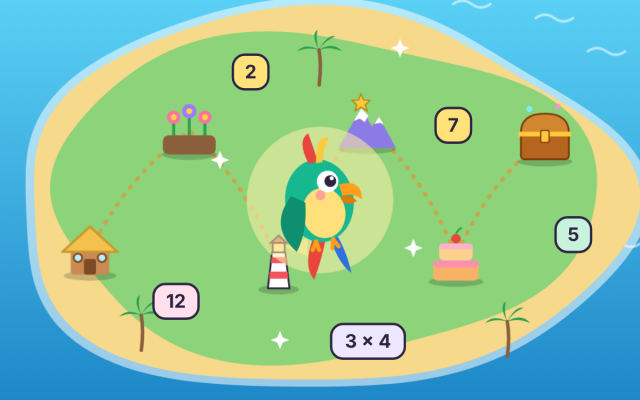
The game has seven chapters, an optional place value warm-up and a 10-question final challenge, and takes about 75 minutes to play through. Children can start any chapter from the map and come back to it later.


 TapLearn