What you'll learn
- Why one whole divided by 100 makes hundredths, written 0.01
- How to count up and down in hundredths past 0.10 and 1.00
- The decimal equivalents of 1/4, 1/2 and 3/4
- What happens to each digit when you divide by 10 or 100
- How to round a decimal like 3.5 to the nearest whole number
- How to compare decimals and write pence as part of a pound
Chapter by chapter
- Tenths and hundredths: splitting a whole into 10 and 100 Free to try
Year 4 maths · 1 Year 4 maths · 2
- Counting up and down in hundredths
Year 4 maths · 1 Year 4 maths · 2
- Decimal equivalents of 1/4, 1/2 and 3/4
Year 4 maths · 3 Year 4 maths · 2
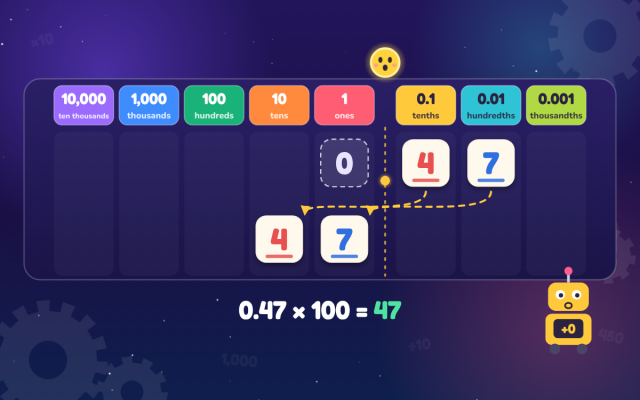
- Dividing by 10 and 100: ones, tenths and hundredths
Year 4 maths · 4
- Rounding decimals to the nearest whole number
Year 4 maths · 5
- Comparing decimals with up to two decimal places
Year 4 maths · 6
- Money and measure problems with decimals and fractions
Year 4 maths · 7 Year 4 maths · 3
- Decimal Champion Challenge (10 questions)
What the chapters cover in the national curriculum in England:
- Year 4 maths: Count up and down in hundredths; recognise that hundredths arise when dividing an object by 100 and dividing tenths by 10
- Year 4 maths: Recognise and write decimal equivalents of any number of tenths or hundredths
- Year 4 maths: Recognise and write decimal equivalents to 1/4, 1/2, 3/4
- Year 4 maths: Find the effect of dividing a one- or two-digit number by 10 and 100, identifying the value of the digits in the answer as ones, tenths and hundredths
- Year 4 maths: Round decimals with 1 decimal place to the nearest whole number
- Year 4 maths: Compare numbers with the same number of decimal places up to 2 decimal places
- Year 4 maths: Solve simple measure and money problems involving fractions and decimals to 2 decimal places
About this adventure
Year 4 Decimals is an interactive maths game that teaches children aged 8 to 10 what tenths and hundredths are and how to use them as decimals, matching the Year 4 national curriculum in England. Dot, a friendly robot, reads every line aloud with captions.
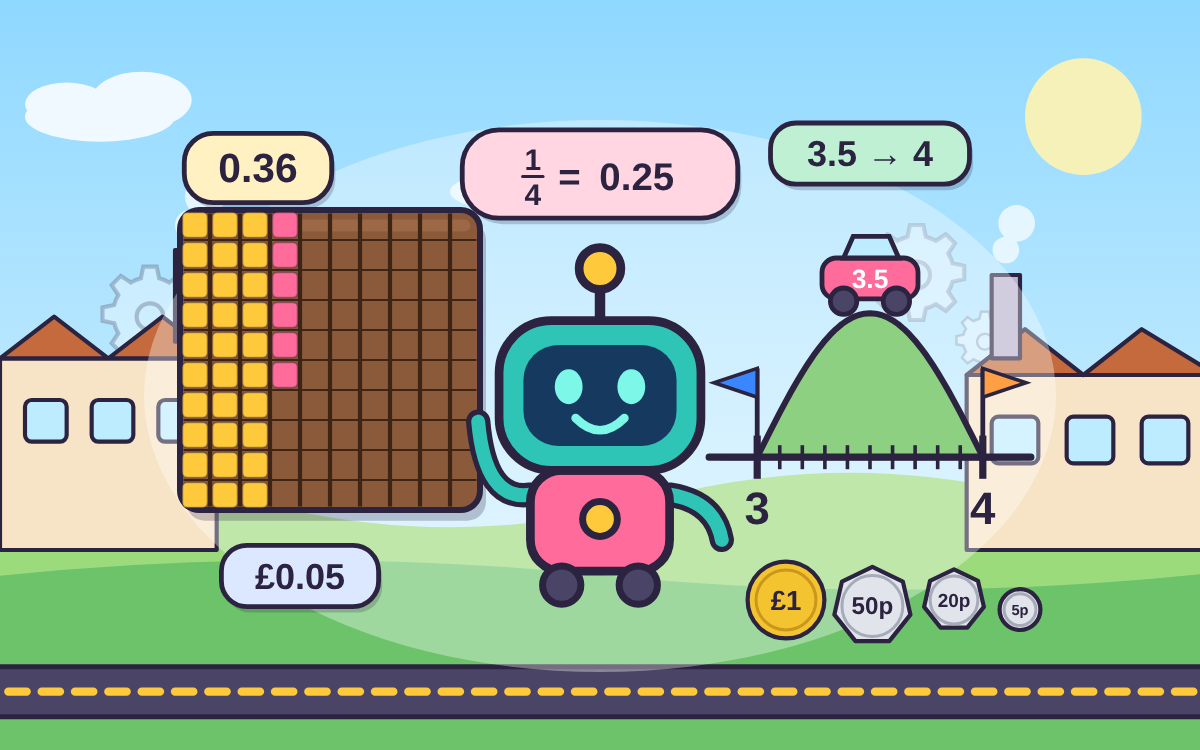
Children cut a 100-square chocolate slab to see that one whole divided by 100 makes hundredths, and that a tenth divided by 10 does too. They count across tricky spots such as 0.09 to 0.10, watch digits slide along a place value chart while the decimal point stays still, roll cars over a hill to round to the nearest whole number, and balance parcels to compare decimals.
Answers are typed on a keypad as well as chosen from options, and gentle hints target common slips, such as writing 5p as £0.5 instead of £0.05.
Questions and answers
What is a decimal, in simple words?
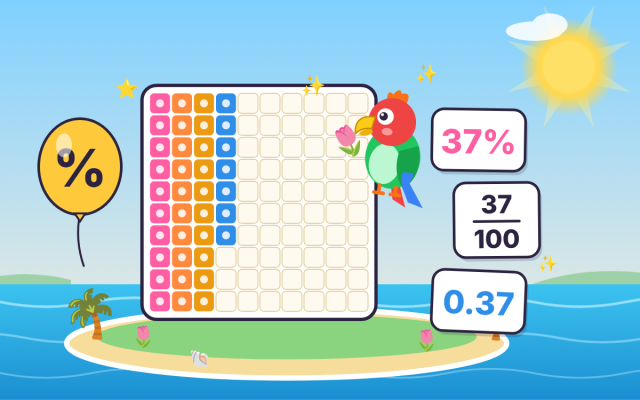
A decimal is a way of writing parts of a whole using a decimal point. The first digit after the point shows tenths and the second shows hundredths, so 0.4 means four tenths and 0.07 means seven hundredths.
What comes after 0.09 when counting in hundredths?
After 0.09 comes 0.10, which is the same as 0.1. Nine hundredths plus one more hundredth makes ten hundredths, and ten hundredths make one tenth. A common mistake is to write 0.010, which is actually a much smaller number.
How do you round a decimal to the nearest whole number?
Look at the tenths digit, the first digit after the decimal point. If it is 5 or more, round up; if it is 4 or less, round down. So 3.2 rounds to 3, while 3.5 and 3.7 both round to 4.
What age is this decimals game for?
The game is for children aged 8 to 10 and matches the Year 4 maths curriculum in England, where tenths and hundredths are taught. Every line is read aloud with captions, so it also suits Year 5 children who want a refresher.
What does the decimals game include and how long does it take?
It has seven chapters, each with an animated introduction, hands-on activities and a three-question check, plus two optional warm-ups and a 10-question Grand Challenge. Playing everything takes about an hour, and children can pick any chapter from the map.
 TapLearn