Why only about 3 in every 100 buckets of Earth's water are fresh
Why rainforests have plenty of fresh water and deserts have little
Why south-east England is drier but has lots of people
How reservoirs, rivers and groundwater supply our taps
The four cleaning steps at a water treatment works, in order
How a service reservoir and gravity bring water to our homes
Chapter by chapter
How much of Earth's water is fresh and usableFree to try
Years 3–6 geography · 1
Why fresh water is shared out unevenly around the world
Years 3–6 geography · 1
How water is collected and stored: rivers, reservoirs and underground
Years 3–6 geography · 1
How water is cleaned at a water treatment works
Years 3–6 geography · 1
How clean water is piped to our homes, and where it goes next
Years 3–6 geography · 1
Water Trail Challenge: from cloud to tap (10 questions, 2 typed) (10 questions)
What the chapters cover in the national curriculum in England:
Years 3–6 geography: Describe and understand key aspects of human geography, including: types of settlement and land use, economic activity including trade links, and the distribution of natural resources including energy, food, minerals and water
About this adventure
From Cloud to Tap is an interactive geography game that teaches children aged 7–11 where our water comes from: how fresh water is shared out unevenly around the world, and how it is collected, cleaned and piped to our homes. It matches the KS2 geography topic of natural resources in England, and Pip the raindrop reads every step aloud.
Players pour Earth's water into 100 buckets and find that 97 are salty sea water, then hide the fresh ones in ice and underground rock. They read rain gauges, blow rain clouds across the UK and help Amara fetch water from a far-off well.
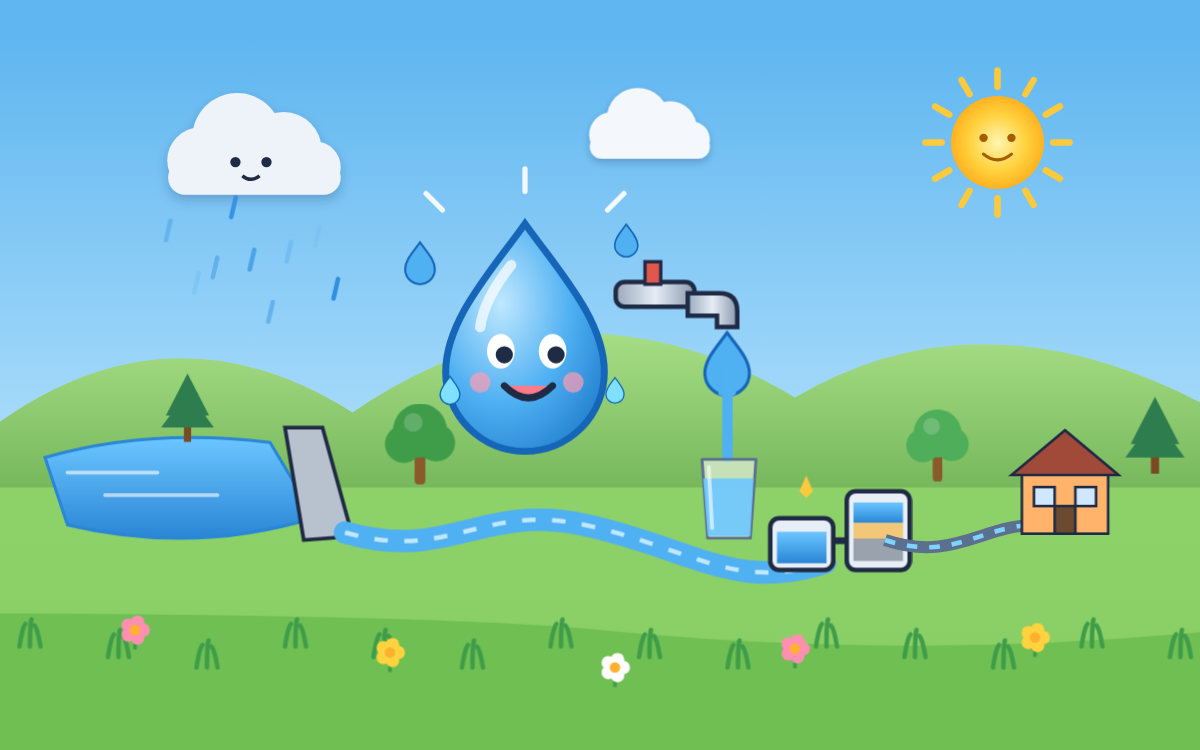
Next they build a dam to make a reservoir, drill a borehole to reach groundwater, and clean river water with screens, settling tanks, a sand filter and a little chlorine. Finally, gravity carries water from a hilltop service reservoir to the kitchen tap.
Questions and answers
Where does tap water come from in the UK?
UK tap water comes from rain that is collected in rivers, stored in reservoirs behind dams, or pumped up from rocks underground called aquifers. In England about a third comes from groundwater, rising to over three-quarters in parts of the south-east.
How much of Earth's water is fresh water?
Only about 3% of Earth's water is fresh; the other 97% is salty sea water. Most of that fresh water is frozen in ice caps and glaciers or stored underground, so only a tiny amount is in rivers and lakes.
How is water cleaned before it reaches our taps?
Water is cleaned at a water treatment works in four main steps. Screens catch sticks and leaves, dirt clumps together and settles, sand filters trap the last tiny bits, and a small amount of chlorine kills germs.
What age is the From Cloud to Tap game for?
From Cloud to Tap is designed for children aged 7 to 11 and is pitched at Year 4. Every line is read aloud with captions, so younger or less confident readers can follow, while the final challenge gives older children something to test themselves on.
What is included in the game and how long does it take?
The game has five chapters, an optional water cycle warm-up and a 10-question Water Trail Challenge with two typed answers. Playing everything takes about 45 minutes, and children can choose any chapter from the Water Trail map.
Can we count your visit? We'd like to use one cookie, only on this site, to see how families find and use TapLearn, so we can make it better. No adverts, and nothing is shared. How we measure
Create a free family account and your child can play every chapter of every game for 7 days, with no card needed. Their progress is kept. After that, the free plan is free for ever, and membership is £6.99 a month if you'd like to keep every chapter.

 TapLearn