Where Ancient Greece was and why it formed separate city-states
How to order BC dates, where bigger numbers are longer ago
When and where the first Olympic Games were held, and the prize
What democracy means and who could vote in Athens
Which ideas came from Socrates, Archimedes, Hippocrates and Pythagoras
How Doric, Ionic and Corinthian columns and Greek words survive today
Chapter by chapter
Where and when: Ancient Greece, city-states and BC datesFree to try
Years 3–6 history · 1
Greek daily life: homes, food, the agora, Athens and Sparta
Years 3–6 history · 1
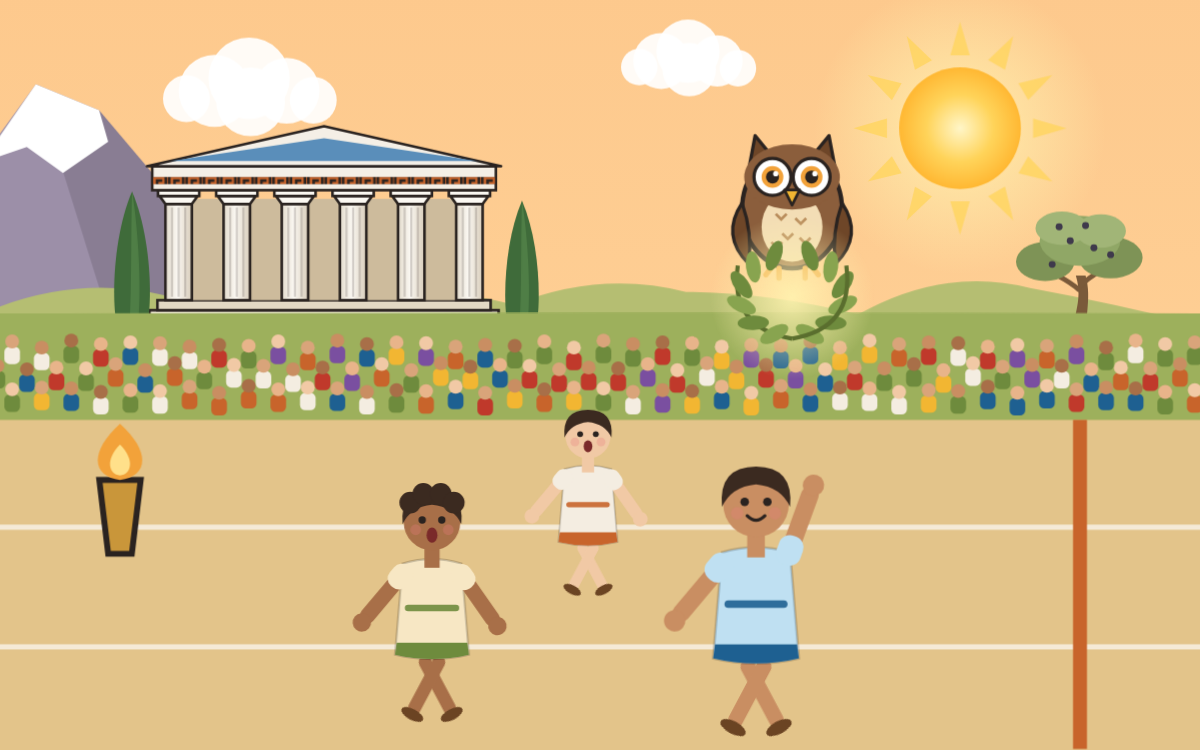
The first Olympic Games at Olympia
Years 3–6 history · 1
Democracy in Athens: the Assembly, voting and ostracism
Years 3–6 history · 1
Greek ideas: gods, myths, theatre and great thinkers
Years 3–6 history · 1
Greek influence on the western world today
Years 3–6 history · 1
Grand Challenge: Ancient Greece quiz (12 questions)
What the chapters cover in the national curriculum in England:
Years 3–6 history: Ancient Greece – a study of Greek life and achievements and their influence on the western world
About this adventure
Ancient Greece Explorer is an interactive history game for kids aged 7–11 that teaches Greek life and achievements and their influence on the western world, matching the KS2 history curriculum in England. Olive, Athena's owl, narrates every step aloud with captions.
Players find Greece on a map of Europe and discover why mountains and sea split it into city-states (each one a polis with its own rules). They order events on a BC timeline, explore a Greek house and the agora (the market and meeting place), compare Athens with Sparta, and race the stadion sprint at Olympia.
In Athens they learn that democracy means rule by the people, sort who could and could not vote, and cast pieces of broken pot in an ostracism vote. They also meet gods, comedy and tragedy plays and thinkers such as Archimedes, then spot Greek columns and words in a modern town.
Questions and answers
What did the ancient Greeks give us that we still use today?
The ancient Greeks gave us democracy, the Olympic Games, theatre with comedies and tragedies, and many English words, such as alphabet from alpha and beta. Their Doric, Ionic and Corinthian columns are still copied on museums and banks, and doctors still learn about Hippocrates.
Who could vote in ancient Athens?
Only free men over 18 who were citizens of Athens could vote. Women, enslaved people and foreigners living in Athens had no vote. Citizens met in the Assembly on the Pnyx hill and usually voted on laws themselves by a show of hands.
When and where were the first Olympic Games held?
The first Olympic Games were held in 776 BC at Olympia, a holy place in southern Greece, as a festival for Zeus. At first there was one sprint race, the stadion, and winners were crowned with olive leaves rather than given medals.
What age is this Ancient Greece game for?
The game is for children aged 7 to 11 and is pitched mainly at Year 5, where Ancient Greece is usually taught in KS2 history. Every line is read aloud and shown as a caption, so younger or less confident readers can follow along.
What does the Ancient Greece game include and how long does it take?
It includes six chapters with animated introductions, hands-on activities and a three-question check each, plus a 12-question Grand Challenge quiz. Playing everything takes about an hour, and children can choose any chapter from the island map and stop between chapters.
Can we count your visit? We'd like to use one cookie, only on this site, to see how families find and use TapLearn, so we can make it better. No adverts, and nothing is shared. How we measure
Create a free family account and your child can play every chapter of every game for 7 days, with no card needed. Their progress is kept. After that, the free plan is free for ever, and membership is £6.99 a month if you'd like to keep every chapter.


 TapLearn