Determiners for Year 4: Ride the Determiner Express
Learn what determiners are, from a, an and the to my, some and every, by building word trains and spotting determiners in real sentences.
- Ages 7–10
- About 45 min
- Some thinking
- Grammar & Punctuation
Learn what determiners are, from a, an and the to my, some and every, by building word trains and spotting determiners in real sentences.
Year 4 english · 1 Years 3–4 english · 2
Year 4 english · 1
Year 4 english · 1
Year 4 english · 1
Year 4 english · 1 Years 3–4 english · 2
Year 4 english · 1 Years 3–4 english · 2
What the chapters cover in the national curriculum in England:
Determiners for Year 4 is an interactive grammar game that teaches children aged 7–10 what determiners are and how to use them, together with the Year 4 terms pronoun, possessive pronoun and adverbial.
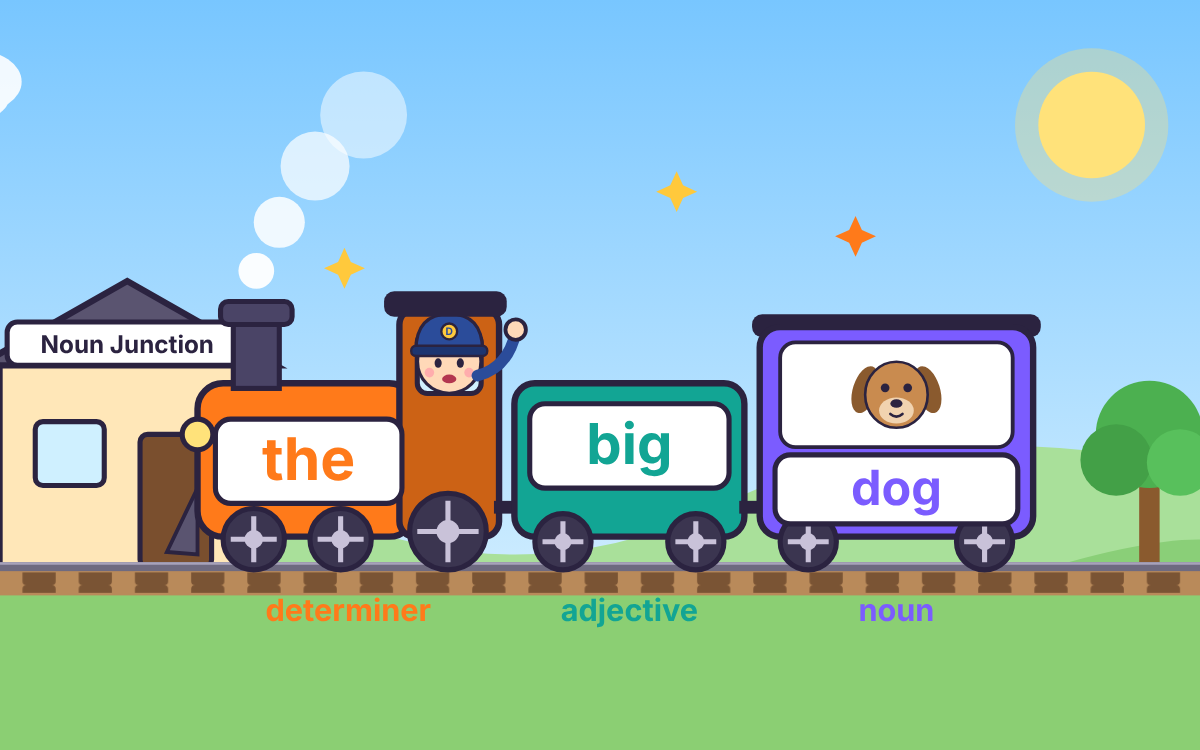
Players join Captain Dee on a railway where every noun phrase is a train. The determiner is the engine at the front, adjectives are the carriages and the noun rides at the back. Children load word trains, tap determiners hidden in sentences, fill gaps with a or an, sort words into wagons and fix short pieces of writing.
Along the way they meet articles, possessive determiners such as her and their, numbers and quantifiers such as some and every, and the test that tells a determiner from a pronoun: a determiner needs a noun after it. Every line is read aloud, and a final quiz checks what has stuck.
A determiner is a word that comes before a noun, and before any adjectives, to tell us which one, whose or how many. Common determiners include the, a, an, my, their, two, some and every, as in 'the big dog'.
A determiner needs a noun straight after it, as in 'my bike', while a pronoun stands alone in place of a noun, as in 'she' or 'mine'. Words like this and that can be either, depending on whether a noun follows them.
Use an when the next word starts with a vowel sound, as in an egg or an hour, and use a before a consonant sound, as in a kite. It is the very next word that counts, so we say an orange but a big orange.
It is designed for children aged 7 to 10 and matches the Year 4 grammar terminology in the national curriculum for England. Year 3 children who already know a and an can follow it, and Year 5 and 6 pupils can use it for revision.
The game has six chapters and a ten-question final quiz, and playing everything takes about 45 minutes. Each chapter starts with a short animated introduction, every line is read aloud, and chapters can be played in any order.
 TapLearn
Getting it ready…
Great work on chapter 1! To open the next chapters, ask a grown-up to take a look.
To play this game, ask a grown-up to take a look. There are lots of free games you can play right now too!
Create a free family account and your child can play every chapter of every game for 7 days, with no card needed. Their progress is kept. After that, the free plan is free for ever, and membership is £6.99 a month if you'd like to keep every chapter.
That's all the learning time for today. Great work! Flip will be ready to play again tomorrow.