Story Structure: Build Tales with Mo the Story Mouse
Learn story structure: beginning, middle and end, story order, linked events and story words, by sorting cards, ordering events and joining in with Mo.
Online game, chapter 1 free · Year 2 (KS1) · ages 6–8 · national curriculum in England · no adverts · plays on a phone, tablet or computer · no sign-up to start.
An online English game for Year 2 (KS1). It covers the national curriculum in England, Year 2 english: “Develop pleasure in reading, motivation to read, vocabulary and understanding by: discussing the sequence of events in books and how items of information are related”, and 1 more statement listed under the chapters.
5 short chapters, about 40 minutes in all. Children can stop after any chapter.
Start playing for free. Plays in the browser on phones, tablets and computers: no app, no adverts.
Free for teachers: every chapter on the whiteboard with a free teacher account.
Last updated · Checked against the national curriculum in England by the TapLearn team
What you'll learn
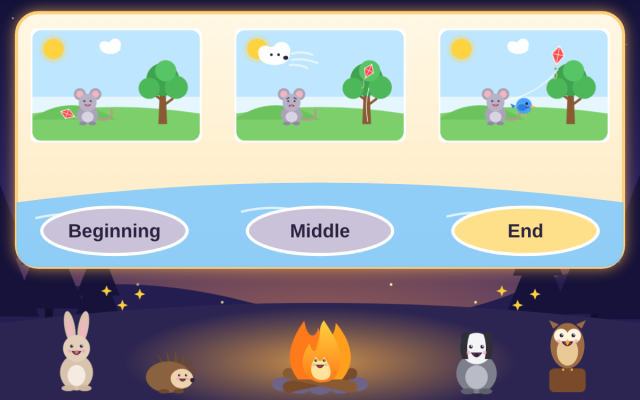
What happens at the beginning, middle and end of a story
How to put story events in sequence with first, next, then and finally
How cause and effect links events, explained with because and so
Common story openings and endings, such as long, long ago
How to spot a refrain: a line repeated in a story or poem
The difference between rhyming words and repeated words
What the chapters cover in the national curriculum in England:
Year 2 english: Develop pleasure in reading, motivation to read, vocabulary and understanding by: discussing the sequence of events in books and how items of information are related
Year 2 english: Develop pleasure in reading, motivation to read, vocabulary and understanding by: recognising simple recurring literary language in stories and poetry
🖨️ Printable worksheets
5 printable Story Structure worksheets for Year 2, one for each of 5 chapters of this game, to print and do away from the screen, with answers for grown-ups.
Story Builders is an interactive story structure game that teaches children aged 6–8 how stories are built, following the Year 2 English reading curriculum for England. Mo the story mouse guides players around Story Hill, where each place explores one part of how a story works.
Children sort picture cards into the beginning, middle and end, and put events in sequence using time words such as first, next, then and finally. They topple domino chains to see cause and effect, where one event makes the next one happen. They use because to explain why something happened and so to say what happened next.
Players also meet recurring literary language: story openings, story endings and refrains, which are lines that a story or poem repeats. They learn to tell rhyming words from repeated words. Instructions and story cards are read aloud to support new readers.
Questions and answers
What is story structure, in simple words?
Story structure is the way a story is put together. The beginning introduces the characters and setting, the middle is where a problem happens, and the end shows how the problem is solved. Knowing this helps children follow, retell and write stories.
How do you teach a child to sequence story events?
Start with three or four key events and ask what happened first, next, then and finally. Time words act as clues to the order. Reading a muddled version aloud and asking whether it still makes sense shows children why order matters.
What is recurring literary language in Year 2?
Recurring literary language means words and phrases that appear again and again in stories and poems. Examples are once upon a time, happily ever after and a repeated line or refrain. Year 2 children learn to recognise this language and join in with it.
What age is this story structure game for?
It is designed for children aged 6–8 and matches Year 2 English in the national curriculum for England. Confident younger readers and Year 3 children who want a refresher can also play, because instructions and story cards are read aloud.
What does the game include and how long does it take?
The game has five chapters, each with an animated introduction, guided activities and a recap, followed by a ten-question Story Builder Challenge. Playing everything takes about 40 minutes, and children can start from any chapter on the story map.
We count visits to make TapLearn better.We use one cookie, only on this site, to see how families find and use it. No adverts, and nothing is shared.One cookie, only on this site. No adverts.How we measure


 TapLearn