Beginning, middle and end worksheet for Year 2: Beginning, middle, end
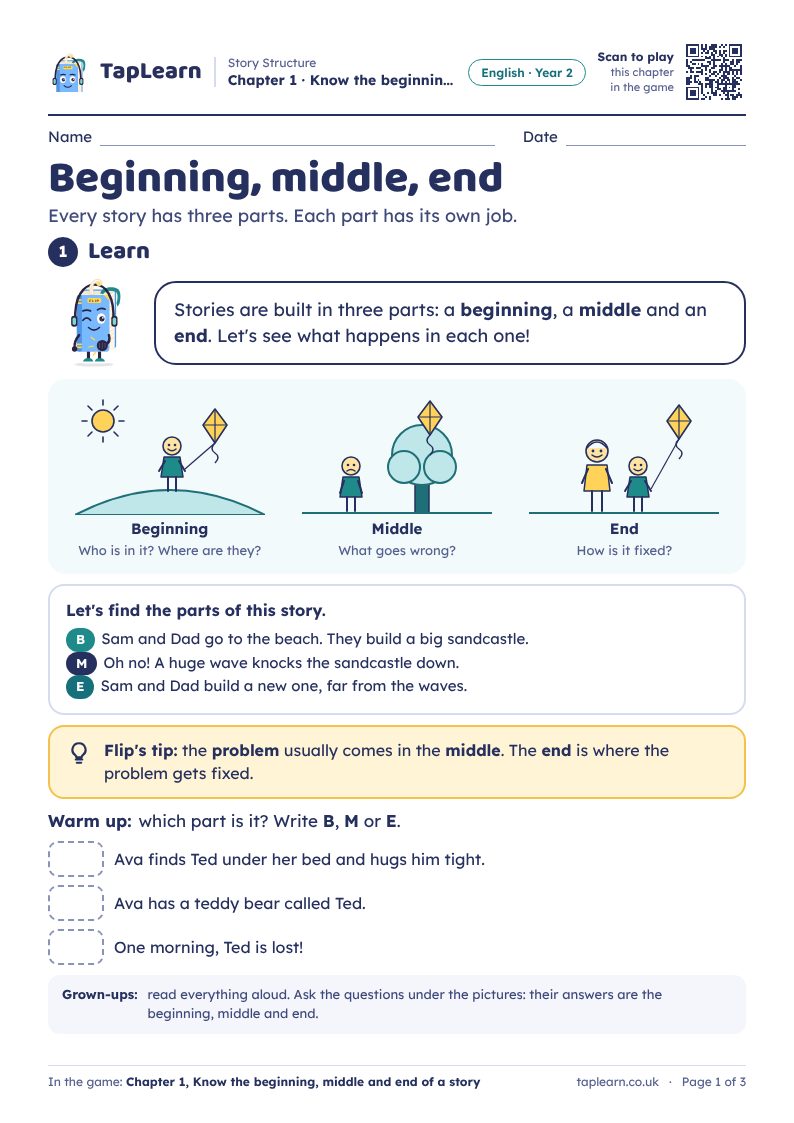
Beginning, Middle, End is a printable beginning, middle and end worksheet for Year 2 (ages 6 to 7) that teaches children that a story starts with who and where, has a problem in the middle and fixes it at the end. It covers the Year 2 English reading statement on discussing the sequence of events in books and how items of information are related.
Free to print, no account needed.
Print it on A4, in colour or black and white. Do it after the chapter, or before it to see what your child already knows.
What's on the worksheet
Your child sorts stories into a beginning (who and where), a middle (the problem) and an end (how it is fixed). Includes a toy story theatre activity and an answers sheet.
- Page 1 · Learn
- The job of each story part, a beach story about Sam and Dad sorted into beginning, middle and end, Flip's tip that the problem usually comes in the middle, and a B, M or E warm-up.
- Page 2 · Try it together
- Toy story theatre: choose toys and a place, think of something that goes wrong and how it's fixed, act it out, retell it with "At the beginning… In the middle… At the end…", then draw it.
- Page 3 · Practise
- Label muddled pictures B, M or E, match each story part to its job, find the problem and the fix in a story, draw and write an ending for a cat story, and a challenge.
- Answers sheet
- Every answer, mix-ups like putting the fix in the middle, and bedtime-questions and three-finger retell ideas.
3 A4 pages and an answers sheet · about 20 minutes
Using it at home
- Read everything aloud and ask the questions under the pictures: who and where, what goes wrong, how it's fixed.
- In toy story theatre, if the problem pops up straight away, ask "Who is in it and where are they, before it goes wrong?"
- As your child retells a favourite story, hold up one, two, then three fingers for the beginning, middle and end.
Watch out for
- Putting the problem at the beginning.
- Ask "What did we find out before anything went wrong?" That is the beginning.
- Putting the fix in the middle.
- Ask "Is anything still wrong now?" If not, it's the end.
Questions from the worksheet
- Draw a line from each part of a story to its job: beginning, middle, end.
- Read the story. Draw a ring round the part where something goes wrong. Underline how it gets fixed.
- Here is a beginning and a middle. A little cat sits by the pond in her new hat. Whoosh! The wind blows her hat into the water. Draw and write an end.
- Leo says, "The beginning is where the problem happens." Is he right? What happens at the beginning of a story?
The answers are on the answers sheet, for grown-ups.
National curriculum in England
This worksheet practises this statement from the Year 2 english programme of study:
- Develop pleasure in reading, motivation to read, vocabulary and understanding by: discussing the sequence of events in books and how items of information are related
In the classroom
- Act out toy story theatre in small groups and share the three parts with the class.
- After a class story, sort sentence strips into beginning, middle and end.
Questions and answers
What happens at the beginning of a story?
The beginning tells us who is in the story and where they are, before anything goes wrong.
What happens in the middle of a story?
The middle is usually where the problem happens, when something goes wrong.
What happens at the end of a story?
The end is where the problem gets fixed and everything is all right again.
 TapLearn