Story sequencing worksheet for Year 2: First, next, then
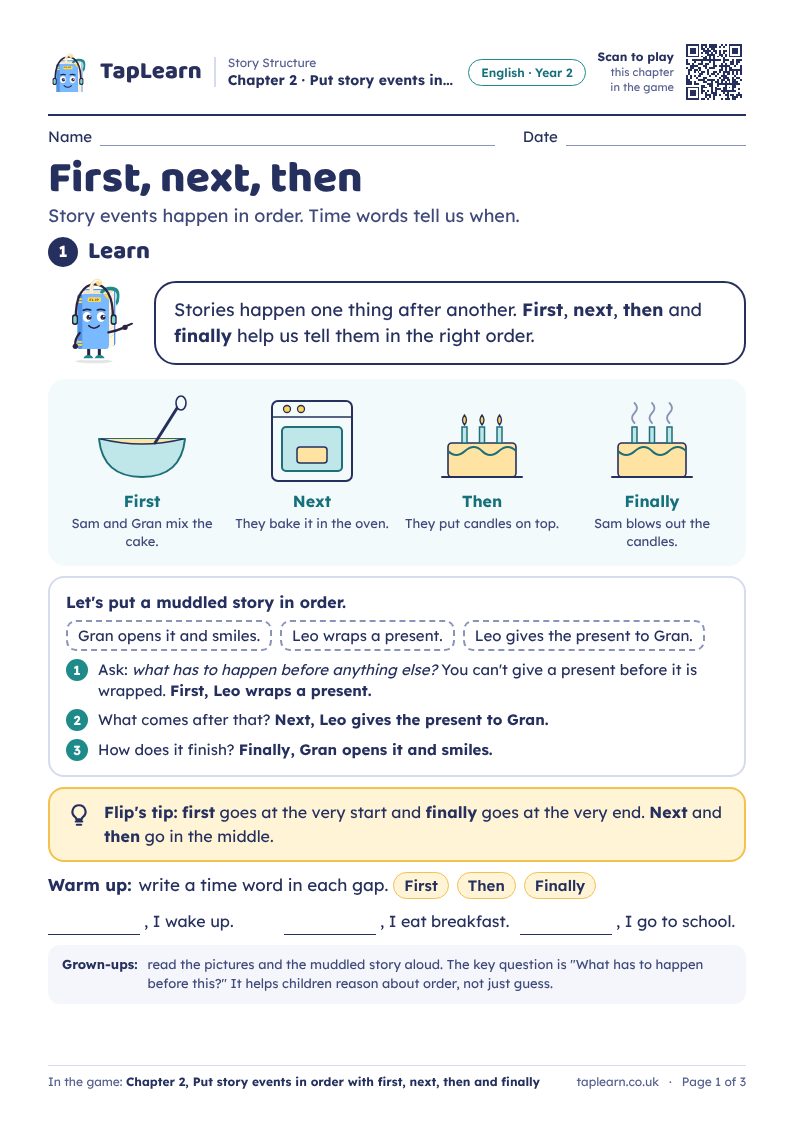
First, Next, Then is a printable story sequencing worksheet for Year 2 (ages 6 to 7) that teaches children to ask what has to happen before each event and to use time words in the right places. It covers the Year 2 English reading statement on discussing the sequence of events in books and how items of information are related.
This worksheet is for members
Membership opens every chapter of every game and every worksheet, for all your children.
See the plansAlready a member? Log in to print it.
Start with the free one: Beginning, middle, end (chapter 1).
Print it on A4, in colour or black and white. Do it after the chapter, or before it to see what your child already knows.
What's on the worksheet
Your child puts story events in order and retells them with first, next, then and finally. Includes a story line-up activity and an answers sheet.
- Page 1 · Learn
- A cake-baking story with first, next, then and finally, a worked example ordering a muddled present story, Flip's tip on where each time word goes, and a morning-routine warm-up.
- Page 2 · Try it together
- Story line-up: draw four events from a story you know, mix them up, line them up in order along the table edge, retell with time words, then swap and spot a deliberate mistake.
- Page 3 · Practise
- Number snowman pictures in order, fill time words in a sunflower story, ring two swapped time words in a bear story, finish Sam's kitten story, and a challenge about story order.
- Answers sheet
- Every answer, mix-ups like starting with finally, and getting-ready and silly-order ideas.
3 A4 pages and an answers sheet · about 20 minutes
Using it at home
- Ask "What has to happen before this?" It helps children reason about order rather than guess.
- In story line-up, ask "How did you know that one came first?"
- Ask your child to tell you how they got ready this morning using first, next, then and finally.
Watch out for
- Muddling the order of events.
- For each picture, ask "What has to happen before this?" The snowman can't have a hat before it has a head.
- Mixing up time words, such as starting with finally.
- Finally means "at the very end", the last thing to happen.
Questions from the worksheet
- Write a time word in each gap: ___, Mia plants a seed in a pot. ___, she waters it every day.
- Two time words in Ava's story have swapped places. Draw a ring round them both.
- Finish Sam's story. First, Sam found a tiny kitten in the garden. Next, he gave her a bowl of milk. Write what happens then and finally.
- Mia says, "You can tell a story in any order. It's still the same story." Is she right?
The answers are on the answers sheet, for grown-ups.
National curriculum in England
This worksheet practises this statement from the Year 2 english programme of study:
- Develop pleasure in reading, motivation to read, vocabulary and understanding by: discussing the sequence of events in books and how items of information are related
In the classroom
- Use a washing line and pegs for story line-up with picture cards from a class book.
- Tell a familiar story in the wrong order and let children stop you and fix it.
Questions and answers
What is story sequencing?
Story sequencing means putting the events of a story in the order they happen, using words like first, next, then and finally.
Where do first, next, then and finally go?
First goes at the very start and finally at the very end. Next and then go in the middle.
Does the order of a story matter?
Yes. If you change the order, the story changes or stops making sense. You can't blow out candles before the cake is baked.
More worksheets from Story Structure: Build Tales with Mo the Story Mouse
- Chapter 1: Beginning, middle and end worksheet: Beginning, middle, end Free
- Chapter 3: Cause and effect in stories worksheet: Because and so Members
- Chapter 4: Story openings and endings worksheet: Story starts and ends Members
- Chapter 5: Repeated words and refrains worksheet: Spot the repeat Members
 TapLearn